|
|
“The spirit of democracy is not a mechanical thing to be adjusted by the abolition of forms. It requires a change of heart.”
|
|
|
By Progressive International (September 2024) |
|
|---|
|
Fifty years ago, the nations of the Third World — having won their independence — united behind a vision of economic decolonization, sovereign development, and international cooperation across areas such as trade, finance, and technology. That vision became known as the New International Economic Order (NIEO) — and in 1974, they won a UN Declaration on its Establishment and a Program of Action or its implementation.
The shape of the world economy has certainly undergone a profound transformation in the past 50 years, both in the institutional architecture of globalization and the distribution of its gains. But the line that Willy Brandt once drew across the map of the world — demarcating a developmental divide between North and South — is still visible today: an affront to peace and justice for present and future generations.
On its 50th anniversary, the NIEO requires renovation. How might we adapt this vision to the conditions of the twenty-first century? How might we confront the crises of climate change, viral pandemics, and extreme poverty that threaten billions of lives and livelihoods across the planet? And how might we seize the opportunity of the present conjuncture — with the tectonic plates of the global economy drifting toward a multipolar formation — to ensure the success of such a program of action where its predecessor failed?
[Download the program]
|
|
|---|
|
By Donella Meadows (The Academy for Systems Change; 1999, n. d.) |
|
|---|
|
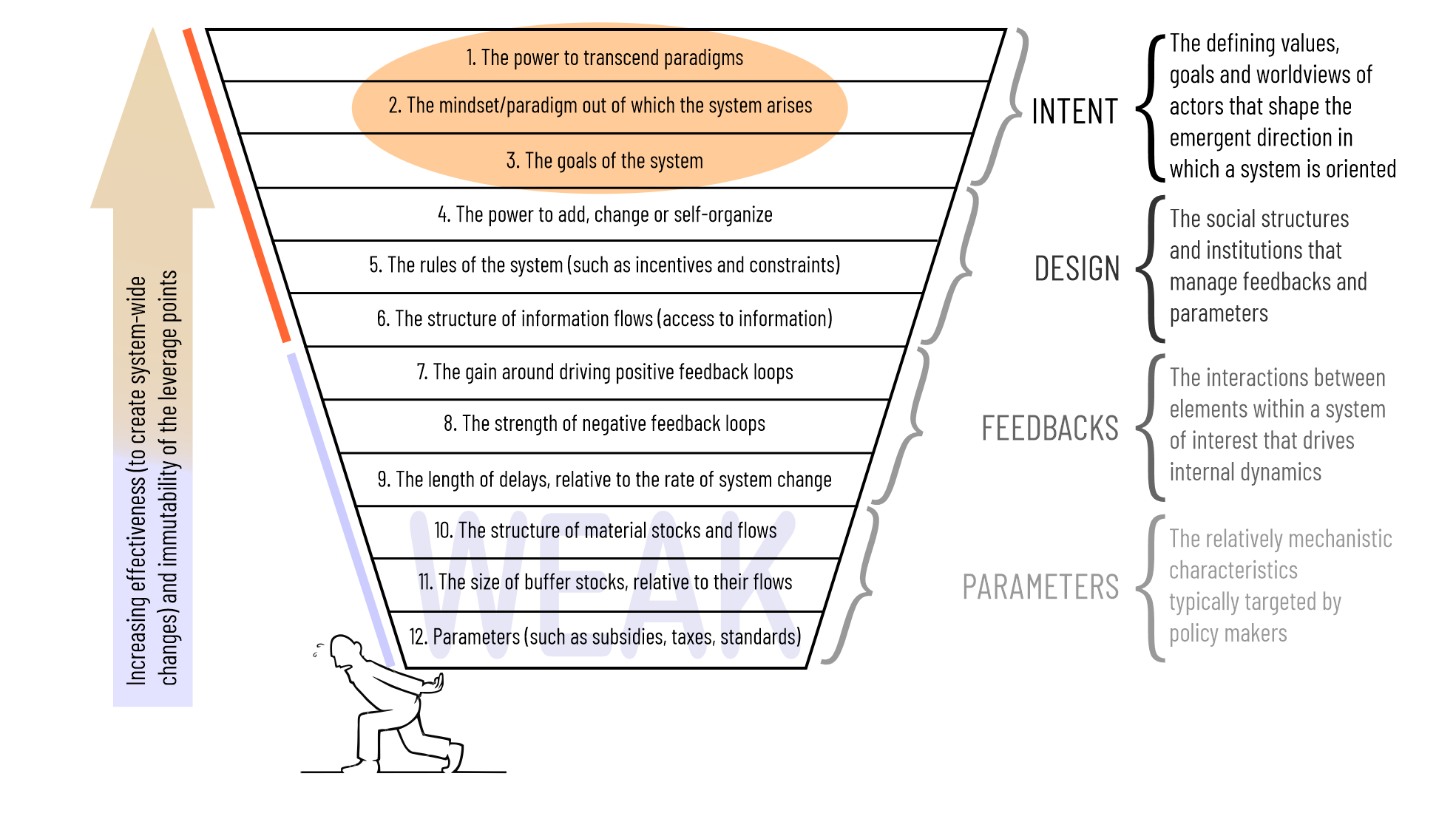
There is one leverage point that is higher than changing a paradigm. That is to keep oneself unattached in the arena of paradigms, to stay flexible, to realize that NO paradigm is “true,” that every one, including the one that sweetly shapes your own worldview, is a tremendously limited understanding of an immense and amazing universe that is far beyond human comprehension. It is to “get” at a gut level the paradigm that there are paradigms, and to see that that itself is a paradigm, and to regard that whole realization as devastatingly funny. It is to let go into Not Knowing, into what the Buddhists call enlightenment.
People who cling to paradigms (which means just about all of us) take one look at the spacious possibility that everything they think is guaranteed to be nonsense and pedal rapidly in the opposite direction. Surely there is no power, no control, no understanding, not even a reason for being, much less acting, in the notion or experience that there is no certainty in any worldview. But everyone who has managed to entertain that idea, for a moment or for a lifetime, has found it to be the basis for radical empowerment. If no paradigm is right, you can choose whatever one will help to achieve your purpose.
[Full article]
.
|
|
|---|
|
By David C. Korten (Living Economies Forum, 3/31/2024) |
|
|---|
|
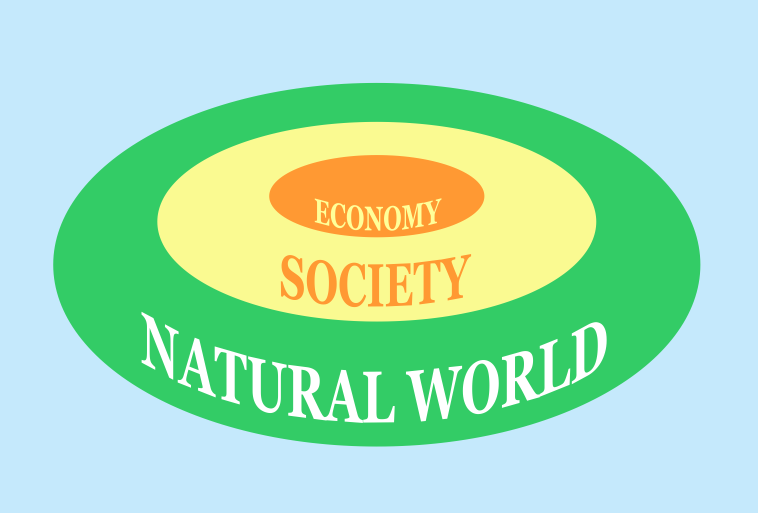
The transformation of our economics begins with a defining question. Is the purpose of the economy to secure the wellbeing of the living Earth and all its people? Or is it to exploit the labor of living beings to make money for a privileged few? Our current economic system delivers the latter. The vast majority of the world’s people would benefit from the former. So, what will be required to change the fundamental purpose of the economy? That is the question this paper addresses.
[Full article]
.
|
|
|---|
|
Image by Kimberly Jeffries | Ocean Image Bank |
|
|---|
|
|
By Sean Mowbray (Mongabay, 9/23/2024) |
|
|---|
|
The first ever pulse check of the planet’s health shows that the Earth is far beyond it’s safe operating space for humanity. Six of nine key planetary boundaries are already transgressed, and continue moving deeper into risk zones that could threaten our planet’s habitability. A seventh boundary, ocean acidification, is on the verge of transgression and may exceed safe limits in a matter of years.
That’s according to the first-ever Planetary Health Check, a nearly 100 page report produced by the new Planetary Boundaries Science (PBScience) initiative led by Earth System scientist Johan Rockström and the Potsdam Institute for Climate Impact Research (PIK), and supported by the Planetary Guardians and other partners.
[Full article]
.
|
|
|---|
|
|
NB:
Metascope is not optimized for small-resolution screens and mobile devices, and it may not render equally well in all email clients and applications. For the best reading experience, we recommend viewing this publication in the web browser of your desktop computer, notebook, or tablet. Gmail and some other email clients may clip the displayed part of the publication. To enjoy the full issue, click on the “view entire message” link at the bottom of this message or select the “view this email in your browser” option at the top.
This month’s demo issue of
Metascope contains 49 unique entries, generally referenced by titles in bold font. It will be easier for you to access the full content of the issue by knowing this, even if your email program ends up clipping the displayed part of the publication. Note that we usually place event announcements and links for open-access book downloads toward the end of the publication. To access previous issues of the publication, visit its website,
metascope.cc. |
|
|---|
|
|
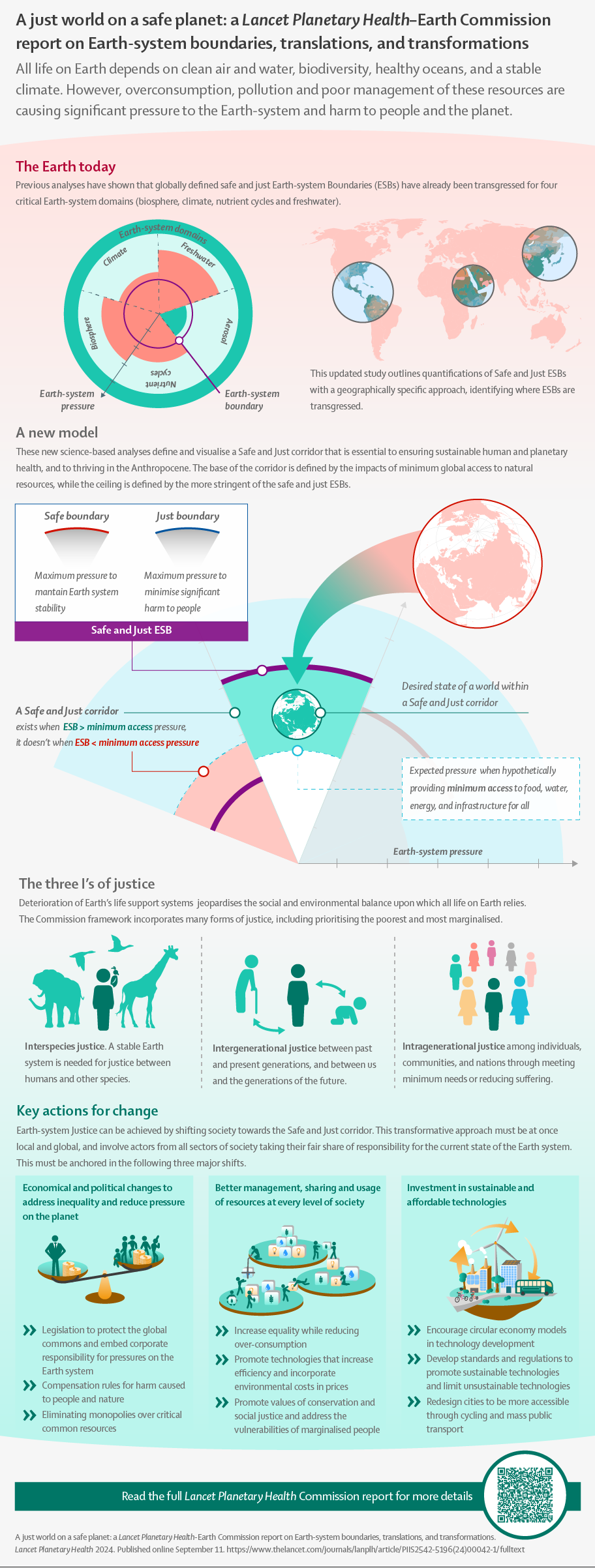
The health of the planet and its people are at risk. The deterioration of the global commons—i.e., the natural systems that support life on Earth—is exacerbating energy, food, and water insecurity, and increasing the risk of disease, disaster, displacement, and conflict. In this Commission, we quantify safe and just Earth-system boundaries (ESBs) and assess minimum access to natural resources required for human dignity and to enable escape from poverty. Collectively, these describe a safe and just corridor that is essential to ensuring sustainable and resilient human and planetary health and thriving in the Anthropocene. We then discuss the need for translation of ESBs across scales to inform science-based targets for action by key actors (and the challenges in doing so), and conclude by identifying the system transformations necessary to bring about a safe and just future.
Finally we discuss system transformations that could move humanity into a safe and just corridor and reduce risks of instability, injustice, and harm to human health. These transformations aim to minimise harm and ensure access to essential resources, while addressing the drivers of Earth-system change and vulnerability and the institutional and social barriers to systemic transformations, and include reducing and reallocating consumption, changing economic systems, technology, and governance.
.
|
|
|---|
|
|
|
Keywords and meta-markers: systemic transformations; planetary health; institutional and social barriers; anthropogenic pressures; significant harm; Earth-system justice |
|
Source:
Gupta, J., Bai, X., Liverman, D., Rockström, J., et al. (2024).
A Just World on a Safe Planet: A Lancet Planetary Health–Earth Commission Report on Earth-system Boundaries, Translations, and Transformation. The Lancet Planetary Health, September 11, 2024.
https://doi.org/10.1016/S2542-5196(24)00042-1
.
.
.
.
.
.
.
.
.
|
|
|---|
|
|
|
|---|
|
| |
Improved knowledge of glacial-to-interglacial global temperature change yields Charney (fast-feedback) equilibrium climate sensitivity 1.2 ± 0.3°C (2σ) per W/m2, which is 4.8°C ± 1.2°C for doubled CO2. Consistent analysis of temperature over the full Cenozoic era—including ‘slow’ feedbacks by ice sheets and trace gases—supports this sensitivity and implies that CO2 was 300–350 ppm in the Pliocene and about 450 ppm at transition to a nearly ice-free planet, exposing unrealistic lethargy of ice sheet models. Equilibrium global warming for today’s GHG amount is 10°C, which is reduced to 8°C by today’s human-made aerosols. Equilibrium warming is not ‘committed’ warming; rapid phaseout of GHG emissions would prevent most equilibrium warming from occurring. However, decline of aerosol emissions since 2010 should increase the 1970–2010 global warming rate of 0.18°C per decade to a post-2010 rate of at least 0.27°C per decade. Thus, under the present geopolitical approach to GHG emissions, global warming will exceed 1.5°C in the 2020s and 2°C before 2050.
Impacts on people and nature will accelerate as global warming increases hydrologic (weather) extremes. The enormity of consequences demands a return to Holocene-level global temperature. Required actions include: (1) a global increasing price on GHG emissions accompanied by development of abundant, affordable, dispatchable clean energy, (2) East-West cooperation in a way that accommodates developing world needs, and (3) intervention with Earth’s radiation imbalance to phase down today’s massive human-made ‘geo-transformation’ of Earth’s climate. Current political crises present an opportunity for reset, especially if young people can grasp their situation.
.
.
|
|
|---|
|
|
|
Keywords and meta-markers: aerosols; climate sensitivity; paleoclimate; global warming; climate forcing; climate response time; energy policy; societal reset; highest priorities |
|
Source:
Hansen, J., Sato, M., Simons, L., et al. (2023).
Global warming in the pipeline. Oxford Open Climate Change, 3(1), kGAD008.
https://doi.org/10.1093/oxfclm/kgad008
.
.
.
.
.
.
.
.
.
.
.
.
.
.
.
.
.
.
. |
|
|---|
|
|
|
|---|
|
| |
High-end climate change requires transformative solutions, as conventional strategies and solutions will not be enough if major disruptions in social-ecological systems are to be avoided. However, conventional climate assessment approaches and methods show many limitations if they are to provide robust knowledge and support to the implementation of such solutions in practice. To this end, we define transformative climate science as the open-ended process of producing, structuring, and applying solutions-oriented knowledge to fast-link integrated adaptation and mitigation strategies to sustainable development. In particular, based on our experiences within regional cases in Central Asia, Europe, Iberia, Scotland, and Hungary, we have selected 12 dimensions that scientists and practitioners can use as a checklist to design transformative-oriented climate assessments. While it is possible to talk both about transformative adaptation and transformative mitigation, in this paper, we make the case that societal transformation does not depend on mitigation or adaptation policies and actions, mostly because they are related to sustainability innovations, which are endogenous developments derived from deliberate social learning.
.
.
|
|
|---|
|
|
|
Keywords and meta-markers: complexity; transdisciplinarity; transformative climate science; integrated assessment procedures; conventional vs. transformative approaches; situated transformative solutions; innovative climate strategies; second-order learning; methodological innovations; trnaformative mitigation; long-lasting solutions |
|
Source:
Tàbara, D., Jäger, J., Mangalagiu, D., et al. (2019).
Defining Transformative Climate Science to Address High-End Climate Change. Regional Environmental Change, 19, 807–818.
https://doi.org/10.1007/s10113-018-1288-8
.
.
.
.
.
. |
|
|---|
|
|
|
|---|
|
| |
The global physical and biogeochemical environment has been substantially altered in response to increased atmospheric greenhouse gases from human activities.
In 2023, the sea surface temperature (SST) and upper 2000 m ocean heat content (OHC) reached record highs. The 0–2000 m OHC in 2023 exceeded that of 2022 by 15 ± 10 ZJ (1 Zetta Joules = 1021 Joules) (updated IAP/CAS data); 9 ± 5 ZJ (NCEI/NOAA data). The Tropical Atlantic Ocean, the Mediterranean Sea, and southern oceans recorded their highest OHC observed since the 1950s. Associated with the onset of a strong El Niño, the global SST reached its record high in 2023 with an annual mean of ∼0.23°C higher than 2022 and an astounding > 0.3°C above 2022 values for the second half of 2023. The density stratification and spatial temperature inhomogeneity indexes reached their highest values in 2023.
.
.
|
|
|---|
|
|
|
Keywords and meta-markers: ocean heat content; salinity anomalies; stratification; global warming; warming rate increase; climate breakdown |
|
Source:
Cheng, L., Abraham, J., Trenberth, K.E., et al. (2024).
New Record Ocean Temperatures and Related Climate Indicators in 2023. Advances in Atmospheric Sciences, 41, 1068–1082.
.
.
.
.
.
.
. |
|
|---|
|
|
|
|---|
|
| |
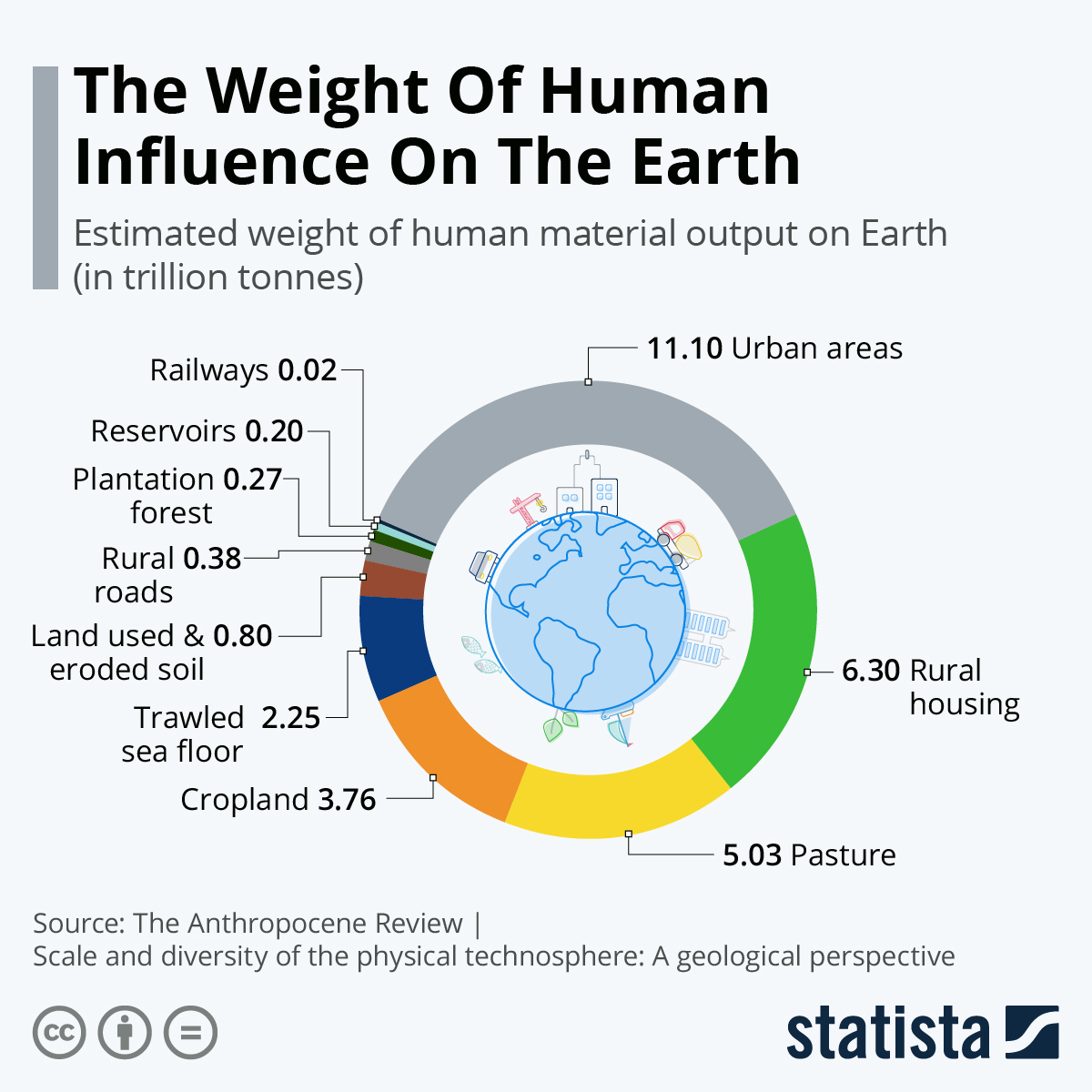
The global assemblage of human-created buildings, infrastructure, machinery and other artifacts has been called the ʻtechnosphere’, and plays a major role in the present-day dynamics of the Earth system. It enables the rapid extraction and processing of materials from other spheres, combusts fossil fuels causing climate change, and transports materials and people across the planet surface. It provides a vast range of services to humans, such as supporting the production of food, shelter, long-distance communication, and entertainment.
However, Earth system science has been slow to explicitly incorporate the technosphere as an integrated part of its conceptual and quantitative frameworks. Here we propose a refined definition of the technosphere, intended to assist in developing functional integration with other Earth system spheres, and an End-Use Technosphere categorization, EUTEC, that is theoretically aligned with human activities and wellbeing. The formal definition and resolved categorization enable basic attributes of the technosphere to be delineated, including its mass distribution among components and in space, as well as its temporal dynamics. In particular, of the roughly 1 Tt of technosphere mass, we estimate that one third is comprised of residential buildings and one third by the transportation system, both of which we map at one-degree resolution. Moreover, we show that reconstructions of technosphere mass since 1900 follow exponential growth with long-run growth rates of >3 % y-1, consistent with autocatalytic behaviour, allowing it to become an ever-more dominant component of the Earth system. The quantitative understanding of the technosphere remains rudimentary, and is in great need of further work to better integrate it with Earth system science.
.
.
|
|
|---|
|
|
|
Keywords and meta-markers: socio-ecological systems; technosphere; technomass; human agency; nonliving creations; exponential growth; material flows; socio-metabolic systems; policy-relevant indicators; energy-matter throughput; autocatalytic growth; long-term sustainability |
|
Source:
Galbraith, E., Faisal, A., Matitia, T., et al. (2024).
Resolving the Technosphere. EGUsphere [preprint].
https://doi.org/10.5194/egusphere-2024-1133
.
.
.
.
.
.
.
.
.
.
.
.
.
.
.
.
.
.
|
|
|---|
|
|
|
|---|
|
|
Rethinking Global Climate Ambitions in the Face of Arctic Emissions
By the Salata Institute of Harvard University; June 2024
Rapid warming in the Arctic—three to four times faster than the global average—is accelerating the release of Arctic greenhouse gas emissions. Total methane and carbon emissions from thawing permafrost and other sources remain uncertain and largely unaccounted for in global carbon budgets, rendering countries’ emissions targets inaccurate. Despite these uncertainties, even moderate projections for Arctic emissions could undermine the world’s ability to cap warming at 2 degrees Celsius, emphasizing the urgent need for action.
This session provides insights into the work being done by Harvard and its partners to shrink these knowledge gaps, and the policy actions that the United States and other countries could take to incorporate Arctic carbon emissions into their climate policy.
|
|
|---|
|
| |
From a systems perspective, ethical behavior is always related to community; it is behavior for the common good. In today’s world, there are two relevant communities to which we all belong. We are all members of humanity, and we all belong to the Earth Household, the global biosphere. As members of the human community, our behavior should reflect a respect of human dignity and basic human rights. As members of the Earth Household, our “common home,” we should not interfere with nature’s inherent ability to sustain life. This is the essential meaning of ecological sustainability.
The defining characteristic of deep ecology is a shift from anthropocentric (human-centered) values to ecocentric (earth-centered) values. It is a worldview that acknowledges the inherent value of non-human life, recognizing that all living beings are members of ecological communities, bound together in networks of interdependencies. All these considerations, and the radically new system of ethics they imply, are clearly expressed in the Papal encyclical
Laudato Si’.
._
|
|
|---|
|
|
|
Keywords and meta-markers: ecotheology; ecological literacy; systemic literacy; complexity; integral ecology; non-human life; socio-cultural transformation; moral character; science and religion |
|
Source:
Capra, F. (2019).
The Ecological Ethics and Systemic Thought of Pope Francis. The Trumpeter, 34(1), 2–13.
https://doi.org/10.7202/1060946ar
.
.
.
.
.
.
.
.
.
.
.
.
.
.
.
.
. |
|
|---|
|
|
|
|---|
|
| |
Epistemic responsibilities (ERs) of universities concern equipping and empowering its researchers, educators and students to attain, produce, exchange and disseminate knowledge. ERs can potentially guide universities in improving education, research and in service to society. Building on earlier philosophical work, we applied empirical methods to identify core ERs of universities and their constituting elements. We used a three-round Delphi survey, alternating between closed questions to gain consensus, and open questions to let panelists motivate their answers. 46 panelists participated in our study. We reached consensus on six ERs: 1) to foster research integrity, 2) to stimulate the development of intellectual virtues, 3) to address the big questions of life, 4) to cultivate the diversity of the disciplinary fields, 5) to serve and engage with society at large, and 6) to cultivate and safeguard academic freedom. Together the six ERs contain 27 elements. Consensus rates ranged from 73%-100% for both the ERs and their elements. Participants’ detailed responses led to substantial improvements in the accompanying descriptions of the ERs. Our findings can inform the debate about the roles and responsibilities of universities, and inform researchers and policy makers to emphasize epistemic tasks of universities.._
Edit
|
|
|---|
|
|
|
Keywords and meta-markers: epistemic responsibilities; universities; higher education; normativity in science and technology; commercialization of academic research |
|
Source:
Lechner, I. M., Mokkink, L. B., de Ridder, G. J., et al. (2023).
The Core Epistemic Responsibilities of Universities: Results from a Delphi Study. Accountability in Research, 1–21.
https://doi.org/10.1080/08989621.2023.2255826
.
.
.
.
.
.
.
.
.
.
.
.
.
. |
|
|---|
|
|
|
|---|
|
| |
Neoliberal ideology is linked to poorer collective health and well-being. At the individual level, however, neoliberal beliefs may actually promote self-efficacy, self-esteem, and self-reliance. We examined the effects of three beliefs underlying neoliberalism—(a) Personal Wherewithal, (b) Natural Competition, and (c) Anti-Government Interference—to understand the unique pathways by which neoliberalism affects health and well-being at the individual level. Participants were recruited using paid advertisements on social media in May/June 2020. Multivariable regression identified associations between each of the three identified neoliberal beliefs and participants’ (a) self-rated physical health, (b) number of health diagnoses, (c) life satisfaction, (d) loneliness, and (e) social trust of family, close friends/partners, coworkers, neighbors, and strangers. Among 2632 respondents, personal wherewithal was associated with better health, life satisfaction, and social well-being (perhaps by promoting self-efficacy and self-reliance to undertake healthy behaviors), while anti-government beliefs were associated with worse life satisfaction and social well-being (perhaps by reducing benefits inherent in collective action and social connection). Those hoping to reduce the negative effects of neoliberalism on collective well-being must contend with the reinforcing effect that personal wherewithal might have in shaping the perceived benefits of neoliberalism among those with these beliefs.
.
.
|
|
|---|
|
|
|
Keywords and meta-markers: ideology; internalized neoliberal beliefs; decision-making logics; neoliberal political thought; misplaced responsibility; inequality by design; neoliberalism’s corrosive effects on collective health and well-being |
|
Source:
Card, K., & Hepburn, K. (2022).
Is Neoliberalism Killing Us? A Cross Sectional Study of the Impact of Neoliberal Beliefs on Health and Social Wellbeing in the Midst of the COVID-19 Pandemic. The International Journal of Social Determinants of Health and Health Services, 53(3), 363–373.
https://doi.org/10.1177/00207314221134040
.
.
.
.
.
.
. |
|
|---|
|
|
|
|---|
|
| |
Responding to the proposition that learning to live in the Anthropocene involves learning how to die, this article problematises the modes of world-making upheld in some of the contemporary proposals for the global reorganisation of societies towards just, socio-ecological transitions beyond the techno-fixes of geoengineering, green growth, and their attendant ideals of progress. Specifically, it critically examines one such proposal that, inspired by process philosophy, has proven deeply influential in China’s recent shift in ecological (geo)politics: the idea of an ‘ecological civilisation’ based on principles of ontological relationality, democratic responsibility, and a new alliance between the sciences and the humanities. The article argues that while such a project rejects the substantive values of modern progress, its regulative notion of civilisation retains the modern story of progress as a mode of valuation and therefore reinscribes imperial, colonial values at the heart of ecology. In response, the article suggests that learning to die in the wake of ecological devastation requires making life outside the modern coordinates of progress, which is to say living without the ideal of civilisation. Seeking to expand the political imagination at a time of socio-ecological transformations, it calls for ‘ecological uncivilisation’ as a permanent experimentation with improbable forms of world-making and methodologies of life that are envisaged thanks to ongoing histories of decolonisation and not in spite of them; that strive to live and die well but not always better.
.
_
|
|
|---|
|
|
|
Keywords and meta-markers: imperial history of devastation; civilizational collapse; political imagination; world-making; forms of sociality; pragmatist thought; social experiments; modes of coexistence |
|
Source:
Savransky, M. (2022).
Ecological uncivilisation: Precarious world-making after progress. The Sociological Review, 70(2), 367–384.
https://doi.org/10.1177/00380261221084782
.
.
.
.
.
.
.
.
.
.
.
.
.
.
. |
|
|---|
|
|
|
|---|
|
|
|
The Powell Memo almost sounds fake: a decades-old manifesto detailing how corporations and oligarchs could fight back against New Deal-era reforms and use their money to hijack American politics.
In this episode, we introduce you to the man behind the memo: the seemingly moderate, deceptively mild-mannered Lewis Powell, who authored a memorandum laying out the future for corporate corruption — and then ascended to the U.S. Supreme Court, where he was positioned to implement his agenda. We trace Powell’s money-drenched past, including the legal work he did helping tobacco companies fight public health advocates, and unearth snippets of his speeches detailing his radicalization.
|
|
|---|
|
|
|
Recurrent economic, ecological and democratic crises provoke opportunities to critically examine previously unquestioned assumptions about economies, an effort which can include those people on which the theory and practice are usually designed and tested. This article claims that there is a role for participatory research (PR) approaches to play for social economists seeking to understand and support local problem-solving, especially in social economy activities and socioecological change processes. The objective of the article is twofold: first, a simple framework for understanding the different manifestations of PR will be presented based on the degree to which a project has (a) scientific or transformative goals, and (b) hierarchical or democratic decision-making. Second, this text will discuss the kind of PR that is ethically and epistemologically compatible with social economic scholarship. This theoretical argument is grounded in feminist, Black and Indigenous principles of (1) highlighting subjective and socially-embedded perspectives, (2) critically interrogating power dynamics within research contexts and processes, and (3) ethically engaging participants in collaborative research. Such an approach aims to dismantle the hierarchical binary between scientific and non-scientific knowledges, with social economists actively contributing to collective problem-solving efforts rather than acting as detached observers and planners.
_
|
|
|---|
|
|
|
Keywords and meta-markers: interlocking crises; value-directed participatory research; collective problem-solving; feminist methodologies; social innovation; democratic citizen science; collective reflection; socio-ecological transformation; radical change; wicked issues; experiential methodologies; critical reflexivity; ethics of democratic participation; economic democracy |
|
Source:
Palka, J. (2024).
The Potential of Participatory Social Economics: A Framework and Feminist Perspective. Forum for Social Economics, 53(2), 141–169.
https://doi.org/10.1080/07360932.2024.2329875
.
.
.
.
.
.
.. |
|
|---|
|
|
|
|---|
|
| |
For too long in higher education, different worker groups have conceived of themselves as separated by distinct, even competing interests. The isolation between groups reduces communication, fosters unawareness of common interests, and hinders their ability to effectively collaborate in solidarity, as does the divided and largely independent structure of the unions and bargaining units representing them. Without greater collaboration and solidarity, members of the higher education community are less able to resist the harmful trends that have been transforming the sector over the previous decades, subjecting them to increasingly similar working conditions and distancing higher education from its student learning, community service, and research missions. We propose a combination of elements from anarcho-syndicalist and social justice organizing approaches, centering intergroup solidarity and a flexible commitment to shared missions, as ways for higher education workers to build greater power and have a greater influence on the transformations occurring across higher education.
.
_
|
|
|---|
|
|
|
Keywords and meta-markers: collective bargaining commons; higher education transformation; academic labor; unawareness of common interests; bureaucratic unionism; academic capitalism; community of interest; positive social change |
|
Source:
Scott, D., & Kezar, A. (2019).
Intergroup Solidarity and Collaboration in Higher Education Organizing and Bargaining in the United States. Academic Labor: Research and Artistry, 3(10).
https://digitalcommons.humboldt.edu/alra/vol3/iss1/10
.
.
.
.
.
.
|
|
|---|
|
|
|
|---|
|
| |
Against pessimistic trends in social and political theory, this article argues for the indispensability of hope in conceptualizing the future. Such hope, however, does not need to be beholden to a unitary vision of the future, as with traditional metaphysical or Enlightenment notions of progress, but should instead accommodate a multiplicity of possible better worlds.
Pluralizing the future links it to diverse nonsynchronous temporalities of past and present and emphasizes the roles of contingency, action and experimentation in concrete aspiration. Immanuel Kant and Ernst Bloch here offer philosophical foundations for this perspective.
.
_
|
|
|---|
|
|
|
Keywords and meta-markers: futurability; pluralizing the future; pragmatic visions of the future; pessimism; presentism; the actuality of hope; horizon of expectations; regimes of historicity; semiotic meta-machine; utopia construction; phenomenologies of history |
|
Source:
Goldman, L. (2024).
Experimentation and the future(s) of political hope. European Journal of Social Theory, 27(2), 314–331.
https://doi.org/10.1177/13684310241229653
.
.
.
.
.
|
|
|---|
|
|
|
|---|
|
| |
Russia’s invasion of Ukraine has provided a critical site for investigating the ethics of American foreign policy and interventionist tendencies. For spectators, the most pervasive question has been whether American aid to Ukraine has materially benefitted Ukrainians. Instead, my research question is twofold: how should we evaluate the ethicality of geopolitical action, and have America’s intentions for aid been as pure as people have assumed them to be? I argue that an action’s ethical value in international relations should be evaluated by the action’s intention, not its consequence, as the latter is too complex given the interwoven nature of geopolitical affairs. Then, under this ethical framework, I assess the intentions of American aid to Ukraine, exploring multiple other possible incentives for involvement aside from mere generosity, including racial bias and strategic interests. Using theoretical literature as well as news coverage, the paper demonstrates the smokescreen of American aid and the ways the media has concealed their true, less generous intentions.
.
_
|
|
|---|
|
|
|
Keywords and meta-markers: ethicality of geopolitical action; intentionality vs. consequentialism; campism; interventionism; transactionalist mentality; media narrative construction |
|
Source:
Ross, M. (2024).
Unmasking Intentions: Ethics in International Relations and Aiding the Ukrainian Cause. Critical Debates in Humanities, Science and Global Justice, 3(1).
https://criticaldebateshsgj.scholasticahq.com/article/116566-unmasking-intentions-ethics-in-international-relations-and-aiding-the-ukrainian-cause
.
.
.
.
.
.
.
.
|
|
|---|
|
|
|
|---|
|
|
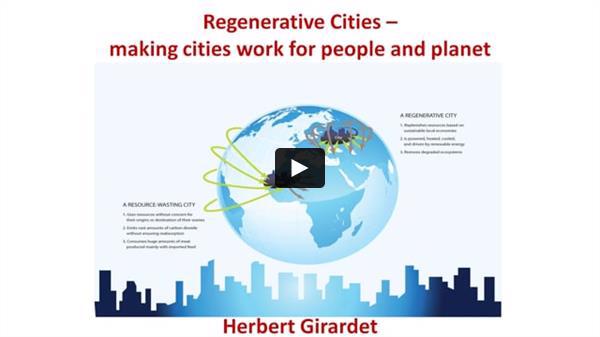
The following presentation was filmed at the Cooperative Research Centre for Low Carbon Living’s (CRCLCL’s) National Forum: Regenerative Cities, hosted by the Curtin University Node on Tuesday May 23rd 2017 at the Atrium in Perth Western Australia. The presenter, Prof. Herbert Girardet, is a recipient of the “UN Global 500 Award for Outstanding Environmental Achievements.”
He is a co-founder, former programme director and honorary member of the World Future Council. He is also a member of the Club of Rome, the World Academy of Art and Science and an Honorary Fellow of the Royal Institute of British Architects. He is a former chairman of the Schumacher Society UK and a trustee of the Charity Artists Project Earth.
In 2003 he was inaugural “Thinker in Residence” in Adelaide, developing regenerative development strategies for South Australia. Many of these have since been implemented.
He is a leading thinker in the realm of Regenerative Cities. His book
Creating Regenerative Cities, first published by Routledge in 2015 is at the forefront of current research in this area.
|
|
|---|
|
| | |
The priorities of our economic system, and the political system supporting it, include ramping up gross national product, growing corporate profits, focusing investments on high financial returns (rather than social and environmental returns), keeping labor markets slack, promoting boundless consumerism, sustaining great bastions of corporate political and economic power, ignoring issues of income distribution, and projecting overwhelming military strength abroad. This complex is reinforced by a flawed, plutocratic democracy and by dominant cultural values that remain severely materialistic, individualistic, and anthropocentric.
My big hope is for progressives to leave behind their issue silos, come together, and forge a mighty political force, both for immediate action and for deep, transformative change. We need a fusion of forces, a movement of movements. That would be new and could make a world of difference.
By Gus Speth (Essays from the Edge; August 12, 2024)
|
|
|---|
|
The truth is this: to the extent that poverty has been reduced, it has happened despite the opposition of capitalists. To credit capitalists and capitalism for the reduction in global poverty is to invert the truth. When capitalists try to take credit for the poverty reduction that was achieved against their efforts, they count on their audiences not knowing the history of fighting poverty in capitalism.
By Richard D. Wolff (Z Network; August 27, 2024) |
|
|---|
|
The U.S. Constitution is profoundly undemocratic, as generations of abolitionists, socialists, labor activists, and Black radicals have loudly proclaimed. Just as it did a hundred years ago, the document creates an infrastructure for minority rule—a specific and very American brand of white authoritarianism. This is because the Constitution organizes representation around states rather than the principle of one person, one vote. And it fragments and undermines popular authority through endless veto points. The consequences today are numerous: presidents elected who lose the popular vote; a Senate that gives vastly more power to voters in Wyoming than in California; an impassible route for constitutional amendments; a tiny, lifetime-appointed Supreme Court that repudiates popular policies, including the right to abortion, and elevates the president above the law—abetting a culture of impunity.
We need an alternative vision that provides meaningful freedom at home and embraces self-determination abroad.
By Aziz Rana (Dissent; July 19, 2024) |
|
|---|
|
 |
Consilience Learning Circles (formerly
Consilience Think Tank) is now a testing ground for our new action-learning, higher-order thinking and critical-reasoning series being constructed at the intersection of philosophy, political science, heterodox economic theory, systemology, environmental thought, and traditional ecological knowledge, as well as utopian, cultural, and design studies. These open-ended series encourage a transdisciplinary dialogue on ends, ways, and means of deep green transformation of societies toward post-capitalist and post-liberal ecological civilization.
The series is intended to build the capacity for practical emancipatory interventions of active citizens in the fields of human activity locally and globally, in addition to cultivating a strong interpretive potential and serving as a hermeneutic and public-education platform outside neoliberal academia’s programmatic, ideological, and operational confines.
The 2024-2025 featured series are:
-
Metanoia (ongoing)
-
Oikonomia (ongoing)
-
Paideia (ongoing)
-
Phrónēsis (scheduled for spring 2025)
-
Technê (ongoing)
The learning circles syllabi are iteratively designed and modified as our participatory action inquiry progresses. Retiring the “think tank” part of the original name of our transdisciplinary knowledge venture underscores our deepening commitment to genuine democratization of knowledge and decolonization of science, alongside our experimentation with innovative modes and forms of intersectoral, collaborative learning firmly rooted in robust civic values and social solidarity.
The list of upcoming collaborative learning events is available on our
pki.events website.
|
|
|---|
|
|
LITMUS TEST
LITMUS, short for
Literacies Mislearned by University Students, is our new academic quality-assessment tool. It is designed to reduce the risk of inferior academic goods being produced and then offered at premium prices to unsuspecting students, who may fall prey to the deceptive marketing practices of extortionist neoliberal academia.
We are developing this tool as a voluntary quality-assessment protocol to counteract the shortcomings of the formalistic and epistemologically limited accreditation process. Since 2022, we have identified three curricular strands
in situ likely to be compromised by a lack of integrity, with sustainability curricula being particularly problematic. This November, we will host an introductory workshop outlining the conceptual and operational framework of LITMUS.
|
|
|
|---|
|
|
|
|
|
.
Your donations to this cause are tax-deductible under section 501(c)(3) of the IRS code. Click here to make your donation.
Image credit: Freepik |
|
|---|
|
|
| |
The unspeakable savagery of the unfolding genocide in Gaza and the absolute impunity of the Israeli genocidists and their Western sponsors have sent shock waves around the world and sparked a global intifada of solidarity with Palestine. Palestinians are struggling against 75-plus years of settler colonialism, occupation, and apartheid, to be sure. But there is more to the genocide than meets the eye. It shows us both the past and the future, a redux of the dark history of European colonialism that reached its zenith in the nineteenth and twentieth centuries and also a ghastly glimpse into the future of a global capitalism whose extermination impulse is rising to the surface in the face of unprecedented crisis.
Let us step back momentarily from the horror of Gaza and recall that the hallmark of radical social science is to distinguish surface appearance from underlying essence in the events we seek to understand. This involves placing the “noisy abode” of headlines and the swirl of current events in a larger historical and structural context that give them deeper meaning.
By William I. Robinson (The Philosophical Salon, August 2024, n.d.) |
|
|---|
|
Buckminster Fuller was the first to use the term “energy slave” in 1940. At the time, he estimated there were 36 billion energy slaves, or 17 per person, serving modern but mostly (~80%) pre-industrialized humans.
In 2022, global per capita energy consumption averaged 21,039 kWh, i.e. the average modern human (rural+urban) is served by 140 energy slaves (so there are currently about 1,136 billion energy slaves on Earth — for a time, and 80% are fossil fueled, with most of the rest (e.g. nuclear, solar PV, wind), except biomass, dependent on the fossil fueled industrial-growth hegemon, e.g. mining, transportation, manufacturing, storage, supply chains…).
By Eric Lee (Medium, 4/3/2024) |
|
|---|
|
|
|
Left Is Not Woke by Susan Neiman is a wonderful little book you can recommend to friends and family members. Her prose is lively and refreshingly fearless. She does not rely on complicated sentences or passive voice to gloss controversy. She takes a stand and sticks to it. Nor does she suffer from the reverse-victimhood complex common to so many “anti-woke” writers.
Wokeness, as defined by Neiman, is an ideology that reduces all groups down to the “prism of their marginalization.” By doing so, it makes an implicit claim about society as a set of conflicts rooted in power dynamics between rival groups (black versus white; cis versus trans; straight versus gay; and on and on). Neiman offers a provocative question at the start: “Which do you find more essential: the accidents we are born with, or the principles we consider and uphold? Traditionally, it was the right that focused on the first, the left that emphasized the second.”
By Dustin Guastella (Jacobin, July 2024, N.D.) |
|
|---|
|
People are familiar with the way drugs are marketed. An equally important aspect of marketing is the way conditions and diseases are marketed. For the pharmaceutical industry, the bigger and wider those diseases, the more people who can be diagnosed, and the bigger your markets are.
The marketing of medical conditions has become a key plank of pharmaceutical industry marketing. The relationship between the medical profession, the pharmaceutical industry, and the patient movements has resulted in a harmful convergence of interests. This has led to the expansion of medical diseases, whereby more and more aspects of ordinary life are being defined as symptoms or signs of illness.
By Ayurdhi Dhar and Ray Moynihan (Mad in America: Rethinking Mental Health, 10/18/2023) |
|
|---|
|
|
|
|---|
|
|
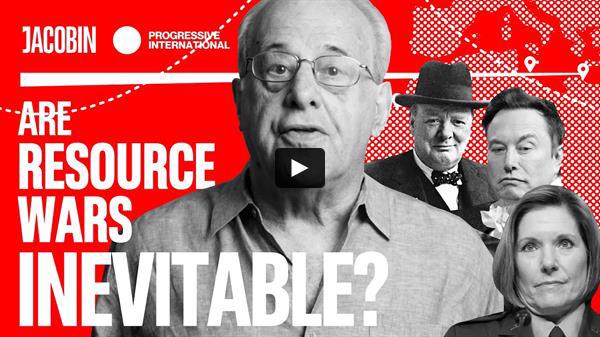
Water wars, oil wars, even lithium wars — as the climate crisis intensifies and the global population swells, we are often told that our future will be marked by a frightening scramble for natural resources. “Increased competition over scarce resources is likely to contribute to internal tensions within countries, as well as external tensions between countries,” warned the Pentagon in 2021.
In this video presentation, renowned economist Richard D. Wolff asks: Is it true? Are we really doomed to a
Mad Max–style future of scarcity, competition, and violence, or is there another way?
|
|
|---|
|
|
It may come as a surprise that the concept of economic growth has only existed since the 1940s. Before that, the idea that an economy should grow, or even that there is such a thing as the economy at all, was foreign to most. This changed after the Second World War, when the United States faced a resurgence of labor movements at home and pressure from communist countries and national liberation movements abroad. It was in this period that the Gross National Product—what later became known as the Gross Domestic Product or GDP—would be introduced as a way to measure economic activities and the success of capitalist accumulation, eventually becoming discursively linked to the idea of progress and modernity.
Economic growth, as measured by the GDP, became an ideological device in the elite toolkit to defer demands from organized labor (“we cannot redistribute wealth until we grow”), measure capitalist countries against socialist ones (“the socialist experiment is a failure because those countries are not growing as much as their capitalist neighbors”), and impose structural adjustment on the global South (“we cannot give you loans until you strip your country of its assets and public services to stimulate growth”).
[Full story]
By Matthias Schmelzer, Aaron Vansintjan and Andrea Vetter (Strange Matters, 2023; N.D.) |
|
|---|
|
The weakness of capitalist growth and investment and rising inequality has meant that the ruling orders have demanded austerity, privatization, the cutting of public services; the deregulation of markets, environment and health; the freeing of international capital movements; the crushing of trade unions; and so on. And the mainstream parties—not only of the “center-right,” but often even more so, the social democratic center left—have accepted and adopted these policies as “there is no alternative” (TINA).
But with these measures imposed now for decades, capitalism is not meeting the needs of billions. The political result is the increasing collapse in support for the “mainstream,” particularly liberal, social democratic left. Everywhere these parties have slumped in support, while so-called “populist” parties of the hard right have gained in support and even entered governments in Europe. The American phenomena of Trumpism is emerging everywhere in Europe, Latin America, and even in parts of Asia.
By Ashley Smith and Michael Roberts (Spectre Journal, 4/6/2024) |
|
|---|
|
|
|
In 1978, the philosopher Bernard Suits used his enigmatic book
The Grasshopper to pose the question: what would we do in utopia, in a world freed from necessity? His answer was that we would play games, which he defines as ‘the voluntary attempt to overcome unnecessary obstacles’.
Today we live in a world saturated with games and gamified social interactions, yet we seem further from utopia now than when Suits’ book was published. Work, the realm of necessity, dominates our lives, while material inequality has skyrocketed. This apparently contradictory situation becomes more understandable when we recognise games as the form of cultural expression native to contemporary, late neoliberalism, or what we might call ‘platform capitalism’.
Neoliberalism can be distinguished from classical liberalism, and indeed other iterations of capitalism, through its drive to re-found the whole of society around an ethos of competition. Neoliberal theorists recognise that competitive markets are not naturally occurring but must be constructed by an active, interventionist state. Extending the effects of competitive markets beyond the economic sphere requires dramatic institutional reform and intrusive managerial practices to both assess and mould behaviour. It’s a set of techniques with which we are all now familiar. Our actions are audited against arbitrary systems of measurement, producing key performance indicators with point systems that can then be used for competitive ranking. When we interact with such structures we must conform to their logic or lose out.
By Keir Milburn (Red Pepper, 6/1/2024) |
|
|---|
|
Film and television writers face an existential threat. Thanks to decades of deregulation and a gush of speculative cash that first hit the industry in the late Aughts, while prestige TV was climbing the rungs of the culture, massive entertainment and media corporations had been swallowing what few smaller companies remained, and financial firms had been infiltrating the business, moving to reduce risk and maximize efficiency at all costs, exhausting writers in evermore unstable conditions.
The film and TV industry is now controlled by only four major companies, and it is shot through with incentives to devalue the actual production of film and television. What is to be done?
By Daniel Bessner (Harper’s Magazine, 5/1/2024)
|
|
|---|
|
|
|
|---|
|
|
In this episode of the
What’s Left of Philosophy podcast, its hosts discuss the educational philosophy of the American pragmatist John Dewey. Focusing on his 1938 treatise
Experience and Education they explore questions concerning the ends of education, what it means to be an effective educator, and the relationship between experience and history. Dewey advocates for a form of education that focuses less on knowledge accumulation and more on cultivating the capacities of students for freedom through the enrichment of their experience. |
|
|---|
|
|
|
Essential Critical Questions (ECQ) are those that stimulate deep reflective thinking and critical inquiry. They can help focus our attention on issues vital for just and peaceful sustainability transitions, reveal our cognitive blindspots, frame our dispositions to settle controversies fairly, “straighten out” our reasoning when dealing with situations of uncertainty, and trigger generation of big ideas and creative approaches for tackling complex, intractable, and truly wicked problems. |
|
|---|
|
We just started generating OCI’s list of essential critical questions, and we invite intellectual input from members of Hawai‘i civil society, as well as fellow knowledge workers laboring in various institutional domains—scientists, physicans, journalists, librarians, educators, and other members of island intelligentsia. Please make your critical thought contribution to ideas@hawaii.edu. |
|
|---|
|
Is rapid economic contraction preferable to ecological collapse?
|
|
Earlier this summer, we resumed our in-person Open-Door Editorial Confabs, enhanced by knowledge sharing via our daily online
Vitamin K channel on Discord. To join the channel (currently run in a test mode), send a four-word email or text message—
subscribe to Vitamin K—to imualabs@hawaii.edu or 808-657-3555. |
|
|
This article explores reading strategies and advocates for a more conscious close reading. Starting by tracing the hermeneutic heritage of close reading, and examining its development from the New Criticism movement onwards, it then describes the fundamental physical and cognitive aspects of reading as a distinct form of analytic attentiveness.
Three methodological steps are delineated, discussed, and exemplified through the author’s close reading practices. By employing a paratextual lens to the close reading of manuscripts from the Early Modern period, the article demonstrates how theoretically informed readings, such as the paratextual perspective, enhance the reading process and deepen our understanding of historical conditions.
.
|
|
|---|
|
|
|
Keywords and meta-markers: verbal behavior; political communication styles; decreasing linguistic complexity; leadership traits; communicating ideas; psychological language analysis |
|
Source:
Jordan, K., Sterling, J., Pennebaker, J. (2019).
Examining Long-Term Trends in Politics and Culture through Language of Political Leaders and Cultural Institutions. PNAS, 116(9), 3476–3481.
https://doi.org/10.1073/pnas.1811987116
.
.
.
.
. |
|
|---|
|
|
|
|---|
|
| |
In the emerging scene of non-western island studies, research done on the sinophone world mainly (but not exclusively) by sinophone scholars has become a conspicuous strand in the literature. Despite the diverse locations in focus, most research tends to functionally apply rather than organically engage with west-inflected island theories. Starting from this premise, I embark on a series of critical reflections on the multilayered and intersecting subjectivities of the non-western island researcher and the related challenges in the context of epistemological decolonialization by analyzing two symptomatic narrative vignettes abstracted from my own research experiences in local island and archipelagic areas in China. Specifically, I argue that in the face of intersecting structures and conflicting forces, the non-western island researcher is both stranded and enabled by a series of in-between conditions in which epistemological innovation is difficult, but still possible if pursued through relentless interrogation of one’s own vested interest and constant realignment of positionality. In the end, I propose three ethical-epistemological traps for non-western scholars practicing island research under the shadow of western intellectual hegemony.
.
|
|
|---|
|
|
|
Keywords and meta-markers: island studies; western intellectual hegemony; epistemological innovation; reflexive scholarship; west-infected island theories; intellectually decolonized scholarship |
|
Source:
Hong, G. (2023).
Typical Islands, Borrowed Islands: Epistemological and Intellectual Decolonialization in Island Studies. Island Studies Journal, 18(2).
https://doi.org/10.24043/isj.394
.
.
.
.
.
..
.
.
.
.
. |
|
|---|
|
|
|
|---|
|
| |
This article explores the theorization of (in)visibility in Honneth, Ranciere, Cavell and Tully. It situates the work of Honneth and Ranciere against the background of Wittgenstein’s account of continuous aspect perception and aspect change in order to draw out their accounts of invisibility and the aesthetic character of transitions to visibility. In order to develop a critical standpoint on these theoretical positions, it turns to Cavell’s concept of soul-blindness and investigates the form of invisibility through the example of racism as addressed by Gaita, Fanon and Memmi. This analysis provides the basis for a critical evaluation of the strengths and limitations of Ranciere’s and Honneth’s approaches and leads to the proposal that Tully’s public philosophy provides a more adequate way of addressing the issues of struggle and uptake that are central to the transition from invisibility to visibility.
.
|
|
|---|
|
|
|
Keywords and meta-markers: invisibility; equality; soul-blindness; aspect-perception; race; recognition; public philosophy |
|
Source:
Owen, D. (2023).
Ways of (Not) Seeing: (In)visibility, Equality and the Politics of Recognition. Critical Horizons,
24(4), 353–370.
https://doi.org/10.1080/14409917.2023.2286867
.
.
.
.
.
.
.
. |
|
|---|
|
|
|
|---|
|
| |
What is close reading and what are the steps we take in close reading as a methodological approach? This article explores reading strategies and advocates for a more conscious close reading. Starting by tracing the hermeneutic heritage of close reading, and examining its development from the New Criticism movement onwards, it then describes the fundamental physical and cognitive aspects of reading as a distinct form of analytic attentiveness. Three methodological steps are delineated, discussed, and exemplified through the author’s close reading practices. By employing a paratextual lens to the close reading of manuscripts from the Early Modern period, the article demonstrates how theoretically informed readings, such as the paratextual perspective, enhance the reading process and deepen our understanding of historical conditions.
.
|
|
|---|
|
|
|
Keywords and meta-markers: close reading; reading strategies; paratexts; cultural history; methodology; manuscript studies |
|
Source:
Ohrvik, A. (2024).
What is close reading? An exploration of a methodology. Rethinking History, 28(2), 238–260.
https://doi.org/10.1080/13642529.2024.2345001
.
.
.
.
.
.
. |
|
|---|
|
|
|
|---|
|
|
|
The guest on this episode of the
Korea Deconstructed podcast is Professor Moon Seungsook, a political and cultural sociologist, scholar of gender studies, and East Asianist specializing in South Korea. She grew up in Seoul, Korea and lived and worked in Boston and Cambridge, MA before moving to Vassar College. Her research evolved from feminist critiques of nationalism, militarism, democratization, and citizenship to globalization and transnationalism shaping militarism and civic agency, production and consumption of food and masculinities. She is a recipient of notable awards, including a Fulbright Scholars Award (2004-05), an inaugural endowed-chair visiting professorship at Harvard University (2014-15), and the Laboratory Program for Korean Studies Research Grant from the Academy of Korean Studies (2018-23). Her latest book is
Civic Activism in South Korea: The Intertwining of Democracy and Neoliberalism (2024).
|
|
|---|
|
|
|
Liberation philosophy seeks to contribute to the liberation of the oppressed and to the creation of a more just society. A meliorative philosophy is one that improves human lives. A liberation philosophy can be regarded as meliorative only if it has a compelling theory of change. A theory of change for philosophical interventions should explain how they can contribute to social, political or economic change. The main components of such a theory are identified and shown to be present in the work of the best liberation philosophers, such as Martin Luther King Jr. A meliorative philosophy improves human lives by, among other things, providing the kind of guidance that leads to better decision-making and improved conduct. Philosophy should conceive of the guidance it offers as co-created and reflect on the conditions for effective co-creation. The distinctive virtues of meliorative philosophy, including liberation philosophy, are personal qualities that enable co-creation. These include humility, practicality, an openness to diverse perspectives, and an instinct for lived complexity. There are philosophical purists who reject the demand that philosophy should answer to practical needs. We should be sceptical about some of the claims made by philosophical purists.
.
|
|
|---|
|
|
|
Keywords and meta-markers: meliorative philosophy; lived complexity; liberation philosophers; theories of change; philosophical interventions; shedding light; route guidance; real-life moral dilemmas; co-creation; public understanding; philosophical priorities |
|
Source:
Cassam, Q. (2024).
Liberation Philosophy.
Aristotelian Society Supplementary Volume, 98(1), 1–26.
https://doi.org/10.1093/arisup/akae009
.
.
.
.
.
.
|
|
|---|
|
|
|
|---|
|
| |
With the constitution of consciousness human experience/behaviour acquires a new “doubled” form. All animal behaviour can be exhausted with reference to inherited experience and personal experience (unconditional plus conditional reflexes). This, however, is not the case with human beings; in humans we have to introduce new elements, for instance, historical experience (inherited from our ancestors through learning; accumulated historical experience), which is extended.
Furthermore, there is social experience, that is, the experience we acquire in connection with other persons. The most important component of human experience, furthermore, is human being’s active adaptability (human activity)—adaptation of the environment to ourselves.
_
|
|
|---|
|
|
|
Keywords and meta-markers: human experience; active adaptability; conceptual sphere of activity; human imagination; sign systems; joint intentionality; materiality of thinking; thought as a mode of human practice; abstract thinking as a material force |
|
Source:
Azeri, S. (2021).
On Reality of Thinking: A Response to Chris Drain’s ‘Ideality and Cognitive Development’. Social Epistemology Review and Reply Collective 10(1), 22–28.
https://wp.me/p1Bfg0-5BO.
.
. |
|
|---|
|
|
|
|---|
|
| |
The cultural pressure to endorse or reject public intellectuals wholesale can be problematic, perpetuating groupthink and diminishing scope for intellectual growth, societal maturation, and political imagination. On encountering public figures who appear to be both right and wrong, sometimes simultaneously, perhaps dangerously, there is scope to be more creative and less reactive in our response. In the illustrative case of Jordan Peterson, commentators often oriented their analysis within a conceptually moribund political spectrum; e.g. Peterson is “alt-right” attacking “the radical left.” Social media echo chambers lead some to read that Peterson’s “fanboys” were “misogynist trolls” while others heard that his critics were “virtue signaling snowflakes”. The tendency of print and broadcast media to seek a defining angle diminishes rather than distills complexity; for instance, Peterson’s fame was associated with a perceived crisis in masculinity, but that was not the whole story. “Petersonitis” is introduced here as a serious joke to describe the intellectual and emotional discomfort that arose from the author’s attempt to seek a fuller understanding of complex characters in a divisive political culture.
In a response to Peterson’s book,
12 Rules for Life: An Antidote to Chaos, twelve relatively dispassionate perspectives on his contribution are offered as an antidote to the language of allergy and infatuation that surrounded his rise to fame. Peterson is described here as symptomatic, multiphrenic, theatrical, solipsistic, sacralizing, hypervigilant, monocular, ideological, Manichean, Piagetian, masculine, and prismatic. First person language is used to reflect the author’s experience of Petersonitis, after having been drawn to Peterson’s online video lectures, debating with him in a public forum, and gradually clarifying the nature of the limitations in his outlook and approach. It is hoped that the paper will help readers recognize, recover from, and ultimately transcend Petersonitis, and to appreciate the much wider application of the idea.
_
|
|
|---|
|
|
|
Keywords and meta-markers: books; Christianity, conversation, culture, Jordan Peterson, Jungian, masculinity, media, Piagetian, postmodernism, psychology, public intellectuals, reductionism, spirituality, transgender |
|
Source:
Rowson, J. (2020).
An Epistemic Thunderstorm: What We Learned and Failed to Learn from Jordan Peterson's Rise to Fame. Integral Review, 16(2), 199–221.
https://integral-review.org/issues/vol_16_no_2_rowson_an_epistemic_thunderstorm.pdf
.
.
.
.
.
.
.
.
.
.
.
.
.
.
.
.
.
.
.
.
.
.
. |
|
|---|
|
|
|
|---|
|
| | |
|
|
|
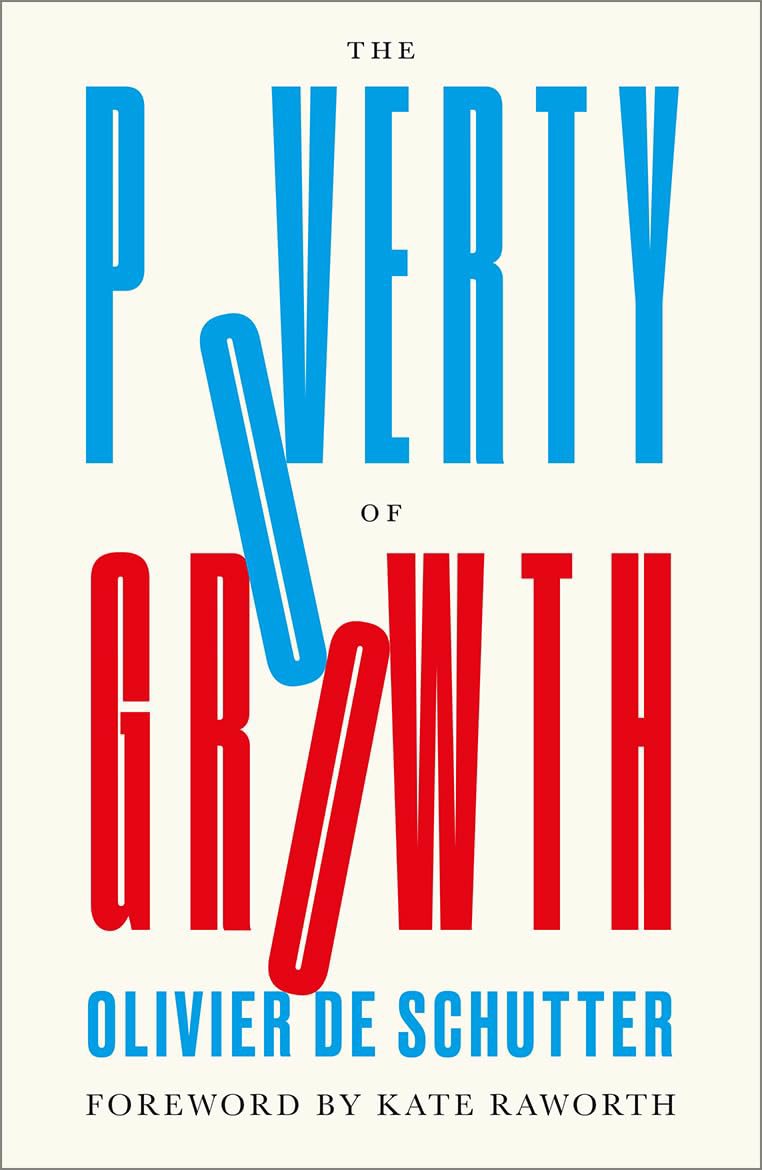
Oliver De Schutter believes that we must fundamentally rethink the fight against poverty. The quest for growth not only clashes with the need to remain within planetary boundaries, but also creates the very social exclusion it is intended to cure: eroding human rights, widening inequality, and modernizing poverty without eliminating it.
The Poverty of Growth is a clarion call to forge a new path demanding progress that is no longer focused on wealth and profit. The book opens with a foreword by Kate Raworth.
[Download the book]
|
|
|---|
|
|
|
This publication and the new
Consilience Learning Series are co-produced by IMUA Labs* and the People’s Knowledge Institute (PKI), a critical social learning system and an experimental vehicle for integral, post-formal education, and transformational community research.
The central goal of our publications, knowledge-sharing streams, and collaborative learning exercises is to cultivate civic intelligence, systemic literacy, and cognitive competences essential for living in a complex, dynamic world, enhance collective reflectivity, and elevate the community’s possession of truth, knowledge, and rational beliefs that support the ecological way of life. We iteratively develop and test innovative institutional-epistemology and knowledge-management know-how to improve the civic community’s learning capacity and self-awareness and to facilitate deeper intersectoral collaboration to respond to the grand challenges of green transformation.
As a collective intelligence initiative, we welcome a diversity of ideas and epistemic pluralism. Thus, the arguments expressed in our knowledge syntheses, bulletins, and event announcements do not necessarily reflect the views of IMUA Labs, PKI or the Hawai‘i Institute for Socio-Ecological Transformation (HISET). Should you spot a data error, a missing critical topic or issue, or an instance of faulty reasoning in our transdisciplinary publications, please submit your feedback to our knowledge gardeners and science communication specialists at
imualabs@hawaii.edu. |
|
|---|
|
*IMUA Labs @UH is a short name of the Hawaiʻi Scholarly Society
for Epistemic Innovation, Integrative Studies, and Transformative Research |
|
|---|
|
|
|