|
| |
By Potsdam Institute for Climate Impact Research |
|
|---|
|
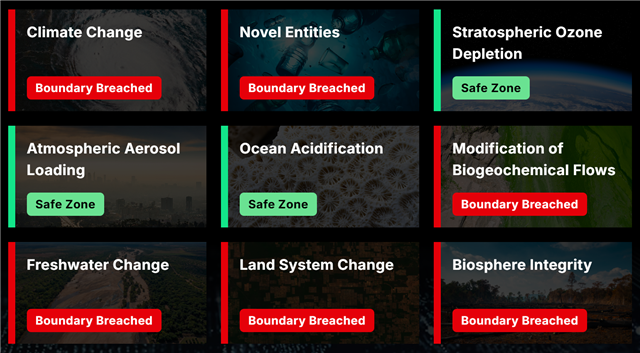
This inaugural annual report represents a crucial step in monitoring and safeguarding Earth’s stability, resilience, and life-support functions — what we refer to as “Planetary Health”. Our recently established and fast-growing international science partnership, called Planetary Boundaries Science (PBScience), will work on advancing the Planetary Boundaries (PBs) framework by integrating new data and methodologies while fostering innovative science communication.
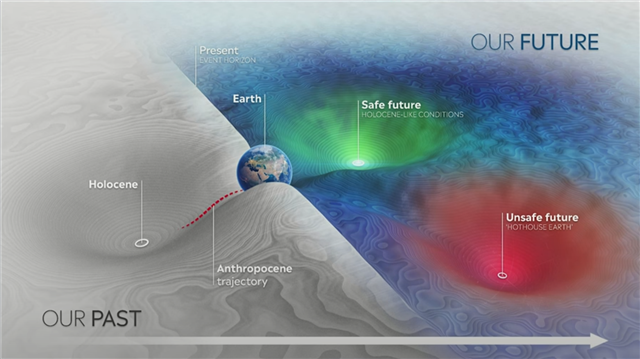
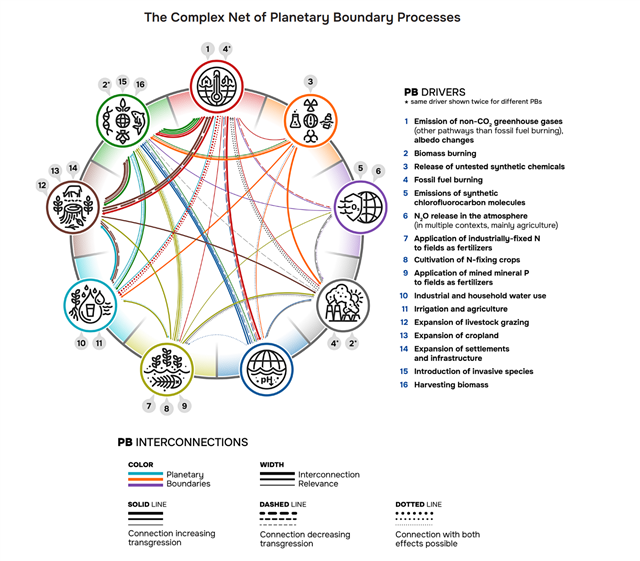
The Planetary Boundaries framework defines a science-based “safe operating space for humanity” to prevent dangerous, large-scale abrupt or irreversible environmental changes. The PBs framework analyses and monitors the nine PB processes and systems that scientifically are proven to regulate the health of our planet. Each of these processes, such as Climate Change or Ocean Acidification, is currently quantified by one or two different control variables. The 2024 Planetary Health Check report reveals that six out of nine PB processes have breached the safe PB levels, with all six showing trends of increasing pressure in all control variables, suggesting further boundary transgression in the near future.
[Learn more and download report]
|
|
|---|
|
By Nima Bassiri (The Baffler, February 13, 2025). Image credit: Eddie Chen/Netflix. |
|
|---|
|
Science continues to be imagined as both a form of truth that grounds democracy, as well as a technocratic solution to political conflict, even while it is deployed largely for political and economic ends. And this otherwise apparent performative contradiction is obscured simply on account of the fact that militarism and capitalism are not inherently seen as incommensurate with the aims of American democracy, at least from the standpoint of Capitol Hill.
What can be drawn from this is that the very idea that science is apolitical, and must thus be protected from politicization, is itself a profoundly politicized way of viewing science. For to say that science is neutral is another way of saying that science must remain not only autonomous but immune to contestation and dissent; and that science only becomes politicized when it is resisted.
[Full article]
|
|
|---|
|
By Michael Levien (Spectre, 1/21/25). Image credit: Trouw |
|
|---|
|
Tacitly or explicitly accepting the need to reduce emissions, fossil fuel companies insist that renewables will not get us there: the world still needs molecules—whether hydrogen, ammonia or methanol—that can be produced in low-carbon (“blue”) form with the help of carbon capture and storage (CCS). No longer is the problem fossil fuels, but emissions, which can be managed with the existing technological know-how of the fossil fuel industry. Rather than face marginalization in a renewable energy economy, fossil fuel companies now project themselves as leaders in “carbon management.”
They are supported in this endeavor by an array of liberal environmental organizations. This includes several of the “big greens”—including the National Wildlife Federation, the Nature Conservancy, the Clean Air Task Force, and the Center for Climate and Energy Solutions—who, with energy sector unions, have joined fossil fuel companies as part of the Carbon Capture Coalition. Taking their justification from IPCC emission reduction scenarios, which increasingly rely on carbon capture and negative emissions technologies, they view CCS as “critical to achieving net zero emissions.” Many such advocates add the vague caveat that it must be done “responsibly,” with “meaningful engagement and consultation with local communities,” community benefits agreements, and so on.
[Full article]
|
|
|---|
|
By Jem Bendell (Defend Democracy Press, 12/15/24). Image credit: Phillip Capper |
|
|---|
|
Any time we use to debunk the irrational ideological arguments of privileged people in privileged societies is time lost for serious exploration for how to respond to reality. The mainstream environmental sector is deluded and wasting precious time.
We, the privileged, need to give up lying to ourselves for our momentary relief and instead start working on reality. Just because the future won’t look like this, doesn’t mean we need to give up trying to reduce harm and to plant seeds of the new. To assume that accepting the collapse of modern societies means to give up in general reflects a failure of imagination which helps preserve a destructive status quo.
[Full article]
|
|
|---|
|
.
July 19–20, 2025
Neoliberal Academia:
An Ecosystem of Bad Ideas and Shallow Thought
In this microforum, we plan to examine the rapid McDonaldization of Hawai‘i’s higher education, its impact on the intellectual well-being and long-term sustainability of island communities, and the structured responses needed to reverse the cognitive harm inflicted by an academic enterprise seemingly oblivious to its own epistemological, metaphysical, and axiological—but perhaps most crucially, teleological—blindness. The latter refers to the failure to interrogate and fulfill academia’s reason for existence—one that is fundamentally about human empowerment, critical thinking, and societal flourishing.
Share your ideas or proposals for this conversation with event curators at our Collective Intelligence Lab:
think@hawaii.edu
.

|
|
|---|
|
|
Summary for Policymakers of the 2024 Thematic Assessment Report on the Interlinkages among Biodiversity, Water, Food and Health of the Intergovernmental Science-Policy Platform on Biodiversity and Ecosystem Services.
doi.org/10.5281/zenodo.13850289 |
|
|---|
|
Transformative change is defined as fundamental, system-wide shifts in views, structures and practices. Deliberate transformative change for a just and sustainable world shifts views, structures and practices in ways that address the underlying causes of biodiversity loss and nature’s decline. At the same time, it remains important to recognize and strengthen views, structures and practices that are aligned with generating a just and sustainable world, such as those of many Indigenous Peoples and local communities.
Underlying causes are deeply rooted and interconnected social and cultural patterns that shape, influence and reinforce all direct and indirect drivers of biodiversity loss. The three key underlying causes identified in this assessment were: (1) disconnection from and domination over nature and people; (2) concentration of power and wealth; and (3) prioritization of short-term, individual and material gains. Together they undermine the effectiveness of efforts to conserve and sustainably use biodiversity and contribute to challenges and barriers to transformative change.
Currently dominant configurations of views, structures and practices perpetuate and reinforce these underlying causes of biodiversity loss and nature’s decline. At the same time, many Indigenous Peoples and local communities around the world have views, structures, and practices aligned with generating a just and sustainable world. Transformative change is necessary to achieve the
2050 Vision for Biodiversity and related global sustainability objectives by shifting views, structures and practices in ways that target and address these underlying causes.
[Read summary]
.
|
|
|---|
|
|
Tekhne Workshops
Nature’s Cycles and Systems Thinking
Systems Diagramming for Navigating Sustainability Transition Complexity
March 21 — April 21, 2025
tekhne.cc | ikegreen@hawaii.edu
|
|
|---|
|
New Documentary Explores Planetary Tipping Points
Are we on the verge of irreversible planetary shifts?
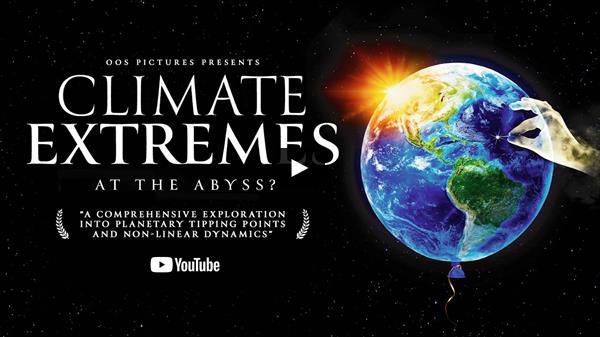
Climate Extremes: At the Abyss? is a new documentary that explores the science behind climate non-linearity, tipping points, planetary boundaries, and ocean circulation patterns. Featuring insights from world-renowned scientists, the film investigates how seemingly minor climate shifts can trigger cascading disruptions—destabilizing ecosystems, altering weather patterns, and profoundly impacting human communities on a global scale.
The documentary brings together experts from the Potsdam Institute for Climate Impact Research, the European Centre for Medium-Range Weather Forecasts, and the U.S. National Center for Atmospheric Research. Directed by David Wallerstein and Jón Atli Guðjónsson and produced by OoS Pictures EHF,
Climate Extremes is a must-watch for anyone seeking a deeper understanding of the forces reshaping our world.
Be sure to visit the glossary section on the documentary’s website—a comprehensive resource designed to deepen viewers’ understanding of key scientific terms and concepts. This glossary breaks down complex climate terminology with clear, concise explanations, making it especially useful for non-specialist audiences.
|
|
|---|
|
NB:
Metascope is not optimized for small screens or mobile devices and may not render consistently across all email clients and applications. For the best reading experience, we recommend viewing it in a web browser on a desktop, notebook, or tablet. Gmail and some other email clients may clip portions of the publication. To access the full issue, click the
“View entire message” link at the bottom of this email or select
“View this email in your browser” at the top.
This month’s demo issue of
Metascope features 75 unique items. Each bolded title is also a hyperlink leading to the original material. Event announcements and open-access book download links are usually placed toward the end of the publication.
To explore past issues, visit
metascope.cc.
|
|
|---|
|
|
|
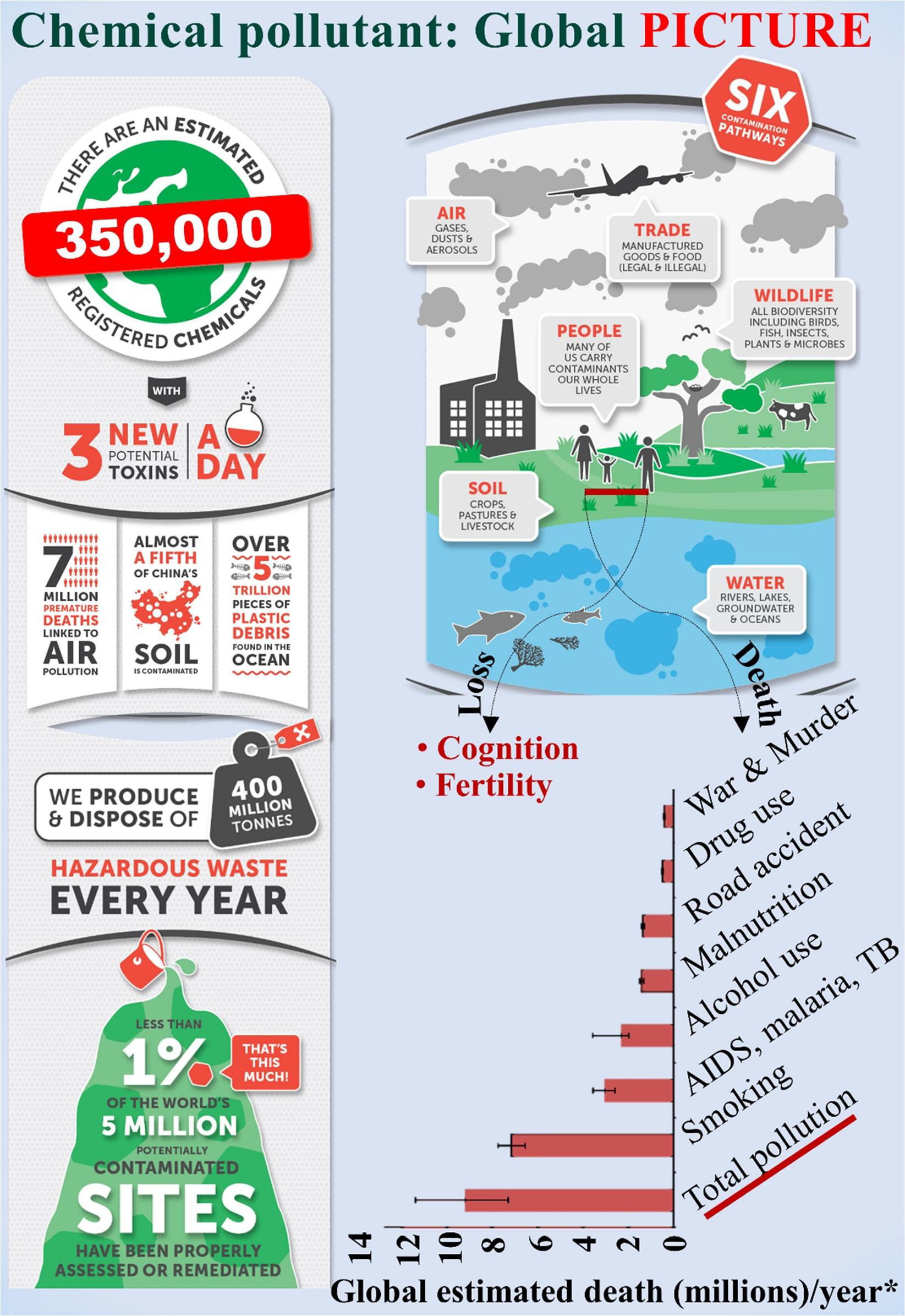
Over the past several decades, the number of chemicals on the market has grown with some estimates as high as 350,000 chemicals registered for production and use globally. Chemicals serve as the building blocks of modern society with diverse usage in agriculture, product manufacture, and medicine. However, the growing number of marketed compounds also increases the potential for chemical pollution and negative pressure on human and ecosystem health. For example, pesticides are hazardous by design, have intentional, widespread environmental release, and easily migrate beyond their area of use, which can result in exposure of nontarget organisms and potential bioaccumulation in ecological food webs.
Chemicals can be released into the environment along their entire life cycle, from resource extraction, chemical synthesis, material and product manufacturing, to product use and end-of-life treatment, including recycling. Despite the apparent risk chemicals pose to both human and ecosystem health, the combined chemical pressure exerted on the natural environment by different chemical classes and across the whole chemical universe is unknown. In this article, we propose an absolute environmental sustainability assessment framework for chemical pollution to guide sound chemical use and protect ecosystem health.
|
Keywords and meta-markers: sustainability assessment; environmental pollution; water pollution; pesticides; biodiversity; ecotoxicity; carrying capacity; safe operating space
Source:
Kosnik, M., Hauschild, M., & Fantke, P. (2022).
Toward Assessing Absolute Environmental Sustainability of Chemical Pollution. Environmental Science and Technology, 56(8), 4776–4787.
doi.org/10.1021/acs.est.1c06098
Image license credit (Creative Commons):
Naidu, R., et al. (2021).
Chemical Pollution: A Growing Peril and Potential Catastrophic Risk to Humanity. Environment International, 156, 106616.
|
|
|
|---|
|
|
Ecology and the climate provide two perspectives of the same biogeophysical system at all spatiotemporal scales. More effectively embracing this congruence is an opportunity to improve scientific understanding and predictions as well as for a more effective policy that integrates both the bottom-up community, business-driven framework, and the popular, top-down impact assessment framework.
The objective of this paper is, therefore, to more closely integrate the diverse spectrum of scientists, engineers and policymakers into finding optimal solutions to reduce the risk to environmental and social threats by considering the ecology and climate as an integrated system. Assessments such as performed towards the 2030 Plan for Sustainable Development, with its 17 Sustainable Development Goals and its Goal 13 in particular, can achieve more progress by accounting for the intimate connection of all aspects of the Earth’s biogeophysical system.
|
Keywords and meta-markers: Earth system; biogeophysical system; climate impacts; policy; ecological science
Source:
Pilke, R., Peters, D., and Niyogi, D. (2022).
Ecology and Climate of the Earth—The Same Biogeophysical System. Climate, 10(2), 25.
doi.org/10.3390/cli10020025
|
|
|
|---|
|
|
This paper aims to address a lacuna in the Transition Debate by reconstructing the origins of international law as a central feature of the formation of the capitalist world-ecology throughout the long sixteenth century (c. 1450-1648). In doing so, this paper bridges a rift in Marxist legal scholarship between the commodity form theorists who emphasize the importance of doctrine and the social property form theorists who stress the determinative role of legal practices. Unacknowledged in this exchange is Wallerstein’s historical-geographic account of the transition and its development by Moore into world-scale political marxism.Through this perspective, I empirically narrate the centrality of legal transformations surrounding property, territoriality, and Naturalism.
The formation of capitalism as a world-ecology, as a way of organizing human and extra-human life, cannot be understood without accounting for the emergence of its legal infrastructure and its dualistic source code—Civilization and Nature—amidst the long sixteenth century. It was only through the failure of the Spanish imperial project that concepts of property, territoriality, and Natural law were revolutionized to create the juridical basis for the capitalist world-ecology and its political structure of nation-states. This geohistorical reconstruction of law, life, and the rise of capitalism allows us to better grasp contemporary debates over planetary law in the climate crisis.
|
Keywords and meta-markers: Anthropocene; natural law; capitalism; colonialism; jurisprudence; property relations; historical materialism; political economy; class struggle; environmental history
Source:
Santora, J. (2024).
Lex Capitalocenae: Cheap Nature and the Emergence of Legal Naturalism. Pre-publication final, forthcoming, Journal of World-Systems Research.
|
|
|
|---|
|
|
A major impediment to action on climate change is the deeply entrenched belief that humans are not capable of planetary-scale impacts. Such denialism is less tenable if geologists officially recognize a new epoch called the Anthropocene. Daunting problems for humanity include an unsustainable reliance on fossil fuels, an increasing gap between wealth and poverty and access to food, a stagnation or loss of the buying power of wages, rampant nation-state instability, climate change, and annually consuming more natural resources than the earth can replace.
Acknowledging the full scale of human impacts could catalyze a paradigm shift, paving the way for environmental sustainability. However, significant barriers hinder such a transformation in worldview. A more probable scenario is that the technological hubris driving relentless capitalist exploitation of the biophysical environment persists unchecked, further deepening ecological crises.
Here, we consider the potential for a paradigm shift by asking whether the Anthropocene as a popular concept may have enough symbolic power to correct ‘ecomyopia’. We define ecomyopia as the tendency for societies to ignore, not recognize, or fail to act on new ecological information that contradicts political arrangements, social norms, or worldviews. The failure to meaningfully address climate change is a spectacular example of ecomyopia.
|
Keywords and meta-markers: ecomyopia; longue durée; capitalist exploitation of the biophysical environment; technological hubris; cognitive dissonance; information ecology; paradigm shift
Source:
Casagrande, D., et al. (2017).
Ecomyopia in the Anthropocene. Anthropology Today, 33(1), 23–25.
doi.org/10.1111/1467-8322.12326
|
|
|
|---|
|
|
Climate change, exacerbated by the extractivist logics of late capitalism, has prompted neoliberal actors to devise a cornucopia of imagined technological solutions through which the market will resolve the very crises it has created. A techno-optimistic paradigm of “moonshot” startups, buzzword technologies, and digitally rendered projects have established and consolidated the discourses and imaginations through which future technology will inevitably justify continued exploitation of the present.
The article examines the architectural tropes used in designs which are concurrently branded as sustainable and futuristic, offering a critique of techno-solutionist architectures that have been promoted by the European Union, World Expos, and forward-looking design pedagogy. Through an analysis of the designs of Belgian architect Vincent Callebaut, I observe that such “eco-futurist” images symbolically communicate an association with sustainability through the visible use of “green” technologies and the adoption of highly contextual encounters with greenery, rhetorically prefaced on the ability of techno-science to mediate human–nature relationships, and visually bound within the design tropes of luxury tourist destinations. By intertwining the aspirational futures of sustainable design with the aesthetic sensibilities of the wealthy, I argue that eco-futurism primarily aligns itself with the interests of neoliberal property development and the spatial and social logics of colonialism.
|
Keywords and meta-markers: eco-futurism; techno-optimism; parametricism; biomimicry; biodome; sustainability; eco-city
Source:
Tvorun-Dunn, M. (2025).
Neoliberalism’s Imagined Futures: Sustainability as Colonialism in Eco-City Design. Antipode, 57(2), 714–733.
doi.org/10.1111/anti.13126
|
|
|
|---|
|
|
This paper argues that for humanity to deal with the intersecting, existential threats of polycrisis, broad-based narrative changes are needed to make practical and relevant eco-social (or social ecological) imaginaries and related contracts. An imaginary is how people conceive or think about the world around them and their relationship to it. Social contracts are explicit and implicit agreements about how humans structure their social institutions, including rights and obligations, privileges, benefits, and restrictions.
Current imaginaries (and related contracts) are almost solely human-centric, while the shift argued for here is towards eco-social imaginaries, in which both humans and nature are granted rights to flourish. Such new imaginaries have the potential to shift ideas about humans as actors in the world towards life-centric eco-social understandings in which human beings are seen as part of and interdependent with nature, and develop economies and societies oriented towards wellbeing for both humans and nature. While historically social imaginaries and their related social contracts have been human-centric, more ecologically centric imaginaries have been emerging for several decades, and in the early 2020s, as this paper documents, have now begun to become explicit. This paper identifies seven recent efforts to define and make explicit the broad parameters of such eco-social imaginaries that might be widely deployed to begin the difficult and long-term process of systemic change needed to achieve flourishing for humans and nature.
|
Keywords and meta-markers: Polycrisis; eco-social imaginary; eco-social contracts; narrative; neoliberalism; planetary boundaries; Doughnut Economics; transformation; wellbeing
Source:
Waddock, S. (2024).
Holistic Eco-Social Imaginaries for a Life-Centered Future. Sustainability Science, 19, 2119–2134.
doi.org/10.1007/s11625-024-01564-9
|
|
|
|---|
|
| |
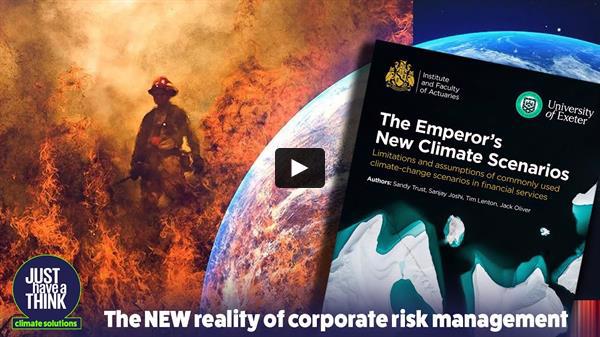
Scenario modelling is an important component of the actuarial risk-management toolkit. In the context of climate change, scenario modelling enables financial institutions and regulators to investigate the impact of different climate futures, which is important given the challenges we face. The Institute and Faculty of Actuaries (IFoA) has partnered with the University of Exeter to produce this paper demonstrating how a deeper understanding of climate change, including tipping points can improve financial services climate-scenario modelling.
In the paper we use actuarial principles to examine the limitations and assumptions in relation to climate-change scenario modelling practices in financial services, focusing on hot-house world scenarios of 3˚C or more of warming. It demonstrates how current techniques exclude many of the most severe impacts we can expect from climate change, such as tipping points and second-order impacts—they simply do not exist in the models meaning the models understate the level of risk. Additionally, carbon budgets may be smaller than anticipated, risks may develop more rapidly, and there is a danger of groupthink—where scenario analysis outcomes are taken too literally and out of context.
[Read report]
|
|
|---|
|
The International Association for the Study of the Commons (IASC) invites scholars, practitioners, and policymakers to its biennial conference in June 2025 in Amherst, Massachusetts, USA. Under the theme “Regenerating the Commons: Addressing Pressing Concerns Through Learning about the Past and Innovating into the Future,” the conference will explore governance, management, and sustainability of shared resources—both natural and human-made.
As enclosure of commons persists globally, this gathering aims to amplify awareness, foster cross-regional dialogue, and advance innovative solutions. IASC 2025 will feature in-person and hybrid sessions, with a special call to expand the commons community by welcoming new voices into the conversation.
[Learn more and join the event]
|
|
|---|
|
|
What Is Neoliberalism?
Neoliberalism is one of the most misused and misunderstood terms in contemporary political discourse. What is neoliberalism? When did it emerge? How has it shaped global politics and influenced public and policymaker mindsets across societies?
In this conversation, artist and writer Joshua Citarella speaks with Quinn Slobodian, professor of international history at Boston University and author of
Globalists: The End of Empire and the Birth of Neoliberalism, to examine the origins and impact of this ideological movement.
|
|
|---|
|
|
|
As an emancipatory political project, cosmopolitanism always invited skepticism. This paper focuses on the economic-progressivist line of critique of cosmopolitanism, which has gained momentum in recent years. This critique is based on real concerns that the economic left must prioritize and integrate into its thinking; however, it is also fatally flawed. Any progressive project that takes seriously strong democratic self-determination for all peoples needs some version of a commitment to a global order that is democratically politically integrated, and this means stronger forms of supranational political integration, not weaker ones.
I argue that the allure of progressive economic statism rests on erroneous assumptions about the character of the Westphalian state system and its relation to the evolution of global capitalism, which give a misleading impression that this system is somehow less friendly than neoliberal globalization to capitalist imperatives for extraction, accumulation, and growth. But there are equally expropriative and violent versions of capitalism that thrive in a closed Westphalian world. With great power rivalry once again emerging as a structuring feature of world order, signs of such versions are already making their appearance today.
|
Keywords and meta-markers: neoimperialism; neoliberalism; capitalism; cosmopolitanism; statism; progressive; economic left
Source:
Milstein, B. (2024).
A Postcosmopolitan Condition? Economic Progressivism and the Return of Great Power War. Philosophy & Social Criticism, 0(0).
doi.org/10.1177/01914537241308116
|
|
|
|---|
|
|
In the XXth century, debates about economic planning were largely shaped by arguments concerning knowledge and information. As the century closed, the dispute almost ended, with an apparent victory of the Austrian side, when a wide spectrum of economists and social scientists accepted that an absolute “problem of knowledge” (Hayek, 1945) made central planning impossible. After decades of liberalization and marketization policies in the shadow of Hayek’s market “spontaneous order,” the tide is turning. Facing the challenge of achieving rapid decarbonization and, more broadly, reducing the material footprint of our economies—along with growing geopolitical and developmental concerns—there is a marked renewal of interest in economic planning with a focus on ecological issues.
In this contribution, we argue that the Austrian premise concerning the ontological superiority of the mobilization of dispersed knowledge over the use of articulated and centralized one to create a successful social order should be revised, considering the rapid escalation of ecological disruptions. As remarked by William Kapp, the current transformation of the environment is no longer an expression of an increasing mastery over the world we live in but is instead a sign of a loss of such mastery. Our incapacity to stabilize the social metabolism epitomizes the faulty institutional framework of our socioeconomic activity. More specifically, it reveals that the prevalent forms of knowledge production and uses are inadequate to guarantee the perpetuation of a safe ecological space for our species.
This contribution aims to take stock of the implications of the ecological issue for the problem of knowledge and the possibilities of planning. It investigates Hayek’s theory weaknesses on environmental matters. Then, it examines the pervasiveness of a Hayekian framework in contemporaries’ attempts at green finance and its contradictions. It subsequently explores the new epistemic conditions for planning in the digital age and the permanence of the necessity to accommodate the fundamental diversity and limitation of knowledge in any planning project. Finally, an institutional architecture for ecological planning is sketched, building on the institutional utopias method.
|
Keywords and meta-markers: Anthropocene; ecological planning; Hayek; knowledge problem; economic planning; market; capitalism; social metabolism; ecological disruption; epistemic conditions; information; planning capabilities
Source:
Durand, C. (2025).
The Problem of Knowledge in the Anthropocene. Hayekian Environmental Delusion and the Condition of Ecological Planning. Working paper; University of Geneva.
archive-ouverte.unige.ch/unige:182570
|
|
|
|---|
|
|
This article begins with a study of the political economy of welfare capitalism to demonstrate how the private quest for profit was never going to be undermined by the advance of socio-economic rights. Contrary to the conventional view among human rights lawyers, capital draws power from its rights or welfarism. It is in recognizing the role that socio-economic rights play in serving capitalism that the field of international law concerned with structurally transformative human rights can begin to explore how socio-economic rights inhibit alternative forms of social organization.
This work then turns to recovering property rights through a study of recent evictions and housing rights case law of the UN Committee on Economic, Social and Cultural Rights that problematizes structural inequities and calls the financialized capitalist system into question. Next this work investigates radical legal positivism in international indigenous rights jurisprudence for how it transcends the private ownership of indigenous lands and control over the means of production. The social function of property rights is then revisited and extended, drawing to a close an article that unearths how socio-economic rights might yet emancipate people from capitalist property relations, alter the underlying structure of the economy, and, in time, sever its concordance with the capitalist welfare state.
|
Keywords and meta-markers: capitalism; political economy; property; socio-economic rights; transformative international human rights law
Source:
Salomon, M. (2023).
Emancipating Human Rights: Capitalism and the Common Good. Leiden Journal of International Law, 36(4), 857 –877.
doi.org/10.1017/S0922156523000316
|
|
|
|---|
|
|
The Anthropocene signifies the start of a no-analogue trajectory of the Earth system that is fundamentally different from the Holocene. This new trajectory is characterized by rising risks of triggering irreversible and unmanageable shifts in Earth system functioning. We urgently need a new global approach to safeguard critical Earth system regulating functions more effectively and comprehensively.
The
global commons framework is the closest example of an existing approach with the aim of governing biophysical systems on Earth upon which the world collectively depends. Derived during stable Holocene conditions, the global commons framework must now evolve in the light of new Anthropocene dynamics. This requires a fundamental shift from a focus only on governing shared resources beyond national jurisdiction, to one that secures critical functions of the Earth system irrespective of national boundaries.
We propose a new framework—
the planetary commons—which differs from the global commons framework by including not only globally shared geographic regions but also critical biophysical systems that regulate the resilience and state, and therefore livability, on Earth. The new planetary commons should articulate and create comprehensive stewardship obligations through Earth system governance aimed at restoring and strengthening planetary resilience and justice.
|
Keywords and meta-markers: planetary commons; Anthropocene; polycentric governance; sustainability; planetary boundaries; tipping points
Source:
Rockström, J., et al. (2024).
The Planetary Commons: A New Paradigm for Safeguarding Earth-Regulating Systems in the Anthropocene. PNAS, 121(5), e2301531121.
doi.org/10.1073/pnas.2301531121
|
|
|
|---|
|
|
In recent years, the entrenchment of autocrats, the rise of populist leaders, and increased polarization in established democracies have led to renewed interest in understanding how political regimes—whether democratic or autocratic—can control and influence public support to maintain power. While studies of political control have primarily focused on coercion and co-optation, this paper joins recent research that highlights indoctrination as an alternative strategy that enables powerholders to induce voluntary compliance and establish support among its citizens.
In this paper, we synthesize literature across disciplines to clarify the concept of indoctrination, focusing particularly on the politicization of education and the media. We then outline how the abstract concept can be operationalized, and introduce and validate an original expert-coded dataset on indoctrination that covers 160 countries from 1945 to the present. The dataset should facilitate a new generation of empirical inquiry on the causes and consequences of indoctrination.
|
Keywords and meta-markers: indoctrination; ideology; voluntary compliance; political education; political communication; knowledge regime; media self-censorship
Source:
Neundorf, A., et al. (2024). V
arieties of Indoctrination: The Politicization of Education and the Media around the World. Perspectives on Politics, 22(3), 771–798.
doi:10.1017/S1537592723002967
|
|
|
|---|
|
|
Information on social media is characterized by networked curation processes in which users select other users from whom to receive information, and those users in turn share information that promotes their identities and interests. We argue this allows for partisan “curation bubbles” of users who share and consume content with consistent appeal drawn from a variety of sources.
Yet, research concerning the extent of filter bubbles, echo chambers, or other forms of politically segregated information consumption typically conceptualizes information’s partisan valence at the source level as opposed to the story level. This can lead domain-level measures of audience partisanship to mischaracterize the partisan appeal of sources’ constituent stories—especially for sources estimated to be more moderate. Accounting for networked curation aligns theory and measurement of political information consumption on social media.
|
Keywords and meta-markers: curation bubbles; social media; networked curation processes; partisan valence; information consumption; political polarization; echo chambers; filter bubbles; productive curation; consumptive curation; story-level heterogeneity
Source:
Green, J., et al. (2025).
Curation Bubbles. American Political Science Review, 1–19.
doi:10.1017/S0003055424000984
|
|
|
|---|
|
|
A Climate Disaster Forces a Polar Bear and Her Cub to Flee Their Home in a Harrowing Animation
A stunning work of both social commentary and technical dexterity, “Migrants” explores the heartbreaking aftermath of a climate disaster. The animation—which is an impressive collaboration between fifth-year animations students Zoé Devise, Hugo Caby, Antoine Dupriez, Aubin Kubiak, and Lucas Lermytte, who are currently enrolled at the French Pôle 3D school—centers on a simple story: a mother polar bear and her cub flee their arctic habitat as styrofoam icebergs crumble into the water and their once-frozen home becomes unlivable. As they encounter insensitive brown bears in a lush, green climate, the duo struggles to survive.
By Grace Ebert (Colossal, 11/22/21)
|
|
|---|
|
|
|
We make history, Karl Marx famously wrote, yet not under conditions of our own making. In comparative politics, we study political regimes, yet not under conditions of our own making. Our changing agenda reflects changing realities. Over the past 50 years, our subsequent thematic waves followed the moves and moods of the time: the breakdown of democracies, transitions to democracy, democratic consolidation, the spread of electoral authoritarianism, and now democratic regressions in “the third wave of autocratization”. In these thematic shifts, we sometimes accumulate knowledge and sometimes squander it. Sometimes we keep weaving threads of debate and sometimes we lose or abandon them. In this contribution, I wish to connect two strands of research that have become strangely disconnected, despite their structural affinities: the study of transitions to and from electoral authoritarianism. The terminology to describe such authoritarian transitions is still unsettled. To emphasize their defining element of agency, I will refer to them as processes of “democratic subversion”, which implies, unconventionally but appropriately, the designation of governments as subversive agents.
The literature on democratic subversion has been resolutely actor centric. It has laid much emphasis on the causal weight of actors. At the same time, however, it has been ignoring the perspective of actors. By looking at democratic subversion through the lens of democratic transitions, we can bring participant perspectives back into the picture. And by putting ourselves in the shoes of actors, we hope to shed fresh light on some simple, basic questions: What are the limits of structural approaches to the measurement and explanation of democratic subversion? How do we recognize a democratic crisis when we see one? How do we recognize processes of democratic subversion and their protagonists when we see them? And how should we think about resistance against democratic subversion?
|
Keywords and meta-markers: democratic subversion; authoritarianism; political actors; regime change; democratic regression; institutional uncertainty; electoral authoritarianism
Source:
Schedler, A. (2024).
Rethinking Democratic Subversion. In: A. Croissant & L. Tomini (Eds.) The Routledge Handbook of Autocratization, pp. 19–36. Routledge.
doi.org/10.4324/9781003306900-3
|
|
|
|---|
|
|
Climate change has had unequal and uneven burdens across places whereby the planetary crisis involves a common but differentiated responsibility. The injustices of intensifying climate breakdown have laid bare the fault lines of suffering across sites and scales. A climate justice framework helps us to think about and address these inequities. Climate justice fundamentally is about paying attention to how climate change impacts people differently, unevenly, and disproportionately, as well as redressing the resultant injustices in fair and equitable ways.
Critical climate justice as a praxis of solidarity and collective action benefits from greater engagement with intersectional and international feminist scholarship. Incorporating insights from feminist climate justice bolsters solidarity praxis while enriching and reframing dominant climate change discussions for more impactful and accountable action.
|
Keywords and meta-markers: climate justice; capitalism; feminism; praxis; solidarity; societal transformations
Source:
Sultana, F. (2021).
Critical Climate Justice. The Geographical Journal, 188(1), 118
–124.
doi.org/10.1111/geoj.12417
|
|
|
|---|
|
|
In this article, the author argues that the prevailing societal paradigm, characterized by the domination of both nature and other humans, has led to the current ecological and social crises. The author posits that this “Scheme of Domination” is rooted in a dual amputation of reason: first, the reduction of reason to instrumental calculation, devoid of moral considerations; and second, the separation of civilization from nature, fostering an anthropocentric worldview that justifies the exploitation of the natural world.
To counter this destructive paradigm, the author proposes a “Scheme of Consideration,” grounded in an eco-phenomenology that recognizes the interconnectedness of all beings and the importance of respecting planetary limits. This framework calls for a new social contract that extends the common good to future generations, other cultures, and non-human species.
The author contends that ecology, when understood as the wisdom of dwelling on Earth and cohabiting with others, becomes an emancipatory force. It necessitates a critical reflection on our practices and a shift away from consumerism and the predatory attitude towards nature.
|
Keywords and meta-markers: consideration; corporeality; domination; ecology; enlightenment; reason; emancipation; Common World
Source:
Pelluchon, C. (2021).
Ecology as new Enlightenment. Global Solutions Journal, 7, 218
–223.
hal.science/hal-03240808v1
|
|
|
|---|
|
|
This paper has a three-fold purpose: to challenge the current conceptualization of firm-stakeholder engagement, to popularize ‘allemansrätten’, the Scandinavian social innovation tradition for environmental value creation and environmental governance for ensuring ecological balance, and to introduce the concept of usufructual rights and the tutelage of natural resources for promoting human dignity. We underscore the deficiencies in the current stakeholder paradigm by pinpointing the specific essential catalysts that move the stakeholder theory to a new paradigm of a universal stakeownership. This is a quest to ensure the preservation and sustainability of natural resources and life support systems within specific institutional orders.
We employ an adaptive research approach based on the Finnish/Nordic ecological case with a focus on the concept of ‘everyman’s right’: Everyone has the freedom to enjoy Finland’s/Scandinavia’s forests and lakes but with that also comes every man’s responsibility to preserve the country’s nature for future generations. We argue that uncritically valorizing the universalized position of the current understanding of stakeholdership, with its flourish of contradictory and inaccurate characterization of global sustainability, retroactively aborts our ecological ideals from the uterus of preferred futures at the expense of humanity as a whole for the benefit of a few speculators and profiteers. Thus, we are woven into an ecological and economic tapestry whose present and future the current generation is accountable for in the era of universal stakeownership for a crucial evolutionary adaptation. This, however, cannot come about without fundamentally ‘democratizing’ resource democracy from the grassroots and questioning the global power structure that decides on the distributive effects of resources.
|
Keywords and meta-markers: resource democracy; environmental resource governance; stakeholders; stakeowner paradigm; universal stakeholders
Source:
Ahen, F. (2019).
Making Resource Democracy Radically Meaningful for Stakeowners: Our World, Our Rules? Sustainability, 11(19), 5150.
doi.org/10.3390/su11195150
|
|
|
|---|
|
|
Transformative learning transforms problematic frames of reference, habits of mind, perspectives, and assumptions that no longer serve a person or situation in order to make them more open, reflective, and able to change.
This article explores scaling deep through transformative learning in Public Sector Innovation Labs (PSI labs) as a pathway to increase the impacts of their work. Using literature review and participatory action research with two PSI labs in Vancouver and Auckland, we provide descriptions of how they enact transformative learning and scaling deep. A shared ambition for transformative innovation towards social and ecological wellbeing sparked independent moves towards scaling deep and transformative learning which, when compared, offer fruitful insights to researchers and practitioners. The article includes a PSI lab typology and six moves to practice transformative learning and scaling deep.
|
Keywords and meta-markers: transformative learning; innovation labs; innovation learning; public sector innovation; social innovation
Source:
Cole, L., & Hagen, P. (2023).
Scaling Deep through Transformative Learning in Public Sector Innovation Labs – Experiences from Vancouver and Auckland. Public Management Review, 26(7), 2094–2121.
doi.org/10.1080/14719037.2023.2254776
|
|
|
|---|
|
|
Around the world Indigenous communities are involved in the renewable energy industries. Relationships with for-profit corporations are integral to this development. Indigenous communities are entering into partnership with renewable energy corporations or developing their own renewable energy corporations. Relying on doctrinal, desk and case study methodologies, this article analyses six case studies and identifies three Indigenous–corporate relationships in the renewable energy sector in Australia. These include (1) Renewable energy corporations that have proposed partial agreements with Indigenous communities; (2) Indigenous-led partnerships with non-Indigenous corporations; and (3) Indigenous-owned renewable energy projects.
We interrogate these Indigenous–corporate relations in the context of energy justice with a focus on fairness in procedure, recognition, and distribution of benefits. We conclude by highlighting the gaps in energy justice in the current practices of Indigenous–corporate relations in renewable energy industries in Australia. Accordingly, this article is significant because it fills a gap in the scholarly literature on Indigenous and corporate relationships. Furthermore, it sheds light on the practices in the field that play an important role in government and community policy development centered around the improvement of Indigenous and corporate relationships – and settler colonial interactions more generally.
|
Keywords and meta-markers: energy justice; renewable energy; cultural ownership; legal ownership; self-determination; indigenous land-use agreements; native title
Source:
Fish, A., & Nehme, M. (2024).
Partnering for Energy Justice: Indigenous–Corporate Relationships in Renewable Energy Industries in Australia. Journal of Energy and Natural Resources Law, 1–23.
doi.org/10.1080/02646811.2024.2419187
|
|
|
|---|
|
| |
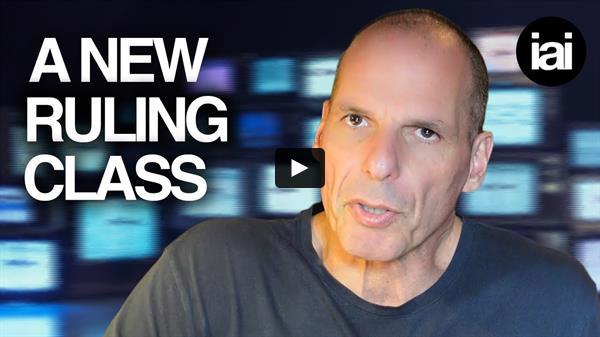
The Next Stage of Capitalism
Economist, politician, and best-selling author Yanis Varoufakis explains the evolution of capitalism, from its beginnings in feudal Europe to its imminent death in the era of Big Tech. As Elon Musk and the Big Tech billionaires increase their control over government institutions, we must all ask ourselves a troubling question: are we witnessing the end of democracy?
Capital triumphed over democracy a long time ago. Today, following the Financial Crisis of 2008 and the rise of the platform corporations, a new type of capital has emerged. Command capital is crushing the remnants of our democracies and giving rise to a new, technofeudal ruling class. Further still, the start of the second Trump administration in the United States has demonstrated, in worrying clarity, just how much control and influence the Tech Giants wield when it comes to geopolitics.
In this video featured by the Institute of Arts and Ideas, Yanis Varoufakis argues that a radical reassessment of property rights over machines and data is the only way for us to confront this new ruling class. Join him for a journey from the feudalist economy of medieval Europe to the modern era of Tech Giant supremacy, exploring how companies like Google, Tesla, OpenAI, and Amazon extract value and capital from their users.
|
|
|---|
|
| |
Following World War II, the world arrived at a significant moment of opportunity when decolonization spawned a temporary global burst of democracy and a drive to create and share prosperity equitably on a global scale. The commitment to economic development sparked hope that assets and power would henceforth be democratically shared.
Aspiring autocrats rebelled. They turned to corporate charters, debt, and other financial instruments to reassert authoritarian control of assets that colonial rulers had been forced to relinquish. Rather than seek the guidance of a true
eco-nomics devoted to caring for Earth and one another, many among us succumbed to the false promises of neoliberal economists. Presented as values-free science, their theories touted the benefits of the “free market” in which we compete to exploit one another and Earth in a quest to maximize personal financial returns. We were assured that this would advance the wellbeing of all. The predictable outcome was to replace the oppression of traditional colonialism with the oppression of contemporary capitalism.
By David Korten (DK Newsletter, 1/31/25)
|
|
|---|
|
Back in 2017, neoreactionary ideology was still largely underground, though gaining in popularity on 4Chan, Reddit, and in small groups of intellectuals interested in the work of Nick Land, who was crucial for providing a philosophical depth that the others couldn’t. The discourse was very similar to internet subcultures not only because of the way it circulated, but also because it integrated technology and transhumanism into a political vision of a post-singularity future. According to this vision, we are quickly approaching the moment when machines will acquire consciousness and their intelligence will consequently surpass that of humans. This moment will call for the traditionally human concept of politics to be subordinated to planning by a greater superintelligence.
Now, the world-historical US presidential election in November 2024 has officially recognized the neoreactionaries and their ideology, granting them entry to the White House through vice president J. D. Vance, who is closely tied to two of neoreaction’s central figures, Curtis Yarvin and Peter Thiel. The US election also begins the cruel process of reconfiguring the post-globalization epoch, a new global order that reverses a number of trends that had advanced since the Cold War. The infrastructures that sustained the neoliberal order will be reconstructed, for better or worse. At the same time, the US election marks a true liberation of political thought from the stagnation of ideological claims such as Francis Fukuyama’s “end of history” thesis and the grand discourses of empire’s thermodynamic ideology of globalization.
By Yuk Hui (e-Flux, February 2025)
|
|
|---|
|
Since the beginning of the process of colonization and conquest of the territories that are commonly called the United States (US), the idea of it being the land of abundance and opportunity has been promoted. Millions of people migrated to these lands with the dream of getting rich quickly. The rise and consolidation of the U.S. as a world hegemonic power occurred some time later, just a century ago. The two world wars and the economic crisis of 1929 were the part of the context and reasons for its rise. With its military and economic power, with its cultural industry, and by making its currency the currency of the world, it managed to prevail against the fascist option. During almost the entire 20th century, it also competed for world hegemony against the socialist alternative until it decreed, at least for a time, a unipolar world.
The arrival of Trump and his allies to power in the U.S., and everything they represent, marks the end of an era: the end of its hegemony. They distance themselves from the discourse and values that sustained them and show themselves in their true colours: the neo-fascist way, of managing capitalism. The “land of abundance and opportunities” to which millions of migrants arrived shows itself to be the denied land, with walls and military preventing free passage. The country that presumed itself to be the bastion of human rights shows itself to be the country of raids, publicised and transmitted in real time, the country of the hunt for the other, the different.
By Raúl Romero (MR Online, 2/8/25)
|
|
|---|
|
In the first hours of Trump’s second term, tech entrepreneurs managed to shield their most profitable ventures from public scrutiny while gaining significant influence over the state bureaucracy. The new administration is not interested in using the federal state to unify the dominant classes as part of a hegemonic strategy. On the contrary, it is trying to emancipate the most bullish fraction of capital from any serious federal constraints, while forcing the administrative apparatus to submit to Musk’s algorithmic control.
As large corporations monopolize knowledge and data, they centralize the algorithmic means of coordinating human activities, from working practices to social media use to shopping habits. With public institutions increasingly incapable of organizing society, the task then falls to Big Tech, which gains an extraordinary capacity to influence individual and collective behavior. The public sphere is thereby dissolved into online networks, monetary power is displaced into crypto-currencies, and Artificial Intelligence colonizes what Marx called the ‘general intellect’, heralding the steady appropriation of political power by private interests.
By Cédric Durand (NLR/Sidecar, 1/30/25)
|
|
|---|
|
To save themselves, the tech-oligarchs must attack the very notion of universality as such—hence their abandonment of liberal universalism for racism, nationalism, masculine domination, etc., because they represent a conspiracy, a shrinking, exclusive interest against a larger one. They are attacking first and foremost the State and the Bureaucracy, the civil servants: everything that Hegel identified in The Philosophy of Right with the universal, general interest of the whole society against the particularity of “bourgeois society,” the chaotic mass of self-interested businessmen. They want the State to appear just as particularistic as they are and destroy its legitimacy.
Musk’s total idiocy is structural: it goes back to the very origin of the Greek term idiotes, a person who cannot understand the shared political life of the city. These people cannot understand that their wealth and power are not their sovereign creations but the shared product of the wider state and society that supports and sustains them. Cryptocurrency is the perfect embodiment of this structural misrecognition: its advocates say it represents wealth outside of the state and society, but its notional value is wholly determined by its price in fiat money, created and sustained by the state. (It also functions a lot like “race” and “IQ:” as a repository of social value that provides a haven from degradation.) Here’s the thing: They can only see corruption around them because they are wholly corrupt.
By John Ganz (Unpopular Front, 2/4/25)
|
|
|---|
|
The concept of settler colonialism has always been a key element in the Marxist theory of imperialism, the meaning of which has gradually evolved over a century and a half. Today the reemergence of powerful Indigenous movements in the struggles over cultural survival, the earth, sovereignty, and recognition, plus the resistance to the genocide inflicted by the Israeli state on the Palestinian people in the occupied territories, have brought the notion of settler colonialism to the fore of the global debate. In these circumstances, a recovery and reconstruction of the Marxist understanding of the relation between imperialism and settler colonialism is a crucial step in aiding Indigenous movements and the world revolt against imperialism.
By John Bellamy Foster (Monthly Review, 2/1/25)
|
|
|---|
|
As Los Angeles burns in unprecedented January wildfires that have already claimed ten lives, the scientific community finds itself in a familiar and frustrating position. The evidence strongly suggests climate change is playing a significant role - through what scientists call "climate whiplash," where extreme wet-to-dry conditions created massive amounts of vegetation, followed by record-breaking drought that turned it into perfect fire fuel. And yet, as we share this evidence-based explanation of why California is burning in January, we're met with hostility, dismissal, or simple indifference from many of the very communities most affected by these disasters. The gap between scientific understanding and public reception seems to widen with each passing crisis.
The scientific establishment and professional science communicators have created their own echo chamber through language, describing presentations filled with "billion buzzwords that are sort-of based in physical tactile reality." This technical jargon, while precise, often serves more to demonstrate expertise than to facilitate understanding.
[Full article]
By Matthew Facciani (Unbiased Science, 1/11/2025)
|
|
|---|
|
Education is not a thing that people get, nor a commodity that people purchase; it is not an end in itself. It is the means by which a community maintains its health. The true purpose of education, then, is not career preparation, or even to ensure that people gain knowledge, but to help them use what they know wisely, responsibly, carefully, charitably.
In a healthy community, everyone will be engaged in the educational process (it takes a village to raise a child) and it will be as much an art as a science. And that leads to a third modern superstition I would like to examine. Educators contend that they have a scientific understanding of learning and that “earning is something that can be chopped up into units of instruction.
How much of the belief in this superstition is the result of the way the structure of schooling has evolved? Because we segment the school day into class periods, were we forced to “discover” that learning could be conveniently fragmented to fit our syllabi? And does the dominant structure require a “science” that justifies the teaching profession?
By Daniel Grego (Life Learning Magazine, 2010)
|
|
|---|
|
In this video interview,
Democracy Now! hosts Amy Goodman and Nermeen Shaikh speak with
Jewish Currents editor-at-large Peter Beinart about his new book,
Being Jewish After the Destruction of Gaza: A Reckoning. Addressed “to my fellow Jews,” the book critiques the increasing privileging of Zionism within Jewish identity. “The Jewish community is structured to basically make the existence of a Jewish state—a state that privileges Jews over Palestinians—sacred, … elevat[ing] ethnonationalism—a Jewish state—over Judaism itself,” Beinart says. In response, he challenges the erasure of Zionism’s explicitly colonial roots and the political myths surrounding majoritarian rule, arguing for the acceptance of more critical stances toward the state of Israel within Jewish communities. |
|
|---|
|
 |
Consilience Learning Circles (formerly
Consilience Think Tank) is now a testing ground for our new action-learning, higher-order thinking and critical-reasoning series being constructed at the intersection of philosophy, political science, heterodox economic theory, systemology, environmental thought, and traditional ecological knowledge, as well as utopian, cultural, and design studies. These open-ended series encourage a transdisciplinary dialogue on ends, ways, and means of deep green transformation of societies toward post-capitalist and post-liberal ecological civilization.
The series is intended to build the capacity for practical emancipatory interventions of active citizens in the fields of human activity locally and globally, in addition to cultivating a strong interpretive potential and serving as a hermeneutic and public-education platform outside neoliberal academia’s programmatic, ideological, and operational confines.
The 2024-2025 featured series are:
-
Metanoia (ongoing)
-
Oikonomia (ongoing)
-
Paideia (ongoing)
-
Phrónēsis (scheduled for fall 2025)
-
Technê (ongoing)
The learning circles syllabi are iteratively designed and modified as our participatory action inquiry progresses. Retiring the “think tank” part of the original name of our transdisciplinary knowledge venture underscores our deepening commitment to genuine democratization of knowledge and decolonization of science, alongside our experimentation with innovative modes and forms of intersectoral, collaborative learning firmly rooted in robust civic values and social solidarity.
Select Events for March–April 2025
- The Sins of Omission: Hawai‘i’s Establishment and Its
Pars Pro Toto Approach to Sustainability Transition Challenges
- Market Fundamentalism vs. “Affordable Anything”
- Repairing the Social Fabric in an Era of Forced Atomization
- Nā Moʻo of the Noösphere: Pivoting Toward the Right Anthropocene
The full list of upcoming collaborative learning events is available to our members on the
pki.events website.
|
|
|---|
|
|
|
|
LITMUS, short for
Literacies Mislearned by University Students, is our new academic-quality assessment tool. It is designed to mitigate the risk of inferior academic goods being produced and then marketed at premium prices to unsuspecting students—who may fall prey to the deceptive practices of extortionist neoliberal academia.
We are developing this tool as a voluntary quality-assessment protocol to countervail the superficial, formalistic accreditation process that tends to conceal more than it reveals. Since 2022, we have identified several programmatic strands compromised by a lack of integrity, with instruction masquerading as “sustainability-focused” being particularly problematic.
For those who wish to support this effort but have yet to determine how to engage, we invite you to review our draft inventory of
Transdisciplinary Learning Outcomes (TLOs)—as a conversation starter. Contact us at
think@hawaii.edu to learn more or request a consultation.
|
|
|---|
|
|
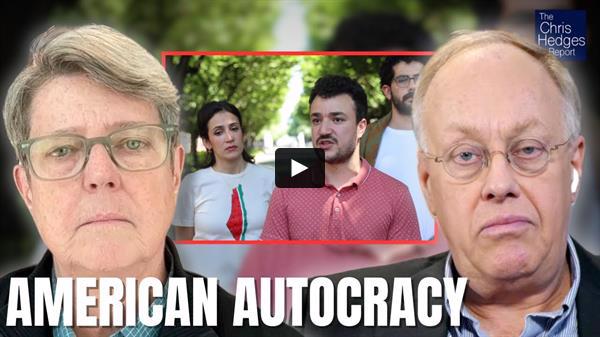
Mahmoud Khalil’s arrest and detention in a Louisiana ICE facility is a harbinger for a new authoritarian era of the United States. Khalil’s arrest, the capitulation of Columbia University against dissent and protest by its own students and the Trump administration’s threat of stripping the university of $400 million in grants if it does not meet its requests is just one place where the tentacles of fascism tighten their grip.
Katherine Franke, a former law school professor at Columbia, is on the front lines of this assault. Her support for student protests and her condemnation of the university for not addressing the harassment of pro-Palestinian students has earned what she called, “a termination dressed up in more palatable terms.”
Franke joins host Chris Hedges on this episode of
The Chris Hedges Report to address the Constitutional crisis that faces the US, how it has manifested itself on university campuses and what are the next steps in challenging it. Franke points to the shift in institutional integrity within universitites. Hedge fund managers, venture capitalists and corporate lawyers now run these institutions and their goals aren’t to maintain the principles of education and democracy, but rather the financial bottom line.
|
|
|---|
|
|
A key element of Donald Trump’s presidential career has been his symbiotic relationship with the organized U.S. far right. This relationship has been unprecedented for any U.S. president or major party presidential candidate, but it has also been complex and unstable and has evolved considerably over the past decade. Exploring Trump’s changing relationship with far-right politics can help us understand and prepare for the looming catastrophe that will be Trump’s second presidency.
By Matthew Lyons (New Politics, Vol. 78, Winter 2025) |
|
|---|
|
Americans watching horror again unfold in Gaza should make no mistake. This is our war, our body count. And it cannot be separated from the authoritarian advance at home that is rapidly choking off our fundamental political freedoms.
Late Monday, White House press secretary Karoline Levitt said Israel had consulted with the Trump administration before launching punishing pre-dawn airstrikes that killed more than 400 people, including multiple children. An Israeli official told the Washington Post that the resumption of violence was “fully coordinated” with Washington.
By Spencer Ackerman (Zeteo, 3/18/25) |
|
|---|
|
U.S. security experts and leaders have been telling European NATO allies to increase their defense spending for at least a quarter century, initially as a gentle nudging, later more insistently, rising to a deafening din after Trump’s election. The infamous White House press conference with President Volodymyr Zelensky on March 1 finally shocked Europeans out of their complacency and opened their purse-strings, according to American analysts, who seem very pleased with themselves.
But this approach puts the cart of military-spending-as-share-of-GDP before the horse of a dynamic assessment of the threats European countries actually face. Going on a spending spree to reach some arbitrary share of GDP or random number of billions of euros, to buy weapons systems favored by lobbyists but of dubious relevance, is a poor replacement for a comprehensive strategy for European security.
By Almut Rochowanski (Responsible Statecraft, 3/13/25) |
|
|---|
|
The French government is reportedly planning to send a “survival manual” to every household in the country with instructions on how to prepare for an “imminent threat” including armed conflict, a health crisis or a natural disaster. If approved by the prime minister, the 20-page booklet will be sent to households before the summer.
By Kim Willsher (The Guardian, 3/18/25) |
|
|---|
|
|
|
Just over a third of all Americans are tenants, and the proportion is growing. Renter households are increasing at triple the rate of homeowners. They are disproportionately young and non-white: over half of Black and Latino households rent, as well as roughly two-thirds of Americans under the age of 35. More than half of renter households—over 22 million—are rent-burdened, meaning they pay over 30 percent of their income toward rent and utilities, and one in five report severe rent burden, paying over 50 percent.
Almost a quarter of renters report skipping meals to make their monthly rent payments. Homelessness is at an all-time high. Wider economic discontent can also be connected to housing. An astonishing 75 percent of swing-state voters said housing costs were the most stressful economic issue for their families, and nearly two-thirds said housing unaffordability made them feel negatively about the economy. Rent remains the single largest factor keeping inflation high, accounting for half the overall increase in inflation as recently as September.
By Charlie Dulik (N+1, 11/26/24) |
|
|---|
|
President Trump claims that Canada is shipping Canadian-made GM and Ford vehicles made in Canada into the US, tariff free and that these should be made in the US by American workers. The thing is, there is a reason so many US cars get built in Canada, and probably why so much of the steel used in the US is produced in Canada and sold to US manufacturers. And that reason is not that Canadian workers make less than workers in the US or that Canadian automakers and steel plants are subsidized by Canada.
The reason a lot of auto and truck manufacturing was shifted away from Michigan and other parts of the US to Canada was because of the enormous cost per vehicle the US car companies were paying for health care coverage for their workers and dependents — which is now adding a production cost of thousands of dollars per vehicle, and that’s not counting the added cost of retiree health care. Canadian companies’ employee health care costs are a pittance compared to at US companies.
Today, total US healthcare spending is running at a $4.9 trillion level, representing a record 16.9% of the nation’s $29-trillion GDP, and is headed towards 20% of GDP by 2030. None of the major car producers, whether in low-wage countries like China and Korea or high-wage countries like Japan, Germany, France of Italy face those kinds of costs to cover for the health care of their employees, who all live in countries where there is some form of nationally funded medical system in which the costs of health care are funded through universal taxation, not by individuals or by employers. This is why German automobiles and French automobiles are able to compete in the US auto market, even though their workers are paid higher hourly wages than their counterparts in the US.
By Dave Lindorff (This Can’t Be Happening, 3/7/25) |
|
|---|
|
|
|
|---|
|
|
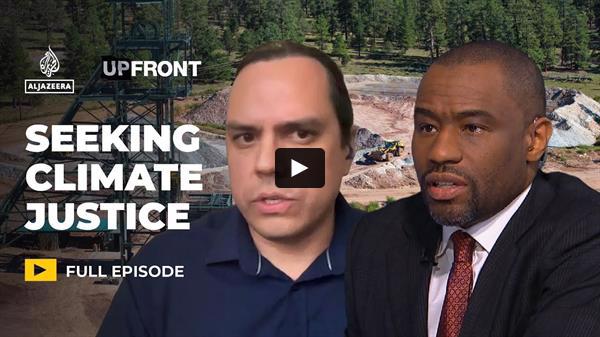
Across the globe, Indigenous peoples are grappling with the devastating effects of a rapidly escalating climate crisis, yet they remain sidelined in environmental decision-making. So how can meaningful change happen when those most affected aren’t part of the conversation? And how is the history of genocide against Indigenous peoples in the US similar to the plight of Indigenous peoples across the globe?
This week on
UpFront, Marc Lamont Hill speaks with Nick Estes, co-founder of the Red Nation and author of
Our History Is The Future. Nick is a member of the Lower Brule Sioux Tribe and a history professor in American Indian Studies at the University of Minnesota.
|
|
|---|
|
|
As the climate crisis worsens, it’s expected to exacerbate heat waves and droughts, bringing water shortages and increasingly devastating fires like those currently scorching southern California. The situation in Los Angeles is already a catastrophe. Climate change-induced water shortages will make imminent disasters even worse.
In the face of this grim reality, it’s worth revisiting one of the major water-guzzling industries that’s hastening future crises from California’s own backyard: artificial intelligence (AI). This technology’s environmental footprint is tremendous. AI requires massive amounts of electrical power to support its activities and millions of gallons of water to cool its data centers. One study predicts that, within the next five years, AI-driven data centers could produce enough air pollution to surpass the emissions of all cars in California.
[Full story]
By Schuyler Mitchell (Truthout, 1/11/25) |
|
|---|
|
One can get a cross-sectional view of the bleeding edge of cybernetic capitalism by considering the fate of the GPUs that have made Nvidia fabulously rich. These devices are key to the calculations that allow AI to fold models of proteins, automate away labour costs, create kill lists for the IDF’s genocide, plagiarise essays, engage in financial speculation, create deep-fakes of dead dictators, and all the other AI wonders. Thereafter, these computing-machines will succumb to their built-in obsolescence and realise their longer-term destiny of becoming toxic e-waste.
This is the dark underside of ‘Moore’s Law’, which projects that the number of transistors that can be packed onto a computer chip doubles roughly every two years: exponentially increasing computer power goes hand-in-hand with exponentially increasing waste. According to the United Nations Institute for Training and Research, 62 million tonnes of e-waste was generated in 2022, double the amount produced in 2010. As their recent report describes, this is ‘equal to the weight of 107,000 of world’s largest (853-seat), heaviest (575 tonne) passenger aircraft – enough to form an unbroken queue from New York to Athens, from Nairobi to Hanoi, or from Hong Kong to Anchorage’.
By Timothy Erik Ström (Sidecar/NLR, 1/18/25) |
|
|---|
|
|
|
From left-wing utopianism to right-wing denialism, ideological echo chambers across the world are eroding the capacity for original, reasoned, and systemic thinking. The United States’ drawn-out electoral process has once again brought out the worst in political tribalism.
However, it has also provided an unexpected opportunity: a laboratory for intellectual rebellion and the formation of new, potentially enduring coalitions. Rather than fuel the fevered shouting matches across alternate-reality filter bubbles, can ecological economics play a role in bridging fractured worldviews?
By James Magnus-Johnston (Resilience/PCI, 1/7/25) |
|
|---|
|
This article challenges a few “facts” that have become as entrenched in ecological dogma as your favorite pair of old sneakers. Armed with basic ecology, paleontology, physics, and a sprinkle of math, this article separates fact from fiction and sheds light on the fascinating journey of how ecosystems and species have evolved. These details are important in crafting strategies to maximize biodiversity, given the significant loss of planetary productivity over the last ten thousand years. Grasping these concepts is essential for calling out misguided practices that masquerade as eco-friendly—cue the greenwashing theatrics.
Recognizing environmental misconceptions and myths is vital for understanding the complex interplay of species within ecosystems. The extinction of megafaunal animals and the subsequent changes in species dynamics, diversity and soil health underscores the need to consider the historical context of ecosystems. This article explores the roles that various organisms played in shaping the world around us. Understanding our ecological history is vital—if you don’t know where you’ve come from, you don’t know where you’re going.
By Lyle Lewis (Race2Extinct, 1/23/25)
|
|
|---|
|
|
|
|---|
|
|
Climate Capitalism: Can Market-Based Solutions Save the Planet?
As the climate emergency intensifies, the effectiveness of market-based solutions is facing increasing scrutiny. Can capitalism resolve a crisis of its own making? Is “green growth” a genuine path to transformative change, or does it merely serve to legitimize and perpetuate systemic inequalities?
Watch this thought-provoking discussion at the London School of Economics and Political Science on the promises and pitfalls of market-based solutions in shaping a just and livable future for all.
[More on the event]
|
|
|---|
|
|
Essential Critical Questions (ECQ) are those that stimulate deep reflective thinking and critical inquiry. They can help focus our attention on issues vital for just and peaceful sustainability transitions, reveal our cognitive blindspots, frame our dispositions to settle controversies fairly, “straighten out” our reasoning when dealing with situations of uncertainty, and trigger generation of big ideas and creative approaches for tackling complex, intractable, and truly wicked problems. |
|
|---|
|
We just started generating OCI’s list of essential critical questions, and we invite intellectual input from members of Hawai‘i civil society, as well as fellow knowledge workers laboring in various institutional domains—scientists, physicans, journalists, librarians, educators, and other members of island intelligentsia. Please make your critical thought contribution to
ideas@hawaii.edu. |
|
|---|
|
Does accepting actuality at face value encourage passivity in the face of injustice and inequality?
|
|
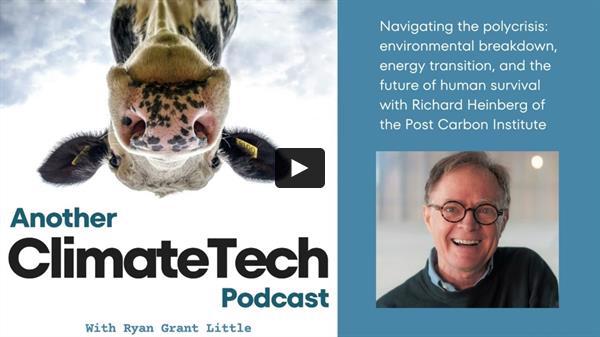
If it feels like we’re living through an era of cascading crises whose interconnections we’re only beginning to grasp, that’s because we are. In this episode, we speak with Richard Heinberg, Senior Fellow at the Post Carbon Institute, about his latest report,
Welcome to the Great Unraveling: Navigating the Polycrisis of Environmental and Social Breakdown
.
The biggest eye-opener, you ask? The extra emissions from creating the hardware we need to avoid surpassing emissions limits could ironically cause us to surpass emissions limits. Listen in as Richard unpacks how to navigate this new reality.
|
|
|---|
|
|
|
The social provisioning process is how heterodox economists define economics in general. Instead of having a narrow definition of what constitutes economics, such as the mainstream has with its allocation of scarce resources among competing ends via the price mechanism, heterodox economists have opted for a much more expansive definition that permits different theoretical explanations for ways in which the provisioning process can take place in different types of economies in different historical contexts. In this chapter, we first examine the changes in the definition of economics from classical political economy to neoclassical and heterodox economics.
The comparison between classical political economy and neoclassical economics manifests a clear distinction in view of economy and economics. The second section substantiates the meaning of the social provisioning process. In doing so we make a case that, first, defining heterodox economics as the study of the social provisioning process positions heterodox economics as an alternative to neoclassical economics, and, second, that such an expansive definition of economics has potential to synthesize various heterodox theoretical frameworks in a constructive manner.
|
Keywords and meta-markers: social provisioning process; heterodox economics; definition of economics; capitalist economy; classical political economy; production process; distribution of wealth; economic theory
Source:
Jo, T. (2016).
The Social Provisioning Process and Heterodox Economics. MPRA Paper No. 72384. The University of Munich RePEc archive.
|
|
|
|---|
|
|
This paper presents an analytical mapping of institutional design possibilities for alternative ways for digital platforms to institutionalise property and corporate form. It builds on the institutional imagination catalysed by three vignettes of experimental sharing economy initiatives presented towards the start of the paper, each of which highlights the imbrication and interdependence between economic and social dimensions of the sharing economy.
The paper then interrogates the vignettes through three analytical entry points to the institutional design of commons-based sharing economies: platform, care and place. By remapping the vignettes’ practices around these three entry points, the paper shows how they help constitute the incipient formalisation of commons-based approaches to the sharing economy. The prospects for carrying out a redesign of property and corporate forms more generally thereby become more visible, providing a sound foundation for more in-depth empirical and historical work on alternative trajectories of the sharing economy in the future.
|
Keywords and meta-markers: commons-based initiatives; property relations; sharing economy; platform economy; digital platforms; care; place; distributed community organizations; economic democracy
Source:
Morgan, B. (2024).
Institutional Design in Commons-Based Sharing Economies: Platform, Care and Place. International Journal of Law in Context, 20(4), 496–513.
doi:10.1017/S1744552324000351
.
.
.
.
.
.
|
|
|
|---|
|
|
The rise of digital commons has expanded shared resources and addressed some challenges of traditional commons. However, this expansion has created new boundaries, forming a complex paradigm that challenges platform capitalism and demands alternative governance models. This study conceptualises shared resources within the framework of cosmolocalism, examining their formation, the processes of enclosure under platform capitalism, and potential pathways for de-embedding.
Platform capitalism utilises legal frameworks and opaque algorithmic systems to appropriate resources and dominates digital labour markets, manifesting a contemporary tragedy of the commons characterised by exploitation and profit maximisation. Using ridesharing as a case study, this research highlights the dynamic nature of cosmolocalism and proposes strategies to counter exploitation. By integrating platform cooperativism and social common capital, this study offers sustainable, equitable resource management solutions, supported by a comparative analysis of business models.
|
Keywords and meta-markers: governance models; cosmolocalism; digital commons; platform capitalism; platform cooperativism; social common capital; ridesharing
Source:
Uchiyama, Y. (2025).
Cosmolocalism Against Platform Capitalism: Evidence From Ridesharing. Communication, Capitalism & Critique, 23(1), 23–39.
doi.org/10.31269/triplec.v23i1.1515
|
|
|
|---|
|
| |
|
This paper, prepared in the context of Community-Led Local Development, discussed the relationships between the adaptive capacity of cities and the latest participatory governance approaches to identify new tools for ecosocial transition. The Polycrisis is an opportunity to reflect upon strategies to mitigate environmental, social and economic waste.
The adoption of a systemic, circular and reiterative methodology considers stakeholders as promoters and drivers of human-centered development processes. From the intercontinental empirical comparison of case studies, the experimentation proposes Community Regeneration Indicators to monitor and evaluate the processes of recovery and adaptation of the built heritage, generating a replicable ecosocial co-design transition model.
|
Keywords and meta-markers: ecosocial transition; community-led local development; Community Regeneration Indicators, co-design transition model; human-centred approach
Source:
Ciampa, F., & Bosone, M. (2022).
Toward Eco-Social Transition: Community Regeneration Indicators Respond to the Polycrisis. TECHNE - Journal of Technology for Architecture and Environment, (23), 200–210.
doi.org/10.36253/techne-12140
|
|
|
|---|
|
|
The commons concept has evolved in multiple ways after the publication of Ostrom’s seminal work in 1990, which emphasized the evolution of resource management institutions and the usefulness of self-governance. As we move into the 21st century, one of the institutional transformations is catalyzed by the emergence of Information and Communication Technology (ICT) as a techno-economic paradigm shift and the epochal creation of a new online social structure. However, there is a lack of understanding about the impact of ICT on common resource management, particularly in urban settings, that is urban commons. This study presents a systematic literature review of ICT-enabled urban commons with particular attention to its application to climate-related issues such as climate mitigation/adaptation in order to improve our collective ability to leverage ICT for building a more sustainable and resilient city.
Our findings identified three key contributions of ICT to innovate climate-resilient solutions: 1) to redefine role of resource user as co-producer, co-designer, and co-monitor; 2) to enable real-time data-driven urban planning; 3) to improve resource efficiency and effectiveness. In other words, in a time of insufficient and limited public resources, the public sector can leverage the power of technology to harness public support and engage non-traditional stakeholders to make cities more sustainable and resilient while allowing policy-making to be big data-driven to tackle new urban problems that cannot be otherwise uncovered without the aid of ICT. The results provide directions to rethink the city based on collective action to diversity modes to govern common resources.
|
Keywords and meta-markers: urban commons; techno-economic paradigm shift; ICT; climate-resilient solutions; resource management; self-governance; climate mitigation; cupolaed infrastructure system; urban planning; public infrastructure
Source:
Chien, H., Hori, K., & Saito, O. (2022).
Urban Commons in the Techno-Economic Paradigm Shift: An Information and Communication Technology-Enabled Climate-Resilient Solutions Review. Environment and Planning B: Urban Analytics and City Science, 49(5), 1389–1405.
doi.org/10.1177/23998083211066324
|
|
|
|---|
|
|
This paper explores the concepts of commons and commoning from an educational vantage point. These concepts point to places and activities that are shared, communal and un-privatised, in other words they point to places and practices not yet enclosed or appropriated by capital and market logics. Education is certainly a place and an activity that is increasingly being enclosed and appropriated by these logics, but at the same time education seems to always find ways of escaping this enclosure, and teachers and students find ways of being that escapes appropriation.
Exploring the concepts of commons and commoning from an educational vantage point is thus an attempt at describing schooling as an activity that takes place in common and makes something common. By sharing and introducing a subject matter to the students, the teacher offers a shared space of exploration and study that can escape the instrumental and proprietarian framework of the neoliberal education agenda.
|
Keywords and meta-markers: education; schooling; commons; communing; philosophy of education; educational theory
Source:
Korsgaard, M. T. (2018).
Education and the Concept of Commons. A Pedagogical Reinterpretation. Educational Philosophy and Theory, 51(4), 445–455.
doi.org/10.1080/00131857.2018.1485564
|
|
|
|---|
|
| |
Enshittification: Why Everything Suddenly Got Worse and What to Do About It
The rapid, precipitous decline of every digital service we depend on isn’t a coincidence. It’s the result of specific known, policy choices made by specific, named individuals. We can reverse those decisions (and we can determine what sized pitchfork those individuals wear).
Enshittification wasn’t inevitable: it was the foreseeable outcome of a plan to encourage digital monopoly platforms and turn them loose to extract unimaginable value from both their users and business customers, leaving behind a homeopathic residue of utility to keep us locked in.
In this talk, cultural critic and writer Cory Doctorow—the originator of the term “enshittification”—explains what it is, how it works, why it’s happening now, and, most importantly, how we can reverse it. He explores how seizing the means of computation can help us build a new, better Internet—one capable of serving as the digital nervous system for a world grappling with environmental collapse, genocide, and rising fascism.
|
|
|---|
|
|
|
The main objective of this study is to better understand the challenges of transdisciplinary knowledge production processes and its institutionalisation at universities. Transdisciplinary research is considered a collaborative and integrative praxis grounded in different ways of knowing, acting and being. However, transdisciplinary research practices differ significantly in the relations between institutions and actors. These differences have an impact on how transdisciplinarity is institutionalised. There is a need to incorporate them into a larger framework of ongoing transformations of scientific timescales and spaces at universities.
We present the results of a case study developed at Babes-Bolyai University (Romania). We discuss it against the background of three models of transdisciplinary knowledge production and two approaches of transdisciplinary problem-solving research. We apply a qualitative methodology of micro level analysis that explores research practices and their embeddedness in the institutional environment. We analyse conditions that enable transdisciplinary knowledge production and show how transdisciplinary institutionalisation can be better understood using the proposed framework applied to the case study. It could be shown that taking into consideration the differences in the models of transdisciplinary knowledge production proved to be useful to gain a deeper understanding of processes of institutionalising transdisciplinarity at universities.
|
Keywords and meta-markers: transdisciplinarity; transdisciplinary research; knowledge production; institutionalization; case study; shared epistemic arena
Source:
Vienni Baptista, B., & Vilsmaier, U. (2021).
Models of Transdisciplinary Knowledge Production at Universities: A Romanian Case Study. Higher Education Research & Development, 41(5), 1757–1772.
doi.org/10.1080/07294360.2021.1910208
|
|
|
|---|
|
|
The field of tourism studies has entered an epoch of manifold vulnerabilities, a period in which the academic community will have to respond to the environmental and planetary crises and consider the wellbeing of not just humans but also nonhumans and multispecies. In these momentous times, it is imperative not to overlook tourism studies’ ontological, epistemological, and axiological vulnerabilities and to survey the potential viabilities. Although the blossoming criticalities in the field have greatly fuelled the urgency to correct, rectify, and recalibrate existing relational arrangements and replace these by more sustainable, just, and inclusive visions for/versions of tourism, there is still a pressing need for more conceptually, theoretically, and philosophically malleable architecture.
Inspired by Donna Haraway’s scholarship on broader planetary matters, this contribution offers ‘kinmaking’ as a critico-creative, disruptive space and fitting thoughtscape for transitioning into more-than-tourism (studies). Among the key ideas covered in this paper are the dangers of epistemocentricism, the necessity for sympoietic approaches, the rise of postdisciplinary and posthuman acumen, and the overall ripeness of tourism studies to become a domain of critical relationalities.
|
Keywords and meta-markers: tourism ontology; tourism epistemology; postdisciplinary; posthuman; relational; critical posthumanities
Source:
Pernecky, T. (2023).
Kinmaking: Toward More-Than-Tourism (Studies). Tourism Recreation Research, 48(4), 558–568.
doi.org/10.1080/02508281.2023.2207154
|
|
|
|---|
|
|
Privatization in education is not essentially about education. It is about the development of capitalism and the deepening of the rule of capital in particular institutions (schools, colleges, universities etc.) in contemporary society.
Of course, this is not how the situation appears in the relevant academic literature. Privatization in and of education is typically framed within a discourse regarding whether it ‘works,’ or not; or whether aspects of education—standards, equity and efficiency in particular—are enhanced or threatened by privatization in educational institutions. Focus on the marketization of education is particularly to the fore in writing and research on educational privatization. Finally, and politically significant, is that privatization is posited as a threat to public, state-financed education. The very ‘publicness’ of education is at issue.
|
Keywords and meta-markers: capitalism; public education; privatization; education; commodity forms; commodification; marketization; labor-power; profit; state revenue; capitalization
Source:
Rikowski, G. (2019).
Privatization: Education and Commodity Forms. In D. Ford (Ed.) Keywords in Radical Philosophy and Education (pp. 355–374). Brill, Boston.
doi.org/10.1163/9789004400467_025
|
|
|
|---|
|
|
In this article, we approach the relationship between neoliberalism and psychological science from the theoretical perspective of cultural psychology. In the first section, we trace how engagement with neoliberal systems results in characteristic tendencies—including a radical abstraction of self from social and material context, an entrepreneurial understanding of self as an ongoing development project, an imperative for personal growth and fulfillment, and an emphasis on affect management for self-regulation—that increasingly constitute the knowledge base of mainstream psychological science.
However, as we consider in the second section, psychological science is not just an observer of neoliberalism and its impact on psychological experience. Instead, by studying psychological processes independent of cultural–ecological or historical context and by championing individual growth and affective regulation as the key to optimal well-being, psychological scientists reproduce and reinforce the influence and authority of neoliberal systems. Rather than a disinterested bystander, hegemonic forms of psychological science are thoroughly implicated in the neoliberal project.
|
Keywords and meta-markers: neoliberslism; cultural psychology; self; individualism; social context; affect management; entrepreneurial self; domination
Source:
Adams, G., et al. (2019).
The Psychology of Neoliberalism and the Neoliberalism of Psychology. Journal of Social Issues, 75(1), 189–216.
doi: 10.1111/josi.12305
|
|
|
|---|
|
|
The article provides a step-by-step framework for educators to transform their practices, a framework that not only challenges Eurocentric knowledge bases but also was designed to scrutinize the foundations of the current dominant Western educational models. It also serves as a catalyst for critical thinking conversations about reclaiming Indigenous education. It is crucial to note that this model is not designed to “diagnose” an individual’s “condition” but rather to provide terminologies that support educators to transform their practices as they articulate their experiences, the stages of the model that they aspire to embody, and the obstacles and promoters that actualize their collective hopes and visions.
We begin this study with an introduction to our praxis and agency as scholars of Indigenous education. Next, we offer a brief history of Indigenous education and depict the impact of systemic racism on Indigenous children and educators in U.S. schools. We discuss the challenges presented by the adoption of neoliberal multiculturalism in whitestream educational systems and reframe our resistance to this context within our respective teaching settings. We explain the theoretical frameworks that grew from our praxis and how those frameworks helped us develop the TIPM and then describe the TIPM, which reflects multiple stages of critical thinking development. We also discuss resistance to each stage and antidotes to that resistance.
|
Keywords and meta-markers: Indigenous education; decolonization; critical consciousness; systemic racism; Eurocentric curriculum; cultural restoration; social justice; self-determination; insurgent research
Source:
Pewewardy, C.D., Lees, A., & Clark-Shim, H. (2018).
The Transformational Indigenous Praxis Model: Stages for Developing Critical Consciousness in Indigenous Education. Wicazo Sa Review, 33(1), 38–69.
doi.org/10.5749/wicazosareview.33.1.0038
|
|
|
|---|
|
|
The central hypothesis of this conceptual commentary is that place-based educational approaches that use local environments as the learning context could not only provide needed educational reforms but also sow the seeds of sustainable behaviors of future generations. Furthermore, natural environments are offered as an optimal context for the emotional and sensory-rich needs of learning experiences that transform eco-paradigms and develop land ethics. The supporting literature examines the nexus of environmental education, place-based approaches, benefits of nature experience, and transformational learning.
Breaking barriers of current economic, political, and educational institutions requires integrative approaches—head, hand, and heart—to transform eco-paradigms. A conceptual diagram is offered to visualize this holistic approach. The rich context of a natural place enhances the esthetic quality of a learning experience and is dependent on the relationships within the community of learners, sensory interaction with the learning context or place, the emotion that arouses, thoughts derived from reflection on the experience, and the depth of engagement and behavior change that ensues. I support the power of place as a learning context through personal narrative. Although place-based education can be applied in any community and educational setting, I offer my own cultural perspective as an American with a critique of the consumer culture of the place in which I reside and the effect of rigid institutions on eco-values. Place-based educational reforms could develop caring for local environments leading to young people striving to preserve the places in which they have learned and come to care about.
|
Keywords and meta-markers: ecoliteracy; place-based education; transformative learning; sustainability education
Source:
Singleton, J. (2024).
Relationship with Place: A Transformative and Sustainable Pedagogy for the Planet. Academia Environmental Sciences and Sustainability, 1(1), 1–8.
doi.org/10.20935/AcadEnvSci7269
|
|
|
|---|
|
| |
|
|
|
Humanity is at crossroads. Resource depletion and exponential emissions that not only cause climate change, but endanger the health of people and planet, call for a decisive turnaround of human civilization. A new and transformative paradigm is emerging that advocates for regenerative civilizations, in which a narrative of systemic health as much as individual and collective vitality guide the interaction of socio-economic-ecological systems.
Truly transformative change must go far beyond technical solutions, and instead envision what can be termed ‘a new operating system’ that helps humankind to live well within the planetary boundaries and partner with life’s evolutionary processes.
|
|
|---|
|
|
This open access book brings science and practice together and inspires a global movement towards co-creating regenerative civilizations that work for 100% of humanity and the Earth as a whole. With its conceptual foundation of the concept of transformation literacy it enhances the knowledge and capacity of decision-makers, change agents and institutional actors to steward transformations effectively across institutions, societal sectors and nations..
[Download the book]
Künkel, P., & Ragnarsdottir, K. V. (Eds). (2022). Transformation Literacy: Pathways to Regenerative Civilizations. Springer Nature.
doi.org/10.1007/978-3-030-93254-1
|
|
|
This publication and the new Consilience Learning Series are co-produced by IMUA Labs* and the People’s Knowledge Institute (PKI), an experimental vehicle for integrative, post-formal education and transformative community research.
The central goal of our publications, knowledge-sharing streams, and collaborative learning exercises is to cultivate civic intelligence, systemic literacy, and cognitive competences essential for navigating a complex, dynamic world; to enhance collective reflexivity; and to elevate the community’s possession of truth, knowledge, and rational beliefs that support an ecological way of life. We iteratively develop and test innovative methods of knowledge organization and dissemination to strengthen island communities' learning capacity and self-awareness, and to facilitate deeper intersectoral collaboration in response to the grand challenges of green transformation.
As a collective intelligence initiative, we welcome a diversity of ideas and epistemic pluralism. Thus, the arguments expressed in our knowledge syntheses, bulletins, and event announcements do not necessarily reflect the views of IMUA Labs, PKI or the Hawai‘i Institute for Socio-Ecological Transformation. Should you spot a data error, a missing critical topic or issue, or an instance of faulty reasoning in our transdisciplinary publications, please submit your feedback to our knowledge gardeners at
imualabs@hawaii.edu. |
|
|---|
|
*IMUA Labs @UH is a short name of the Hawaiʻi Scholarly Society
for Epistemic Innovation, Integrative Studies, and Transformative Research |
|
|---|
|
|
|