|
|
“
...once the substantial form of the spirit has inwardly reconstituted itself, all attempts to preserve the forms of an earlier culture are as vain as the effort to attach withered leaves to the new buds already sprouting from the root.”
|
|
|
By Brian Ashley (Amandla!, November 25, 2025) |
|
|---|
|
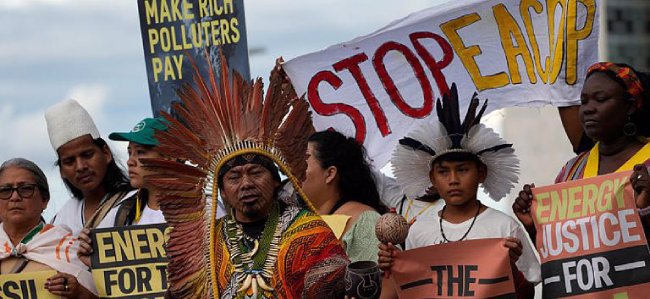
As the dust settles after COP30 in Belém, the scale of the failure becomes impossible to ignore. The world is on a path toward catastrophic warming, ecological systems are collapsing, and millions across the Global South face annihilation, not in the distant future, but today. The world’s political and economic elites arrived in the Amazon to negotiate when the 1.5°C target had already slipped out of reach, and they left with little more than symbolic gestures. No binding emissions cuts. No serious plan to phase out fossil fuels. No meaningful climate finance for adaptation. No accountability for the destruction already unleashed.
The gap between official international climate policy and the lived reality of a warming world has never been wider. In Belém, that gap became a chasm. The world is heading towards roughly 2.8°C of warming by the end of the century. This is
not a scenario compatible with human dignity — or even, for many, with life itself. Rising seas, extreme heat, drought, and flooding are eroding food security, displacing communities, and driving inequality to historic heights. The economic costs of climate disasters are skyrocketing, but the social and human costs are immeasurable: lives lost, livelihoods shattered, ecosystems irreversibly damaged.
[Continue reading]
|
|
|---|
|
By The Lancet in Collaboration with Wellcome (The Lancet; November 2025) |
|
|---|
|
The latest
Lancet Countdown report warns that health impacts of climate change are worsening, with millions dying needlessly each year due to fossil fuel dependence, growing greenhouse gas emissions, and failure to adequately adapt.
As some countries and companies rollback on climate commitments, local and grassroots leadership is building momentum for a healthier future.
The report represents the work of 128 experts from 71 institutions, monitoring progress across 57 indicators – from heat-related deaths to bank lending to fossil fuels – providing the most comprehensive assessment yet of the links between climate change and health.
[Continue to
Key Findings and Visual Summary]
|
|
|---|
|
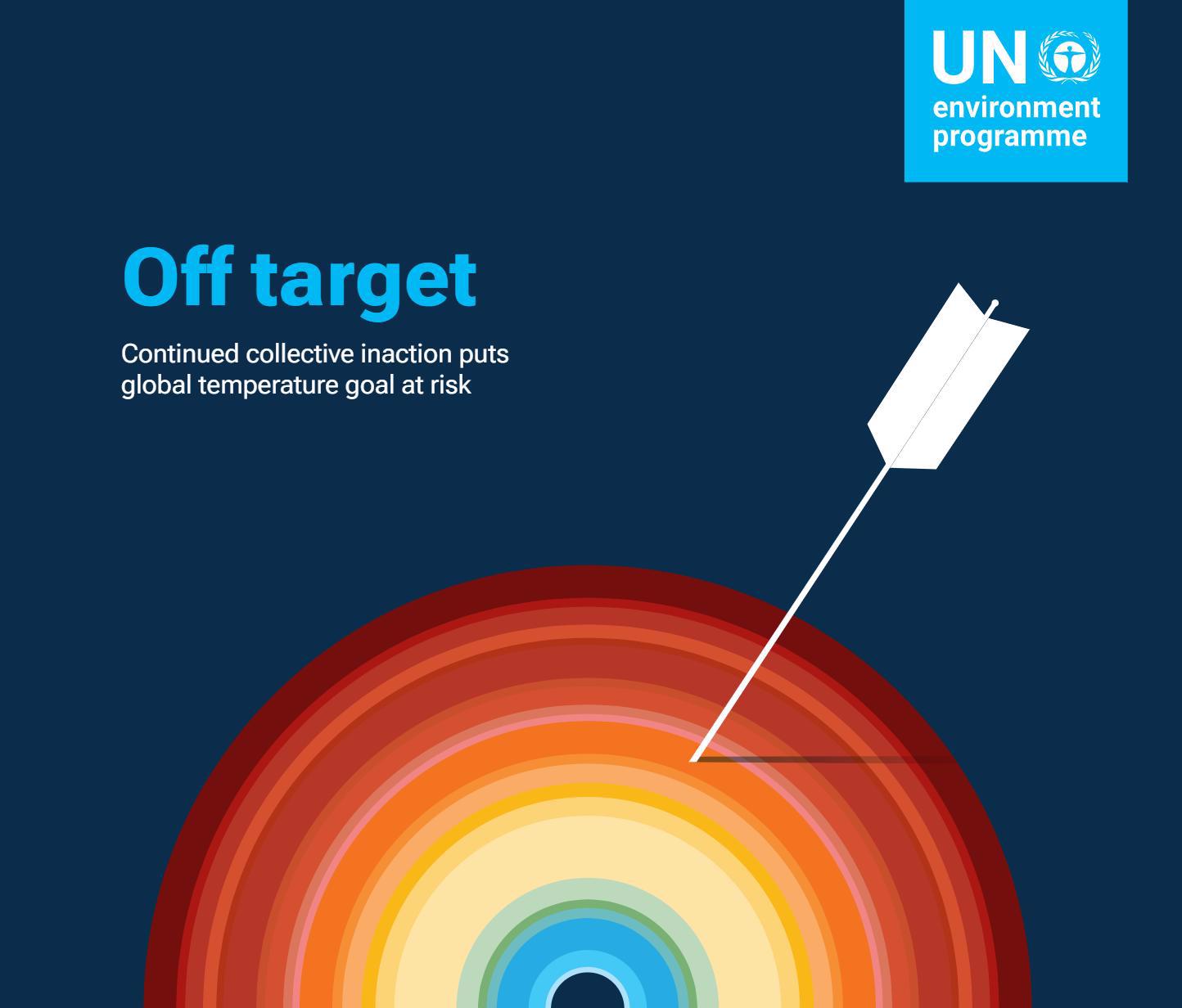
The sixteenth edition of the Emissions Gap Report finds that global warming projections over this century, based on full implementation of Nationally Determined Contributions (NDCs), are now 2.3-2.5°C, while those based on current policies are 2.8°C. Nations remain far from meeting the Paris Agreement goal to limit warming to well-below 2°C, while pursuing efforts to stay below 1.5°C. Reductions to annual emissions of 35 per cent and 55 per cent, compared with 2019 levels, are needed in 2035 to align with the Paris Agreement 2°C and 1.5°C pathways, respectively.
Given the size of the cuts needed, the short time available to deliver them and a challenging political climate, a higher exceedance of 1.5°C will happen, very likely within the next decade. The report finds that this overshoot must be limited through faster and bigger reductions in greenhouse gas emissions to minimize climate risks and damages. Every fraction of a degree avoided means lower losses for people and ecosystems, lower costs, and less reliance on uncertain carbon dioxide removal techniques to return to 1.5°C by 2100.
[Go to report]
Also read UNEPs 2025 Global Cooling Watch Report.
|
|
|---|
|
People have been forecasting the future for as long as they’ve had language. Premodern ideas of what’s to come often featured either a catastrophic end of the world or an eventual paradisiacal condition of peace and plenty. This was true both for many, though not all, Indigenous peoples and for followers of the world’s missionary religions (i.e., Christianity and Islam, and to a lesser degree Buddhism). For some cultures, the arc of time was imagined as a progression from ancient virtue to present corruption and eventual ruin or salvation; for others, time was cyclical, with multiple Golden Ages and periods of decline.
Today, most scientific futurists regard such traditional concepts of collective human destiny as worthy of ethnographic study but otherwise useless. In their place, the modern futurist supplies scenarios based on quantifiable trends. Extrapolating trends in population, economic activity, and technology can lead, in their view, to projections reliable enough to be used by city planners, policy makers, and CEOs.
But there’s a problem with these scenarios: trends change. They encounter limits, countervailing trends, and contradictions inherent in social systems.
[Continue reading]
|
|
|---|
|
|
The Nature of the Future
On October 28, 2025, The American Academy in Berlin recently hosted a talk by Pulitzer Prize-winning environmental journalist Elizabeth Kolbert, a staff writer at the New Yorker since 1999 and author of the acclaimed book
The Sixth Extinction. Kolbert’s analysis drew on decades of reporting that has earned her honors including the BBVA Foundation Biophilia Award, a Guggenheim fellowship, and election to the Academy of Arts and Letters.
Her presentation, “
The Nature of the Future,” opens (@05m10s) by tracing the evolution of humanity’s relationship with nature through a provocative historical lens. She highlights a century-old inscription on a University of Wyoming engineering hall—“Strive on; the control of nature is won, not given”—which symbolized an era of arrogant optimism. This ideal, however, was fundamentally critiqued by Rachel Carson in
Silent Spring, who called the “control of nature” a phrase “conceived in arrogance.” With staggering statistics, Kolbert grounds this shift: humans have directly transformed over half of Earth’s ice-free land (27 million sq mi), dammed most major rivers, and emit CO₂ at a rate unprecedented in 66 million years. In perhaps the most telling metric, the mass of human-made materials now equals all planetary biomass, and plastic alone outweighs all animal life by a factor of two to one.
To illustrate the recursive logic of this age, Kolbert presents three “fables.” The first details Chicago’s reversal of its river to solve sewage contamination, which inadvertently created a conduit for invasive Asian carp, leading to a $1 billion project to electrify the waterway as a “disco barrier.” The second follows the Mississippi River levees around New Orleans; while preventing floods, they starved the delta of sediment, causing the land to sink and prompting plans for massive artificial sediment diversions—a classic “second-order” technological fix. The final example moves to the planetary scale, examining direct air capture of CO₂ and the speculative but looming prospect of solar geoengineering—dimming the sun by injecting reflective particles into the stratosphere. Each story followed the same pattern: a technological solution creates a novel, more complex problem, demanding another layer of control.
Kolbert concludes with a pressing dilemma. While a powerful ethical and environmental case exists for “scaling back” our footprint, she sees no evidence of the collective will to do so. Instead, the dominant trajectory is toward deeper technological management of the crises we’ve created. The talk, initially framed during a more hopeful political moment, ended on a note of deepened pessimism, noting that current U.S. policy could add 7 billion tons of CO₂ by 2035.
Kolbert’s final insight is sobering: our extraordinary power has not led to mastery but to an escalating loop of controlling the consequences of our prior control. The “nature of the future” is thus one of our own fraught and perpetual making—a spiral where each solution tightens the knot of our dependency on ever-more drastic interventions.
|
|
|---|
|
On this episode of
Politics Theory Other—titled “The Sunlight Managers”
—host Alex Doherty is joined by Princeton University climate research fellow Sofia Menemenlis. They discuss her recent article for
The Break-Down on solar geoengineering, often called ‘solar radiation management’ or SRM. Their conversation delves into how SRM is conceived, its potentially catastrophic side effects, and the key players researching—and potentially deploying—this world-altering technology. |
|
|---|
|
|
NB:
Metascope is not optimized for small screens or mobile devices and may not render consistently across all email clients and applications. For the best reading experience, we recommend viewing it in a web browser on a desktop, notebook, or tablet. Gmail and some other email clients may clip portions of the publication. To access the full issue, click the
“View entire message” link at the bottom of this email or select
“View this email in your browser” at the top.
This demo issue of
Metascope features 129 unique items. Each bolded title is also a hyperlink leading to the original material. Event announcements and open-access book download links are usually placed toward the end of the publication.
As of the time of this publication, the digital lockout imposed by the UH administration on all of our seventeen Hawaii.EDU email and shared drive accounts on March 28, 2025, has not been lifted. If you encounter difficulty reaching us via the email addresses associated with our labs or outreach programs, please contact our sister community-research organization, the People’s Knowledge Institute.
To explore past issues of this publication, visit
metascope.cc.
|
|
|---|
|
.
Early 2026 Thematic Focus:
The More They Know, The Less They Follow:
Knowledge Prevention as an Institutional Function
of Neoliberal Academia

Dismantling the Ivory Pyramid & Democratizing Hawai‘i’s Knowledgescape
|
|
|---|
|
|
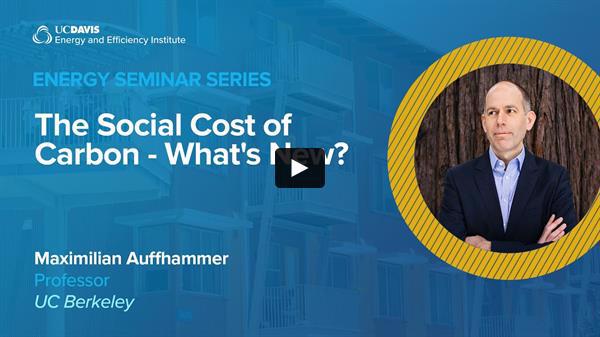
In this talk, environmental economist and IPCC lead author Professor Maximilian Auffhammer—the Avice M. Saint Chair at UC Berkeley—explains the interdisciplinary calculation and regulatory use of the social cost of carbon. He details the most recent scientific advancements in the field and addresses key open questions that remain. Professor Auffhammer’s distinguished research at the intersection of climate economics and applied econometrics is complemented by his extensive university leadership, numerous teaching and mentoring awards, and co-founding of the Berkeley Summer School.
|
|
|---|
|
|
|
While historical and future increases in heatwave frequency, duration and intensity are well documented, no studies have yet examined heatwave changes after anthropogenic greenhouse gas emissions reach net zero. We address this by examining heatwave projections from millennial-scale simulations run with the Australian Earth System Model, ACCESS-ESM1-5. Each simulation branches off the SSP5-8.5 scenario at 5 year intervals between 2030–2060, from which point anthropogenic carbon dioxide emissions are set to net zero. Heatwaves are systematically hotter, longer and more frequent the longer net zero is delayed and reach their highest values when net zero is delayed until 2060. Moreover, most regional trends show no decline over the entire 1000 years of each simulation, indicating that heatwaves do not start to revert to preindustrial conditions.
Some regions even display significantly increasing millennial-scale trends when net zero occurs by 2050 or later. Furthermore, the longer net zero is delayed, the more occurrences of historically rare and extreme heatwave events. This is problematic for low-latitude countries which are also generally more vulnerable, where historically record-breaking events occur once a year or more when net zero is delayed until after the middle of the 21st Century. Should the global effort to permanently reach net zero occur before 2040, future heatwaves will be less severe than in a 2°C warmer world, however if net zero is not reached until 2060, heatwaves will be systematically more severe than this upper threshold of the Paris agreement.
Our research critically challenges the general belief that conditions after net zero will begin to improve for near future generations. While our results are concerning, they provide a novel length of foresight, such that effective and permanent adaptation measures can be planned and implemented while the world is still on the imperative path to permanent net zero.
|
Keywords and meta-markers: heatwaves; net zero; climate change; foresight
Source:
Perkins-Kirkpatrick, S., et al. (2025).
Heatwaves in a Net Zero World. Environmental Research, 4, 045015.
doi.org/10.1088/2752-5295/ae0ea4
.
|
|
|
|---|
|
|
That the environment has become a major political issue is uncontested even by most resolute denialists of climate change or its anthropic causes. Moreover, decades of debates and interventions have not produced much, at least if we consider the situation about climate change and other alterations to the processes that, since the inception of the Holocene about 10000 years ago, have reportedly ensured a ‘safe operating space’ for humanity. This alone suggests the need for a thorough critique of environmental politics carried out thus far.
A critical outlook is committed to questioning the backdrop against which, or the framework whereby, problems are identified and solutions devised, and in so doing being attentive to the origin and contestation of institutional arrangements, power differentials, agency distribution, knowledge and authority claims, reality definitions, interest and identity attributions, and the transformative potential of alternative approaches and social struggles. It is therefore sensitive to historical change.
Leaving aside for the moment who the subject of emancipation is, being critical thus entails both doing good research (increase of knowledge) and making that research instrumental to tackling domination. This goal reminds the Enlightenment principle of human progress, a famous description of which comes from Kant. For him, enlightenment is the task for humanity to emerge from immaturity, which depends on a lack of courage to use one’s reason, intellect, and wisdom without the guidance of someone else. His famous motto is
Sapere aude! (Dare to be wise!) – a call for the use of reason to emancipate themselves addressed to each and every human being. This involves also, and perhaps primarily, being alert to the dominative assumptions and outcomes hidden within our own intellectual posture.
|
Keywords and meta-markers: climate justice; political ecology; critical theory; green economy; environmental politics; immanent critique
Source:
Pellizoni, L., Leonardi, L., & Asara, V. (2022).
Introduction: What Is Critical Environmental Politics? In: Handbook of Critical Environmental Politics (pp. 1–21). Edward Elgar Publishing.
doi.org/10.4337/9781839100673.00005
.
|
|
|
|---|
|
|
The second Trump administration has disrupted global climate politics, turning the United States away from the clean energy and environmental policies of the Biden administration. Consequently, analytical attention is turning, inside and outside of the United States, to a family of concepts referred to as “Climate Realism” (CR), which favors long-run investments in technology and adaptation over near-term climate mitigation efforts.
We critically engage with CR and argue that political science identifies four key features of climate politics that shed light on CR’s strengths and weaknesses, and which will persist even in the second Trump era. Despite CR’s flaws, we contend that its emergence in reaction to the second Trump administration highlights some important dimensions of climate politics that deserve greater attention going forward. We highlight three topics for research: the political and practical strategies of the anti-green coalition; the heterogeneity in viable national economic strategies; and the implications for IR of a turn away from meaningful climate mitigation in powerful nations.
|
Keywords and meta-markers: climate change; International Relations theory; Trump presidency; international cooperation; United States; environmental politics; China
Source:
Colgan, J., & Genovese, F. (2025).
Global Climate Politics after the Return of President Trump. International Organization, 79(S1), S88–S102.
doi:10.1017/S002081832510115X
.
|
|
|
|---|
|
|
This article revisits the climate-conflict-displacement nexus by analyzing the Syrian Civil War as a case of climate-exacerbated state collapse. Rejecting linear causality, it asks: how does climate-induced stress contribute to armed conflict and forced migration, and how might these dynamics be understood through ecocide? Drawing on international relations, legal studies, and environmental studies, we develop a framework positioning environmental refugeedom and ecocide as concepts revealing international legal categories’ insufficiencies.
Examining Syria, we show how drought, environmental mismanagement, and authoritarian governance intensified grievances, fueling conflict and mass displacement. Rather than presenting climate change as a singular cause, we argue for its role as a threat multiplier within authoritarian rule, developmental failure, and global inequality structures. The article contributes by proposing expanded conceptual vocabulary to capture environmental collapse’s political violence. It calls for rethinking state responsibility, legal protection frameworks, and human rights paradigms under planetary crisis—especially in authoritarian regimes facing ecological breakdown..
|
Keywords and meta-markers: ecocide; environmental refugees; authoritarianism; climate change; forced displacement
Source:
López Bremme, M., & Regilme, S. S. (2025).
Climate Change, Ecocide, and the Rise of Environmental Refugees: The Case of Syria. Political Studies, 0(0).
https://doi.org/10.1177/00323217251382404
.
|
|
|
|---|
|
|
This paper examines the ideological and strategic links between Cold War-era authoritarian neoliberalism and contemporary climate obstructionism, arguing that the criminalization of dissent has shifted from anti-communism to anti-environmentalism. Through a genealogical and contextual analysis of think tank networks – particularly the Mont Pèlerin Society (MPS) and the Atlas Network (AN) – grounded in key texts and proceedings published by them or their affiliated institutions, I show how neoliberal thought has long been entangled with fossil capital, militarized epistemologies, and reactionary politics.
The study reveals how neoliberal politics, despite its rhetoric of freedom, relies on illiberal measures to enforce market fundamentalism, from Pinochet’s Chile to the rise of figures like Milei and Bolsonaro. By tracing the theological, military, and epistemic dimensions of this dispositif, I analyze neoliberalism’s authoritarian dimensions, showing how climate change denial and the repression of environmental activism serve as modern iterations of Cold War-era ideological hunts. The Southern Cone emerges as a critical site where this continuum is tested, showing the alliance between neoliberalism and authoritarian governance.
|
Keywords and meta-markers:
anti-environmentalism; think tanks; authoritarian liberalism; neoliberal subject
Source:
Vaillancourt, T. (2025).
From Cold War Repression to Think Tank Communication: The Evolution of Neoliberal Authoritarianism and the Criminalization of Climate Activism. Environmental Communication, 1–16.
doi.org/10.1080/17524032.2025.2560396
.
|
|
|
|---|
|
|
This synthesis article conceptualizes transformative climate actions (TCAs) by reviewing social-science-based climate and transformation research, with a particular focus on (Western) sufficiency literature. It identifies six key characteristics of TCAs.
First, they aim to transform social practices and provisioning systems to reshape society-nature relations, requiring a ‘whole-of-government’ approach and state capacity building for cross-sectoral coordination. Second, TCAs prioritize sufficiency, using efficiency and substitution as supporting strategies rather than parallel goals. Third, they empower collective agency, shifting the focus from individual behaviour changes to societal structures. Fourth, they presuppose a shift toward a multi-level planning framework that moves beyond market-based governance, integrating top-down steering with bottom-up, reflexive deliberation and experimentation. Fifth, TCAs recognize the distributional character of ecological crises, ensuring universal access to essential provisioning while curbing excess production and consumption through eco-social policy portfolios.
Finally, they rely on broad alliances of diverse actors, grounded in everyday interests, with empowered multi-stakeholder platforms to challenge entrenched interests. In developing these six characteristics, the article bridges conceptual debates with real-world policymaking, highlighting key climate policy challenges while demonstrating how integrating these characteristics can drive deep societal transformations and support policymakers in designing holistic strategies for effective climate action
|
Keywords and meta-markers: sufficiency; transformation; climate action; climate policy; mobility; critical realism
Source:
Bärnthaler, R., Barlow, N., Novy, A., & Aigner, E. (2025).
Conceptualizing Transformative Climate Action: Insights from Sufficiency Research. Climate Policy, 1–20.
doi.org/10.1080/14693062.2025.2494782
.
|
|
|
|---|
|
|
|
|
|
In this episode of the
Upstream podcast, European economist Timothée Parrique joins hosts Della Duncan and Robert Raymond for a wide-ranging conversation on degrowth. The discussion begins by defining the concept, tracing its history, and unpacking what degrowth is—and what it is not. The hosts and guest explore degrowth’s twofold agenda: scaling down production and consumption for ecological reasons, and reducing the centrality of the profit motive in how we organize society.
|
|
|---|
|
|
The episode also examines the distinctions between degrowth and recession, the limitations of GDP as a measure of societal success, how degrowth can help reduce poverty in certain contexts, the benefits of a dynamic steady-state economy, the current state of the degrowth movement, and much more.
Timothée Parrique is an economist from Versailles, France, and a researcher at HEC Lausanne—the Faculty of Business and Economics at the University of Lausanne in Switzerland. He works on macro-ecological planning as part of the STRIVE research project and is the author of
Slow Down or Die: The Economics of Degrowth.
[Play the episode]
|
|
|---|
|
|
IThis paper deals with progress and evolution. Regarding progress, it in particular critically engages with recent works (Wagner, Allen, Jaeggi), arguing that we need a more assertive perspective. Our immersion in an evolutionarily and contingently created but globally established (modern) imaginary is found to underpin that more assertive perspective of progress.
To articulate its perspective more generally, the paper draws upon a former elaboration on evolutionary homology and homoplasy regarding power. Thereby it tackles the development of morals/ethics, leading to a discussion of progress – and regression – including but going beyond material and cognitive issues. It grapples with evolutionary theory (introducing ‘homoplasy’ and ‘convergence’) and discontinuist views of history, as well as modernity, also glancing at some post/decolonial perspectives regarding history (Chakrabarty, Dussel). Finally, the text introduces the concepts of
retrospective teleology and of
prospective teleology in order to frame how these issues are, or may be, dealt with within the imaginary of contemporary modernity, in which universalized equal freedom – and universal solidarity – appear as a criterion for progress.
|
Keywords and meta-markers: progress; regression; evolution; universality; modernity
Source:
Domingues, J. M. (2025).
Progress and Regression, Modernity and Social Evolution. Emancipations, 4(2), 1.
doi.org/10.55533/2765-8414.1127
.
|
|
|
|---|
|
|
This article critically reflects on the research portfolio by the ecological economist Clive Spash who has helped pinpoint specific and systemic blindspots in a political-economic system that prioritises myopic development trajectories divorced from ecological reality. Drawing on his published work and collaborations it seeks to make sense of the slow, or absent, progress in averting global warming and ecological destruction. Three strands of key concern and influence are identified and discussed with reference to their orientation and explicit expression regarding Ontology, Epistemology and Axiology. Some complementary points about indeterminacy and holism are presented to further strengthen the arguments for a transition towards a social-ecological economic system that puts values and principles back into focus.
While Clive Spash’s work has made a strong case within the economic community and appealing to ecology professionals, the value-myopia or value-vacuum has to be tackled across all disciplines, politics and society for a meaningful and urgently required transformation in decision making. Hence, the article finishes with some suggestions for the (higher) education system, and highlights the importance of simplicity and sufficiency, as well as strong sustainability-driven citizen and community action as necessary catalysts of change in this social-ecological transformation.
|
Keywords and meta-markers: social-ecological transformation; critical realism; ontology; epistemology; axiology; values; indeterminacy; sufficiency
Source:
Carter, C. E. (2024).
Reconnecting with the Social-Political and Ecological-Economic Reality. Environmental Values, 33(2), 103-121.
doi.org/10.1177/09632719241231418
.
|
|
|
|---|
|
|
Evolutionary science has led to many practical applications of genetic evolution but few practical uses of cultural evolution. This is because the entire study of evolution was gene centric for most of the 20th century, relegating the study and application of human cultural change to other disciplines. The formal study of human cultural evolution began in the 1970s and has matured to the point of deriving practical applications.
In this article, we will first review major developments in our basic understanding of human cultural evolution. Then, we will show how they can be applied to a diversity of positive change efforts, no matter what the scale (e.g., from the individual person to global governance) or topic domain. We elaborate for the topics of complex systems science and engineering, economics and business, mental health and well-being, and global change efforts.
.
|
Keywords and meta-markers: cultural evolution; multilevel selection; systems engineering; economics; mental health
Source:
Wilson, D. S., et al. (2023).
Multilevel Cultural Evolution: From New Theory to Practical Applications. Proceedings of the National Academy of Sciences, 120(16), e2218222120.
doi.org/10.1073/pnas.2218222120
.
|
|
|
|---|
|
|
In the Anthropocene, debates about global climate risks have taken carbon as a measure of policy success, with land-based mitigation strategies like afforestation receiving particular scrutiny. While scientists and policymakers discuss forestry as a potential climate solution, China has been implementing massive forestry projects for decades, drastically transforming environments under the Ecological Civilization framework.
This article showcases China’s globally emerging paradigm of Eco-Civilization and its implications for the climate-forestry nexus. Drawing parallels with Ulrich Beck’s concept of ‘metamorphosis’ and Bruno Latour’s concept of ‘mutation,’ we argue that China’s Eco-Civilization aspires to a fundamental transformation in worldview – but one that is promoted as distinctly non-Western. We use the case of forestry to illuminate the potentially unique features of Chinese environmentalism as encapsulated in Eco-Civilization. We find that Eco-Civilization affords a strong role for the central state in actively
building and
constructing an ecological future in which the natural and the socio-political are not considered separate. This is in contrast to certain Western visions of preserving nature from human encroachment through grassroots environmental movements. We conclude by highlighting the theoretical contributions more pluralized debates about China’s environmental rise could bring to environmental sociology.
|
Keywords and meta-markers: ecological civilization; climate change; metamorphosis; forestry; ecological compensations; risk society; China
Source:
Weins, N. W., et al. (2023).
Ecological Civilization in the Making: The ‘Construction’ of China’s Climate-Forestry Nexus. Environmental Sociology, 9(1), 6–19.
doi.org/10.1080/23251042.2022.2124623
.
|
|
|
|---|
|
|
Social-ecological systems research aims to understand the nature of social-ecological phenomena, to find ways to foster or manage conditions under which desired phenomena occur or to reduce the negative consequences of undesirable phenomena. Such challenges are often addressed using dynamical systems models (DSM) or agent-based models (ABM).
Here we develop an iterative procedure for combining DSM and ABM to leverage their strengths and gain insights that surpass insights obtained by each approach separately. The procedure uses results of an ABM as inputs for a DSM development. In the following steps, results of the DSM analyses guide future analysis of the ABM and vice versa. This dialogue, more than having a tight connection between the models, enables pushing the research frontier, expanding the set of research questions and insights. We illustrate our method with the example of poverty traps and innovation in agricultural systems, but our conclusions are general and can be applied to other DSM-ABM combinations.
|
Keywords and meta-markers: dynamical systems model; agent-based model; complexity; heterogeneity; asymptotic dynamics; transient dynamics
Source:
Radosavljevic, S., Sanga, U., & Schlüter, M. (2024).
Navigating Simplicity and Complexity of Social-Ecological Systems Through a Dialogue between Dynamical Systems and Agent-Based Models. Ecological Modelling, 495, 110788.
doi.org/10.1016/j.ecolmodel.2024.110788
|
|
|
|---|
|
|
Greenwashing is on the rise as a strategy for maintaining business-as-usual through false ecological claims. This paper articulates an approach to the study of greenwashing guided by the philosophy of critical realism. In its first move, it identifies greenwashing as depending on the possibility of socially conflating the relation between transitive and intransitive objects of knowledge.
The paper discusses theories of truth suitable for detecting mismatches between ecological claims and performances, with particular attention to correspondence theory and alethic truth. It then provides an illustrative reading of the oil corporation Preem’s greenwashing campaign through critical realism’s ‘holy trinity’ and explores ‘ideology’ and ‘fetishism’ as concepts for judging falsehoods and theorizing greenwashing. The paper ends with a step-by-step guide to the critical realist study of greenwashing and its emancipatory absence.
|
Keywords and meta-markers: greenwashing; critical realism; judgmental rationality; fetishism; transitive and intransitive; differentiation-in-unity
Source:
Roos, A. (2025).
Greenwashing: A Critical Realist Approach to the Study of False Ecological Claims. Journal of Critical Realism, 24(2), 176–197.
doi.org/10.1080/14767430.2025.2503634
.
|
|
|
|---|
|
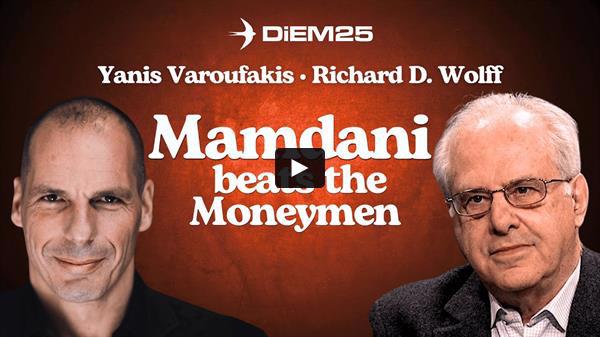
What does Zohran Mamdani’s breakthrough victory in New York signal for the Left — not only in the United States but across a world trapped between oligarchy, neoliberal decay, neofascist surges and rising authoritarianism?
Join Yanis Varoufakis and Richard D. Wolff as they unpack the political earthquake shaking America’s political establishment, and what it means for progressives worldwide.
|
|
|---|
|
|
|
Global capitalism is undergoing multiple crises and rapid transformation – though, it’s not quite clear into what. Research in IPE and related disciplines has captured important patterns of contemporary restructuring through analyses of (among other things): processes of financialization, assetization, rentierization, and platformization; the re-organization of global value chains; and new and old forms of extractivism. Yet these analyses have often been pitched in terms that overlook, and at times outright dismiss, the continuing relevance of labor.
The article argues for wider engagement with Marxist debates about ‘exploitation' as a way of grasping the continued importance of labor and work amidst the turbulent transformations of contemporary global capitalism. Engaging the problematic exploitation from this perspective demands enquiry into the concrete forms of relational activity through which value is created, circulated and accumulated. Or, in short, it enjoins us to ask: How does some people's activity become other people's wealth? The article moves on to argue that a plural and dynamic view of exploitation is needed in order to adequately grasp how these dynamics operate in past and present capitalism. It closes by considering questions around how the dynamics of exploitation are stabilized and reproduced through processes of racialization and practices of statecraft.
|
Keywords and meta-markers: exploitation; value; Marxism; race; governance; state
Source:
Bernards, N. (2025).
Centering Exploitation in Global Political Economy. New Political Economy, 1–17.
doi.org/10.1080/13563467.2025.2531013
.
|
|
|
|---|
|
|
This paper critically examines the emerging discourse on technofeudalism. While mainstream narratives celebrate technological advancement driven by American tech giants, proponents of the technofeudalism thesis argue that a new ruling class – ‘cloudalists’ – has supplanted traditional capitalists, extracting data and rent in ways reminiscent of feudal relations. However, this discourse fails to account for the ongoing dynamism of capitalist investment and competition. In contrast, this paper advances the concept of rentier capitalism by revisiting Marx’s analysis in Capital, with particular attention to his often-overlooked theory of ground rent in Volume III.
Drawing on Marx’s notebooks published for the first time in the Marx-Engels-Gesamtausgabe (MEGA), the paper argues that rentier capitalism constitutes the most advanced and contradictory form of contemporary capitalism, which accelerates the destruction of the common and undermines the conditions necessary for working-class solidarity. As the dual crisis of capital accumulation and anti-systemic movements intensifies socio-economic and political instability, the threat of an authoritarian turn towards technofascism becomes increasingly imminent.
|
Keywords and meta-markers: rent; digital platform; technofeudalism; monopoly
Source:
Saito, K., & Sasaki, R. (2025).
Rentier Сapitalism, Technofascism and the Destruction of the Сommon. Area Development and Policy, 1–15.
doi.org/10.1080/23792949.2025.2557911
.
.
|
|
|
|---|
|
|
The article delves into Friedrich Hayek’s theory of cultural evolution as a framework for understanding his “restatement” of liberalism. Beginning in the 1950s, Hayek increasingly embraced a naturalistic perspective, leading to a conceptualization of the market in evolutionary terms. His definition of the market sharply contrasts with the one proper to laissez-faire liberalism of the nineteenth century. Unlike classical liberalism, Hayek claims that the market is “unnatural,” as it has culturally evolved in opposition to innate human traits.
The article argues that Hayek’s concept of “evolutionary rationalism” establishes a new political rationality aimed at cultivating conditions that promote the flourishing of the market order and protect it from innate human instincts. According to this political rationality, the cultural reproduction of the market order maximizes the evolutionary “progress” of the human species and must be upheld to prevent the purported decline of modern civilization attributed to political rationalities based on “primitive” behavioral traits such as “solidarity” and the pursuit of “common goals.”
|
Keywords and meta-markers: Hayek; neoliberalism; cultural evolution; political rationality; Foucault
Source:
Piasentier, M. (2025).
Politics of Evolution: Hayek’s Naturalization of Neoliberalism. Political Theory, 53(5), 657–683.
doi.org/10.1177/00905917251367668
.
|
|
|
|---|
|
|
This article presents an analytical framework that explains how militarism emerged as the prevailing paradigm in narcotic governance and its implications for human rights. The framework comprises four interconnected mechanisms—dehumanization, moralistic justifications, intensified state coercion, and a culture of impunity—that uphold and legitimize militarized drug policies.
Dehumanization portrays populations as expendable threats, while moralistic narratives depict repression as necessary for maintaining public order and security. These processes enable intensified state coercion, evident in militarized policing, mass incarceration, and extrajudicial violence, while a culture of impunity protects perpetrators from accountability, consequently perpetuating cycles of state violence. This framework contributes to scholarship in international relations, security studies, and political sociology by demonstrating how states and other transnational as well as domestic actors institutionalize expanded and intensified violence in narcotic drug governance.
|
Keywords and meta-markers: war on drugs; militarism; dehumanization; impunity; policing; human rights; political sociology
Source:
Regilme, S. S. (2025).
The Global War on Drugs: Militarism and Its Human Rights Consequences. Critical Sociology, 0(0).
doi.org/10.1177/08969205251364102
.
|
|
|
|---|
|
|
Despite extraordinary scientific and medical resources, the US health-care system underperforms. In this Review we consider the damage wrought by decades of market-based policies that have stimulated profit-seeking by insurers and health-care providers. Policy makers have subcontracted coverage under the public Medicaid and Medicare programmes for people with low incomes and those older than 64 years to private insurance firms—which now derive most of their revenues from those programmes—raising taxpayers’ costs and constricting patients’ care. Despite worrisome evidence of misbehaviour, firms obligated to prioritise shareholders’ interests—and, more recently, private equity firms with a single-minded focus on short-term profit—have gained control of vital clinical resources.
President Biden rescinded some of Donald Trump's most egregious first-term policies, expanded coverage for lower-income Americans, and initiated modest drug price controls. Since regaining office, President Trump has laid siege to science and public health, cut US$990 billion from Medicaid to offset tax reductions for the wealthy, and is accelerating Medicare's privatisation. State governments can tighten regulation of profit-driven abuses, and the medical community should resist Trump's health-harming agenda. But neither restoring the pre-Trump status quo, nor further attempts to reconcile the human rights of patients with the property claims of investors will suffice. Reforms must, instead, decommercialise insurance and care provision.
|
Keywords and meta-markers: public funding of private profit; for-profit healthcare; private equity in healthcare; healthcare privatization; healthcare costs; insurance consolidation; healthcare quality decline; healthcare policy reform; decommercialization of healthcare
Source:
Gaffney, A., Woolhandler, S., Himmelstein, D. U., & McCormick, D. (2025).
Health Care in the USA: Money Has Become the Mission. The Lancet.
doi.org/10.1016/S0140-6736(25)01669-1
.
|
|
|
|---|
|
|
 |
In this highly insightful episode on U.S. tax politics and policy, host Chuck Mertz interviews Ray D. Madoff—legal scholar at Boston College Law School and cofounder/director of the Boston College Forum on Philanthropy and the Public Good. Madoff is the author of
Immortality and the Law: The Rising Power of the American Dead and lead author of
The Practical Guide to Estate Planning. Her writing has appeared in
The New York Times,
The Wall Street Journal,
The Washington Post, and
The New York Review of Books, among other outlets.
The conversation centers on Madoff’s new book from the University of Chicago Press,
The Second Estate: How the Tax Code Made an American Aristocracy. In it, she offers an unprecedented look into the workings of America’s byzantine system of taxation—revealing not only how it consolidates wealth but also how it has helped create two fundamentally separate societies: the working Americans who pay and the ultra-rich who benefit.
Madoff shows that the US system itself has, over time, been stripped and reconstituted such that it now offers a series of secret paths, hidden in plain sight, for wealthy people in the know to avoid taxation altogether. Through the strategic avoidance of traditional income, leveraging of investments and debt, and exploitation of rules designed to promote charitable giving, America’s wealthy do more than just pay less than their share; they remove themselves from the tax system entirely. Wealth becomes its own sovereign state, and the living is surprisingly—and maddeningly—cheap.
|
|
|---|
|
|
The richest Americans control $46 trillion in wealth—but many pay little or no federal tax.
Madoff explains how a century of tax policy created two Americas: one that pays taxes and one that doesn’t. Drawing on her new book, Madoff reveals how the wealthy use legal tools—inheritance loopholes, trusts, and philanthropy—to avoid taxation altogether. She shows how “charitable giving” often benefits billionaires more than the public, and how our tax code has quietly built an American aristocracy.
Madoff calls for a new vision of stewardship—where wealth is once again tied to responsibility, and the public good comes before private dynasties.
|
|
|---|
|
|
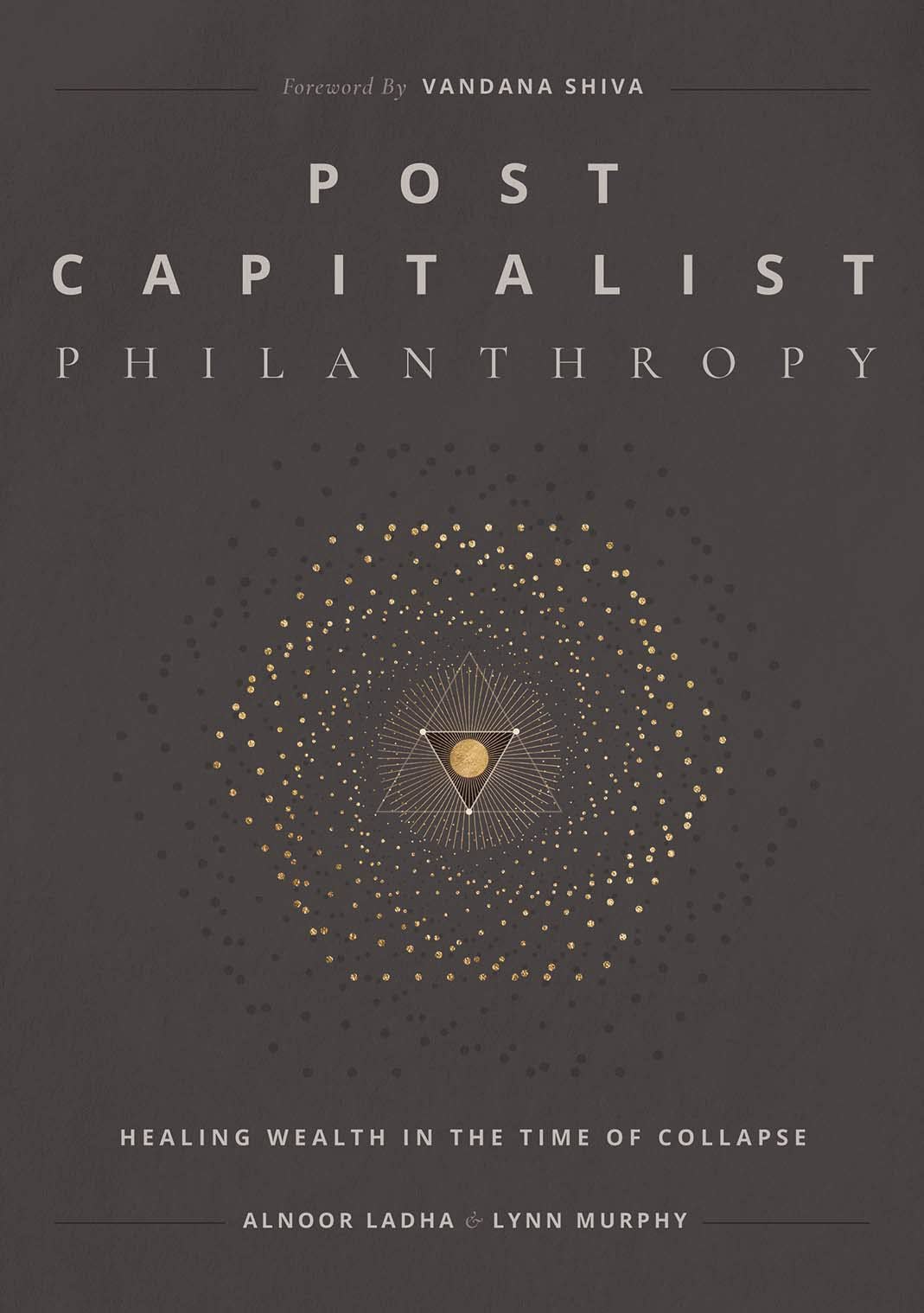
Long-time activist Alnoor Ladha and former foundation program officer Lynn Murphy explain why so many philanthropies aren’t really interested in system change. In their book
Post Capitalist Philanthropy, they explain how large foundations are more intent on reproducing capitalist modernity and its norms than in moving beyond the growth economy. The real challenge for philanthrophy, say Ladha and Murphy, is to help the world move to a post-capitalist economy and culture that overcomes the cultural traumas of Western conquest and coloniality.
|
|
|---|
|
|
|
All of us have been wrong about things from time to time. But sometimes it was a simple, forgivable mistake, while other times we really should have been correct. Properties that systematically prevent us from being correct, and for which we can legitimately be blamed, are “intellectual vices.” Examples might include closed-mindedness, wishful thinking, overconfidence, selective attention, and so on. Quassim Cassam is a philosopher who studies knowledge in various forms, and who has recently written a book
Vices of the Mind: From the Intellectual to the Political. We talk about the nature of intellectual vices, how they manifest in people and in organizations, and what we can possibly do to correct them in ourselves.
Quassim Cassam received his Ph.D. in philosophy from Oxford University. He is currently Professor of Philosophy at the University of Warwick. He previously held faculty positions at Cambridge University and University College London. He has served as the president of the Aristotelian Society, and was awarded a Leadership Fellowship by the Arts and Humanities Research Council in the UK.
|
 |
|
|---|
|
|
|
The term
disinformation is generally used to refer to information that is false and harmful, by contrast with
misinformation (false but harmless) and
malinformation (harmful but true); disinformation is also generally understood to involve
coordination and to be
intentionally false and/or harmful. However, particular studies rarely apply all these criteria when discussing cases. Doing so would involve applying at least three distinct problem framings: an epistemic framing to detect that a proposition in circulation is false, a behavioural framing to detect the coordinated efforts at communicating that proposition, and a security framing to identify threats or risks of harm attendant on widespread belief in the proposition. As for the question of intentionality, different kinds of clues can be picked up within each framing, although none alone is likely to be conclusive. Yet particular studies tend to centre on or prioritise a single framing.
Many today aim to make policy recommendations about
combatting disinformation, and they prioritise security concerns over the demands of epistemic diligence. This carries a real risk of disinformation research being ‘weaponised’ against inconvenient truths. Against combative approaches, this article argues for a critical approach which recognizes the importance of epistemic diligence and transparency about normative assumptions.
|
Keywords and meta-markers: disinformation; misinformation; malinformation; epistemic diligence
Source:
Hayward, T. (2024).
The Problem of Disinformation: A Critical Approach. Social Epistemology, 39(1), 1–23.
doi.org/10.1080/02691728.2024.2346127
.
|
|
|
|---|
|
|
Widening polarization about political, religious, and scientific issues threatens open societies, leading to entrenchment of beliefs, reduced mutual understanding, and a pervasive negativity surrounding the very idea of consensus. Such radicalization has been linked to systematic differences in the certainty with which people adhere to particular beliefs. However, the drivers of unjustified certainty in radicals are rarely considered from the perspective of models of metacognition, and it remains unknown whether radicals show alterations in confidence bias (a tendency to publicly espouse higher confidence), metacognitive sensitivity (insight into the correctness of one’s beliefs), or both.
Within two independent general population samples (n = 381 and n = 417), here we show that individuals holding radical beliefs (as measured by questionnaires about political attitudes) display a specific impairment in metacognitive sensitivity about low-level perceptual discrimination judgments. Specifically, more radical participants displayed less insight into the correctness of their choices and reduced updating of their confidence when presented with post-decision evidence. Our use of a simple perceptual decision task enables us to rule out effects of previous knowledge, task performance, and motivational factors underpinning differences in metacognition. Instead, our findings highlight a generic resistance to recognizing and revising incorrect beliefs as a potential driver of radicalization.
|
Keywords and meta-markers: metacognition; radicalism; change of mind; confidence; post-decision evidence; politics; cognitive flexibility
Source:
Rollwage, M., Dolan, R. J., & Fleming, S. M. (2018).
Metacognitive Failure as a Feature of Those Holding Radical Beliefs. Current Biology, 28(24), 4014-4021.
doi.org/10.1016/j.cub.2018.10.053
.
|
|
|
|---|
|
|
Rather than seeking to recuperate the ideal of a digital public sphere or lament its demise with the rise of social media platforms, in this paper I seek to identify the dangers of precisely this insistence to imagine the Internet as a public sphere. It is this curious insistence and persistence that, I claim, may feed into precisely those post-truth media dynamics such critical accounts worry about and rally against.
The success of viral conspiracy narratives like Pizzagate and QAnon, as well as other forms of mis- and disinformation, hinges not (only) on the absence or distortion of a healthy democratic public sphere, as is typically assumed, but (also) on its persistence as an imaginary in an environment that obeys an altogether different set of logics, namely that of ‘communicative capitalism’ and ‘information warfare.’ Whereas the former has drawn most critical attention in connection to current post-truth dynamics (e.g., the effects of targeted advertising and the role of algorithms in creating polarizing echo chambers and filter bubbles), I will instead focus on the latter.
The unique problem and ‘cunning’ of what I refer to as ‘post-truth conspiracism’ is that it draws on idea(l)s of digital publicness to establish its own epistemic legitimacy, as well as derive its unique powers of persuasion, while also mobilizing the full tactical arsenal of information warfare in a global attention economy. The resulting weaponization of digital public sphere imaginaries complicates attempts to recuperate the idea(l) of a digital public sphere as a solution to a ‘polluted’ information environment.
|
Keywords and meta-markers: public sphere; publics; post-truth; information warfare; weaponization; QAnon; conspiracy theory; Pizzagate
Source:
de Zeeuw, D, (2024).
Post-Truth Conspiracism and the Pseudo-Public Sphere. Frontiers in Communication, 9, 1384363.
doi.org/10.3389/fcomm.2024.1384363
.
|
|
|
|---|
|
|
The Financial Times called the Alliance for Responsible Citizenship’s 2025 conference the ‘right-wing Davos’. The Alliance involves academics from elite universities, current and former members of government from the UK, Australia, Hungary, and the USA, global media personalities, international capital investors, and CEOs of major companies. Superficially, it appears to represent a motley association of self-described Classical Liberals, evangelists of free-market capitalism, ethnonationalists, atheists and conservative theologians. We need a better understanding of what unites this power elite because through its interventions it is seeking to radically change societies. The dataset is all the publicly available keynote speeches (32) given at ARC 2025. The method is the Discourse-Historical Approach.
The analysis reveals a community unified by its opposition to a common enemy that the conference claims is destroying ‘Western Civilisation’ from within. By drawing on its bespoke history and a series of discursive strategies, ARC 2025 becomes a theatre of self-affirming ideological recursion that, despite each speaker’s different origins, converges on an ideology that morally justifies its members’ investments in fossil fuels, their social status, and right to intervene in society. Consequently, ARC’s regressive neoliberalism erases the boundaries between Christian nationalism, neoliberalism, and the far-right.
|
Keywords and meta-markers: elite; ideology; conspiracy theories; critical discourse analysis; net-zero; classical liberalism; neoliberalism; far-right; conservativism; religious nationalism; regressive neoliberalism
Source:
Davies, H. C. (2025).
‘A Great Awakening of Men of Action’: What Does the ‘Right-Wing Davos’ Represent? Discourse & Society, 0(0).
doi.org/10.1177/09579265251368397
.
|
|
|
|---|
|
|
This paper suggests that the conservative-populist backlash that liberal democracies are facing can be understood as part of heterodox protest movements which react to the liberal-legal hegemony, and, in alliance with populist movements and parties, move into the political centre. Here, I understand the illiberal, or better anti-liberal, reaction to liberal democracy, constitutionalism, and human rights as the result of a long-term mobilization of different counterforces around a dissensus on liberal democracy and its main constitutional and legal approach and mindset. In recent years, an initially rather marginal or peripheral, but now forceful, set of protest and protest movements has been able to move to the political centre, attacking the liberal-constitutional hegemony head on.
The paper will discuss the heterodox critique of the liberal-legal consensus, subsequently identifying five key components (including the sacred and the profane, leadership, intolerance, impure universalism, and a turn to the past), particularly derived from Eisenstadt’s analysis of sectarian and heterodox movements. In the second part, I will apply these components to, first, a discussion of intellectual, theoretical justifications for the conservative-heterodox project, to then turn to more practically oriented documents, using a similar analysis of the five components. I conclude by arguing that the heterodox project contains a strong totalizing dimension, by combining a range of positions of charismatization, closure, and fundamentalism, and which prioritizes the primordial and the sacred, to the detriment of the civic.
|
Keywords and meta-markers: backlash; conservatism; heterodox protest; liberal consensus; uncivil society
Source:
Blokker, P. (2025).
Heterodox Protest, the Conservative Right, and the Law. Hague Journal on the Rule of Law.
doi.org/10.1007/s40803-025-00265-4
.
|
|
|
|---|
|
|
The terms left and right are essential poles in the context of political ideology. Their meanings and understandings vary across contexts, affecting political communication, discourse, representation and polarisation dynamics. We know less about how different meanings and understandings manifest themselves beyond differential usage of the left-right scale. Building on this research gap, I measure how associations with left and right systematically vary across different political positions.
I present a novel theoretical two-dimensional model distinguishing between left- and right-leaning individuals and their associations with left and right. In doing so, I propose ‘in-ideology’ (alignment with one’s political leanings) and ‘out-ideology’ (opposition to one’s leanings) as a theoretical foundation to understand diverging associations. Using data from German GLES candidate studies (2013, 2017, 2021), I introduce a methodological framework that maps left-right word associations from open-ended survey responses into a semantic space, combining these with political positions to reflect the in- and out-ideology dichotomy.
The findings reveal substantive differences based on left-right positions, manifested in associations with—for example, justice (left) and patriotism (right)—and negative connotations for out-ideology—for example, racism (right) and socialism (left). The model’s applicability is demonstrated in scaling parliamentary speeches and is reliable across different model specifications in terms of construct and external validity. The study advances the understanding of ideological associations and their role in political research by highlighting the importance of distinguishing between in- and out-ideology in explaining ideological language across the political spectrum.
|
Keywords and meta-markers: ideological associations; left-right semantics; political polarization; word embeddings; political elites; framing; affective polarization
Source:
Warode, L. (2025).
Mapping Left-Right Associations: A Framework Using Open-Ended Survey Responses and Political Positions. Humanities and Social Sciences Communications, 12, 1318.
doi.org/10.1057/s41599-025-05679-x
.
|
|
|
|---|
|
|
Every social situation that people encounter in their daily lives comes with a set of unwritten rules about what behavior is considered appropriate or inappropriate. These everyday norms can vary across societies: some societies may have more permissive norms in general or for certain behaviors, or for certain behaviors in specific situations. In a preregistered survey of 25,422 participants across 90 societies, we map societal differences in 150 everyday norms and show that they can be explained by how societies prioritize individualizing moral foundations such as care and liberty versus binding moral foundations such as purity. Specifically, societies with more individualistic morality tend to have more permissive norms in general (greater liberty) and especially for behaviors deemed vulgar (less purity), but they exhibit less permissive norms for behaviors perceived to have negative consequences in specific situations (greater care).
By comparing our data with available data collected twenty years ago, we find a global pattern of change toward more permissive norms overall but less permissive norms for the most vulgar and inconsiderate behaviors. This study explains how social norms vary across behaviors, situations, societies, and time.
|
Keywords and meta-markers: social norms; cross-cultural comparison; individualistic morality; Moral Foundations Theory (MFT); norm permissiveness; everyday behavior; cultural values; norm change over time; situational appropriateness
Source:
Eriksson, K., et al. (2025).
Everyday Norms Have Become More Permissive Over Time and Vary Across Cultures. Communications Psychology, 3, 145.
doi.org/10.1038/s44271-025-00324-4
.
|
|
|
|---|
|
|
AI Snake Oil: What Artificial Intelligence Can Do, What It Can’t, and How to Tell the Difference
|
|
|---|
|
|
|
Recently, we have been inundated with reports about the revolutions brought about by AI. However, much of our knowledge about these ‘revolutions’ arises from media sensationalism and advertising clamor – from AI hype. Therefore, to understand the societal impacts of AI, we must first grapple with its hype and ask: What truly transpires in the ‘revolutions’ allegedly brought about by AI? What role does hype play in them?
This paper addresses this need by offering a methodological framework for studying AI, a way to scrutinize AI hype while acknowledging its power. I begin by presenting the STATE typology of AI hype that differentiates between five distinct types of hype. I then offer six heuristics to identify and explore AI hype. Lastly, I argue that holistic empirical research can leverage the STATE typology and its heuristics into a robust methodological design for scrutinizing AI-driven phenomena and their hype.
|
Keywords and meta-markers: AI hype; AI; methodology; critical algorithm studies; algorithm
Source:
Kotliar, D. M. (2025).
Can’t Stop the Hype: Scrutinizing AI’s Realities. Information, Communication & Society, 1–22.
doi.org/10.1080/1369118X.2025.2531165
.
|
|
|
|---|
|
|
This article highlights the role of data imaginaries in shaping narratives about social movement mobilization. Weaving together critical data studies and social movement studies, it examines how activists imagine, negotiate, and resist the politics of datafication, which may further construct collective understandings of political opportunity structures and shape their repertoires of action. Empirically, we analyzed discussions about digital data and surveillance in Hong Kong’s 2019–2020 Anti-Extradition Bill (Anti-ELAB) movement. These discussions took place on LIHKG, a Reddit-like online forum that served as a crucial site for framing and mobilizing the Anti-ELAB movement.
The analysis identified three data imaginaries. The first envisioned CCTV, transaction, biometric, locational, and mobile phone data as everyday omnipresent surveillance infrastructures. Second, participants imagined how police could weaponize their personal data against them, reflecting deep institutional distrust. Third, participants envisioned how smart lamppost sensor and biometric data, and CCTV could be integrated into a trans-border regime of surveillance, rendering data surveillance an object of contention.
Each imaginary articulated a distinctive framing of the threats of datafication and mobilized specific anticipatory tactical responses. Together, they conveyed unease about the present and possible futures of techno-authoritarian control. This study contributes to understanding how activists develop collective visions of data surveillance—data imaginaries—that enable them to identify threats, devise counter-strategies, and foster mobilization within datafied movements.
|
Keywords and meta-markers: data imaginary; social imaginary; connective action; contentious politics; mobilization
Source:
Chan, N. K., et al. (2025).
Contesting Data Power at the Margins: Contentious Data Imaginaries and Social Movement Mobilization. Big Data & Society, 12(4).
doi.org/10.1177/20539517251389866
.
|
|
|
|---|
|
|
With every advent of a new technological phase — whether social media, big data, machine learning algorithms, or generative artificial intelligence (AI) — one fundamental task among many falls to legal scholars and practitioners, adjudicators, and lawmakers to confront: determining what the new technology changes, what it does not, and where and how the differences matter (legally and otherwise). To that end, this talk will address issues such as how algorithmic discrimination differs from “analog” discrimination; how society and our laws should view human labour in a time when so much more of it seems instantly replicable by machines; and the connection between how automated decision-making works and proposed changes to liability frameworks when it comes to AI.
What will become clear through this discussion is one thing that has never changed: technology is about power. Questions of technology thus carry particular weight in contexts built around systemic power imbalances, whether as a matter of workplace relations or human rights law. Drawing on a panoply of work by lawyers, academics, researchers, and grassroots community experts in various interdisciplinary combinations of law, computer science, labour, human rights, science and technology studies, and algorithmic accountability scholarship, this keynote will challenge the audience to reconceptualize AI not as a “neutral tool” or coherent technical object, but as, to quote anthropologist and computer scientist Ali Alkhatib, “an ideological project to shift” power, and consider the consequences of ignoring what that means for our legal and human rights.
|
Keywords and meta-markers: algorithmic decision-making; labor rights; human rights; artificial intelligence; labor and employment law; human rights law; technology law; automated decision-making; critical AI
Source:
Khoo, C. (2025).
Of Data and Dissent: Labor and Human Rights at the Crossroads of the Automation Agenda. SSRN.
dx.doi.org/10.2139/ssrn.5533804
.
|
|
|
|---|
|
|
In the field of ethics of LLMs, agency is a highly contested topic: Can LLMs perform agency? The current discourse on the agency of LLMs is heavily shaped by a traditional, properties-based, individualistic, and anthropocentric approach. In contrast, I propose a relational and network-based approach to agency, drawing on Actor-Network Theory and New Materialism, which is open to non-human agency and a plurality of agencies. Building on this relational, non-anthropocentric perspective, I also introduce a material perspective that has been largely overlooked in the LLM discourse.
While LLMs are often thought of as immaterial, I develop a framework that distinguishes various dimensions of their materiality. I refer both to their material production and conditions, as well as how they concretely materialize in our devices and the materializing effects they have on us and our bodies. This perspective highlights the connection of LLMs with culture and material practices, cultural and social values: they are part of us, our culture, our time, politics, and our society. It also shifts the focus from human users as individual agents and opens up a view of the hidden network of multiple agents – human workers, big tech actors, environmental and technological non-human agents, and more – while drawing attention to the diversity and specificities of agencies. This shift transforms the questions currently posed in the ethics of LLMs and opens up new avenues for ethical inquiry.
|
Keywords and meta-markers: Large Language Models; agency; materiality; relational; network; AI agents
Source:
Puzio, A. (2025).
The Material Agency of a Large Language Model. Digital Society, 4, 73.
doi.org/10.1007/s44206-025-00225-3
.
|
|
|
|---|
|
The Palestine Lab: Exporting Occupation Technology
Gaza has become a testing ground for Israeli and Western weapons and surveillance tools — technologies that, as filmmaker and journalist Antony Loewenstein warns, will inevitably be used to target populations across the globe.
|
|
|---|
|
|
The ongoing destruction in Gaza demands urgent academic and ethical reckoning, exposing the complicity of universities and scholarly disciplines in sustaining settler-colonial violence. This essay interrogates the role of Sociology as a discipline and academic institutions in shaping, legitimising, or resisting systemic oppression, with a focus on institutional neutrality as a mechanism of erasure.
Drawing on critical scholarship on settler colonialism, anti-Palestinian racism and neoliberal academia, the article examines how universities suppress Palestine advocacy through overt repression, bureaucratic silencing and material entanglements with the military-industrial complex. It critiques the discourse of neutrality and balance, demonstrating how these frameworks function to maintain dominant power structures. By tracing the complicity of Western academic institutions – from their partnerships with Israeli military research to their suppression of pro-Palestinian activism – the article argues that meaningful decolonisation requires a rejection of performative neutrality and an active dismantling of structures that sustain occupation and genocide.
|
Keywords and meta-markers: academic complicity; Gaza; genocide; neutrality; settler colonialism; systemic oppression
Source:
Ziadah, R. (2025).
Genocide, Neutrality and the University Sector. The Sociological Review, 73(2), 241–248.
doi.org/10.1177/00380261251321336
.
|
|
|
|---|
|
|
In this paper, we engage with the manifestations of academic solidarity with Palestine, particularly those that have appeared since October 2023. We problematise the prevalence of performative and conditional support that criminalises resistance to the occupation and requires Palestinians to be passive victims. We analyse a three-tiered framework of solidarity in academic spaces: Macro-level institutional repression, Meso-level faculty conditional solidarity which preserves privilege, and Micro-level student-led unconditional solidarity despite high precarity.
Drawing on participatory observations, student activist interviews and systematic databasing of solidarity initiatives, we analyse academic solidarity models and backlash in the United States, United Kingdom and Lebanon. We argue that unconditional solidarity with Palestinian liberation requires a rupture from virtue signaling, which necessitates a greater willingness to take risks and a commitment to the frameworks advanced by Palestinian academics and collectives. We conclude by advocating for an unconditional solidarity model, as defined by Palestinian scholars, that centres liberation, rematriation and return over humanitarianized victimhood.
|
Keywords and meta-markers: Palestine; Gaza; genocide; academic solidarity; unconditional solidarity; performativity
Source:
Badaan, V., & Abu Moghli, M. (2025).
Academic Solidarity in the Time of Genocide. Globalisation, Societies and Education, 1–21.
doi.org/10.1080/14767724.2025.2558989
.
|
|
|
|---|
|
|
This study examines body counting practices of enemy combatants across six critical conflicts: Korea (1950–1953), Vietnam (1955–1975), Iraq (2003–2011), Afghanistan (2001–2014), Israel’s operations in the West Bank and Gaza (from the late 2010’s onward), and the Israel-Gaza war (2023–2025). I argue that body counting repeatedly emerged as a key criterion for assessing military progress once warfare shifted from occupying territory to pursuing other goals, such as attrition, destroying enemy forces, enhancing deterrence, counterinsurgency, and counterterrorism.
Post-World War II military managerialism made this criterion a ready-made method. Such vague and often unwinnable goals coincided with diminished legitimacy for the use of force and for bearing its associated costs. Thus, the legitimation system shifted from legitimating results—the outcomes of military operations—to legitimating means, focusing on how results are produced and emphasizing their direct impact through casualty numbers. Initially, body counting served as a criterion for progress, but over time it assumed additional functions: encouraging killing, reflecting and promoting dehumanization, demonstrating resolve, mitigating casualty sensitivity, and serving as a humanizing mechanism by distinguishing between intentionally killing combatants and protecting non-combatants.
|
Keywords and meta-markers: dehumanization; instrumental rationality legitimation; war managerialism
Source:
Levy, Y. (2025).
The Logic of Body Counting: From Korea to Gaza. Critical Military Studies, 1–25.
doi.org/10.1080/23337486.2025.2583760
.
|
|
|
|---|
|
|
Historian David McNally (author of Slavery and Capitalism: A New Marxist History) joins economist Clara Mattei to uncover how plantation slavery powered global capitalism, why coercion (not “free markets”) is the system’s core, and how exploitation survives today through austerity and war, from the shop floor to Gaza.
We explore:
• Slavery as modern business, the roots of today’s exploitation
• Enslaved people’s stolen labor as the engine of modern wealth
• Why “innovation” means faster extraction of unpaid labor
• Austerity as state-enforced market dependence
• Militarism as permanent demand (and profit)
• Resistance from below, freedom won, not given
This conversation breaks the Lincoln myth, centers enslaved people’s self-emancipation, and asks what real freedom requires now.
|
|
|---|
|
Aaron Benanav, professor and researcher in the Department of Global Development at Cornell University, joins
Future Histories International podcast host Jan Grooß to discuss his “Beyond Capitalism” essay series published in New Left Review.
In the first part of the conversation, Benanav lays the groundwork for his proposal of a
multi-criteria economy; the second part focuses on the institutional design required for its implementation.
Benanav is a historian, sociologist, and economic and social theorist whose research spans topics such as automation and the future of work, unemployment and underemployment, histories of social and economic development, critical theory, and alternative economic systems. His first book,
Automation and the Future of Work, was published by Verso in 2020 and has been translated into ten languages.
|
|
|---|
|
|
|
Democratic theorists often argue that democracy is in crisis, but nonetheless maintain democracy can be revived. In contrast, this paper argues that modernization and democracy have become opposed. Drawing on the work of Michael Th. Greven and Hartmut Rosa, it argues that as modernization intensifies, it erodes the preconditions necessary for democracy to credibly make the promises long associated with it.
This process of debilitation involves ‘ratchet effects’, such that it becomes steadily less possible to restore lost capacities. The regime that remains is like a marathon runner who has been subjected to an amputation – it continues on in a minimalist sense, but its horizons of possibility are irrevocably altered. Because this debilitated democracy is unable to check or manage modernization, it will remain subject to the process that has debilitated it, further reducing its horizons in the years to come.
|
Keywords and meta-markers: democracy, modernization, ratchet effects, inequality, acceleration
Source:
Jörke, D., & Studebaker, B. (2025).
Debilitated Democracy: When the Legs Get Ripped Off. European Journal of Social Theory, 0(0).
doi.org/10.1177/13684310251393914
.
|
|
|
|---|
|
|
In this article, we explore the crisis of the socialist imaginary and Left melancholy at the “end of history,” the utopian and ideological shifts of the past decades, the lost cultural and spiritual resources of socialism, as well as the open question of the 21st century utopias still to be invented. Examining the way in which three decades of neoliberal hegemonic struggle has remade the world and diminished socialism, we contend that the Global Financial Crisis has triggered a shift beyond neoliberal hegemony into a state of interregnum, a moment of both crisis and opportunity.
Drawing on Gramsci’s emphasis on culture building and moral and intellectual leadership, Bloch’s reformulated materialism, and emergent forms of Left movements and thought today, we argue that the “end of the world” is not just a reason for despair, but also for hope, courage, and solidarity. Specifically, we suggest that the reactivation of emancipatory history might require a prophetic socialist orientation: an insistence on the possibility of another world and its prefigurative emergence, an understanding of the longer arc of struggle, and an emphasis on the spiritual inflections and beauty of the socialist dream of “an entire earth as the homeland of humanization”.
|
Keywords and meta-markers: utopia; socialism; hope; hegemony
Source:
Lockie, G., & el-Ojeili, C. (2025).
Hope in the Interregnum: On the Prospects of Prophetic Socialism. Journal of International Political Theory, 21(3), 307-325.
doi.org/10.1177/17550882251380726
.
|
|
|
|---|
|
|
This article argues that contemporary radical republican critiques of wage-labour rely on an unduly narrow conception of human needs. While radical republicans have rightly highlighted how structural dependence on work can produce a form of domination, they typically frame that dependence as arising from the worker’s separation from the means to meet their ‘basic’ or ‘fundamental’ needs. As a result, their focus has predominantly been on material deprivation, the wage as a means to subsistence, and the distribution of material productive assets. Against this trend, I argue that domination can also arise through the processes in which the needs themselves are constructed.
Drawing on contemporary needs theory, I propose that republicans adopt a political conception of need that treats needs not as fixed prerequisites for a decent human life, but as historically contingent, socially mediated, and contested objects of political struggle. This reframing extends and deepens the radical republican critique of work by shifting focus from material subsistence to the broader terrain of need production. On that basis, I illustrate how dominators manipulate that terrain in two key ways: first, by reshaping the norms and values that define what counts as a legitimate or intelligible need; and second, by reorganising productive processes to render workers dependent not just on the wage, but on the very form of modern work itself. Dependence on work to meet needs is thus driven not only by separation from the means of production, but also by shaping human needs in ways that compel individuals into wage-labour.
|
Keywords and meta-markers: republicanism; domination; work; human needs; politics of need
Source:
Boss, G. (2025).
Depending on Work: Human Needs in the ‘Radical Turn’ on Workplace Domination. Critical Review of International Social and Political Philosophy, 1–27.
doi.org/10.1080/13698230.2025.2535862
.
|
|
|
|---|
|
|
This paper theorizes ecowelfare as the arena in which the capitalist state governs co-produced crises of climate change and inequality by adding a third regulatory imperative—ecoregulation—to accumulation and legitimation. Read through metabolic rift and world-ecology, ecoregulation is the ongoing (re)composition of human–nature relations via discursive, administrative, and material techniques—eco(de/re)commodification.
Deployed heuristically, this lens surfaces three recurrent contradictions: legitimation, as programs stabilize human/nature binaries even as lived experience erodes them; accumulation, as carbonized, commodified need-satisfaction forecloses sufficiency; and scale/time, as national policies mismatch planetary dynamics. U.S. cases—FEMA’s Individual Assistance Program and the National Flood Insurance Program—show how eligibility, mapping, and pricing humanize and exclude. The paper proposes evaluative criteria and sketches ecosocial designs that reorient crisis governance.
|
Keywords and meta-markers: ecosocial policy; ecowelfare; climate change; eco-Marxism; critical theory
Source:
Brown, C. T. (2025).
Contradictions of the Ecowelfare State: The State, the Human, and Nature. Capitalism Nature Socialism, 1–20.
doi.org/10.1080/10455752.2025.2587871
.
|
|
|
|---|
|
| |
This October 30, 2025 conversation between Debbie Ngarewa-Packer—organized as part of the Better Tomorrow Speaker Series—and Noelani Goodyear-Kaʻōpua, Professor of Political Science, examined Indigenous politics in Aotearoa, focusing on how Māori communities protect their ancestral lands and waters amid accelerating resource extraction, and how they build political power through community organizing, legislative action, and social movements. The relevant portion of the event begins at 14:30 in the recording and opens with an introduction by Professor Jon Osorio, Dean of Hawaiʻinuiākea School of Hawaiian Knowledge at the University of Hawaiʻi at Mānoa.
Debbie Ngarewa-Packer is a Member of Parliament representing Te Tai Hauāuru on Aotearoa’s North Island and a co-leader of Te Pāti Māori (the Māori Party). In her remarks, she spoke from her experience as an activist, executive, and elected official about Māori self-determination, environmental protection, and the defense of Indigenous rights under Te Tiriti o Waitangi.
|
|
|---|
|
Turning the spotlight on the King while letting the barons off the hook will not stop Donald Trump and his copycats from amassing feudal powers. The illusion of the strong man who will fix everything cannot be dispelled by reviving the illusion that oligarchy offers the population democratic choices.
By Yanis Varoufakis (Project Syndicate, 10/28/25)
|
|
|---|
|
Americans across the political spectrum believe their government no longer represents them. They are not imagining things. Year after year, polls show overwhelming majorities convinced that elected officials listen more to wealthy donors and special interests than to the people who sent them to office. According to a Pew Research Center survey, 80 percent of U.S. adults say campaign donors have too much influence over congressional decisions, and 84 percent say special interest groups and lobbyists wield excessive power.
This report argues that reform is both necessary and possible. For 15 years, Americans have been told that Citizens United was a fact of life, and there were only two very politically remote ways to get rid of it entirely: a U.S. constitutional amendment or a Supreme Court willing to reverse itself.
But those are not the only options. Two paths, already opening, can together break the dominance of big money.
By Tom Moore (Center for American Progress, 9/15/25)
|
|
|---|
|
A lot has been said about how to characterize Trump’s method of conveying information, with many portraying him as a bullshitter, in the sense elucidated by philosopher Harry Frankfurt. Frankfurt explains the concept by contrasting bullshitters with liars: while both the liar and the bullshitter are involved in misrepresentation of a sort, the liar tries to misrepresent what they believe to be true, while the bullshitter attempts to misrepresent their being interested in the truth at all. In Frankfurt’s words, the bullshitter “does not care whether the things he says describe reality correctly. He just picks them out, or makes them up, to suit his purpose.”.
By Kenneth Boyd (Prindle Institute, 10/24/25)
|
|
|---|
|
United States’ evangelistic rhetoric describes the imminent political and economic fracture of the world economy as a “conflict of civilization” between democracies (countries that support US policy) and autocracies (nations acting independently). It would be more accurate to describe this fracture as a fight by the US and its Western allies against civilization.
By Michael Hudson (Policy Research in Macroeconomics, 11/4/25)
|
|
|---|
|
A low hum emerges from within a vast, dimly lit tomb, whose occupant devours energy and water with a voracious, inhuman appetite. The beige, boxy data center is a vampire of sorts—pallid, immortal, thirsty. Sheltered from sunlight, active all night. And much like a vampire, at least according to folkloric tradition, it can only enter a place if it’s been invited inside.
In states and counties across the US, lawmakers aren’t just opening the door for these metaphorical, mechanical monsters. They’re actively luring them in, with tax breaks and other incentives, eager to lay claim to new municipal revenues and a piece of the explosive growth surrounding artificial intelligence.
By Jon Gorey (Lincoln Institute of Land Policy, 10/17/25)
|
|
|---|
|
Politics and current events have always been challenging topics for teachers to navigate, but Hawaiʻi educators say they’ve faced new levels of uncertainty and worry over the past year when it comes to discussing potentially controversial issues with their students.
By Megan Tagami (Civil Beat, 11/10/25)
|
|
|---|
|
The tradition of learning is like a precious golden thread of knowledge running through human history linking reader to reader through time. It last snapped during the collapse of the Western Roman Empire as the barbarian tides beat against the frontier, cities shrank and libraries burned or decayed. As the world of Rome’s educated elite fell apart, many writers and works of literature passed out of human memory — either to be lost forever or to be rediscovered hundreds of years later in the Renaissance.
That golden thread is breaking for the second time.
By James Marriott (Cultural Capital, 9/18/25)
|
|
|---|
|
The economic rationality that has dominated the twenty-first century is not merely flawed; it has actively contributed to the systemic dysfunction we now face. I won’t rehearse the now-familiar catalogue of crises, but it is enough to say that capitalism and economic liberalism have spectacularly failed to deliver on their promises of shared prosperity, stability, and progress.
This failure is not only political or institutional; it is also intellectual. The discipline of economics, though often resistant to critiques, has drifted from its foundational concerns. Classical political economy once asked fundamental questions about the sources of wealth and power, but today, mainstream economics is more likely to focus on individual choices, preferences, and market efficiencies.
By Carolina Alves (Verso, 10/24/25)
|
|
|---|
|
Classical western colonialism is dead, but neocolonialism is alive and well. In this context, anticolonial thought is very much relevant for addressing today’s global injustices, argues University College London Lecturer in Political Theory Shuk Ying Chan and author of the recently published book
Postcolonial Global Justice in the interview that follows.
By C. J. Polychroniou (Global Policy, 11/10/25)
|
|
|---|
|
Capitalism seems unstoppable. Laws and regulations that are meant to contain its excesses can slow its expansion but are unable to contain it. How is it that a system that relies extensively on the law to code assets as capital is so resistant to legal constraints is the big question this book addresses. The answer lies in the fact that capitalist law is Janus-faced: Its private law side empowers non-state actors to use law as a tool to build private wealth and power over others; the public law side seeks to rein in some actions, but it also protects private actors against state interference through constitutional constraints on state power. This is how private actors rule over others with impunity, shift the risk of their actions on society at large and the environment. EDIT: Columbia Law Professor Katharina Pistor concludes in her new book [TITLE] that private law needs a reset to ground it in principles of mutual respect and support among private actors rather than exploitation and power.
[Continue reading]
By Pranab Bardhan (PB/Substack, 10/14/25)
|
|
|---|
|
Some years ago, I began to study and theorize the political phenomena taking place over social media. In the early years, my work focused on the posting activity of Gen Z meme makers, ages 12–25. Today, I find myself interviewing some of the most prominent voices in our online discourse.
After years of immersing myself in this field, I’ve uncovered that many seemingly silly and innocuous memes are part of a multi-decade propaganda campaign whose underlying philosophies have shaped our very conception of political alignment. In this text we will explore a brief history of two of the most popular online formats and their neoliberal ideological origins.
[Continue reading]
By Joshua Citarella (Doomscroll, 9/24/25)
|
|
|---|
|
 |
CONSILIENCE LEARNING CIRCLES (formerly
Consilience Think Tank) is now a testing ground for our new action-learning, higher-order thinking and critical-reasoning series being constructed at the intersection of philosophy, political science, heterodox economic theory, systemology, environmental thought, and traditional ecological knowledge, as well as utopian, cultural, and design studies. These open-ended series encourage a transdisciplinary dialogue on ends, ways, and means of deep green transformation of societies toward post-capitalist and post-liberal ecological civilization.
The series is intended to build the capacity for practical emancipatory interventions of active citizens in the fields of human activity locally and globally, in addition to cultivating a strong interpretive potential and serving as a hermeneutic and public-education platform outside neoliberal academia’s programmatic, ideological, and operational confines.
The 2025-2026 featured series are:
-
Metanoia (ongoing)
-
Oikonomia (ongoing)
-
Paideia (ongoing)
-
Phrónēsis (scheduled for spring 2026)
-
Technê (ongoing)
The learning circles syllabi are iteratively designed and modified as our participatory action inquiry progresses. Retiring the “think tank” part of the original name of our transdisciplinary knowledge venture underscores our deepening commitment to genuine democratization of knowledge and decolonization of science, alongside our experimentation with innovative modes and forms of intersectoral, collaborative learning firmly rooted in robust civic values and social solidarity.
🔴 Upcoming Conversations (January–February 2026)
-
Climate Futures, Carefully Managed: The Local Neoliberal Thought Collective and the Epistemic Grooming of Youth Activists
-
Confidently Wrong: Meta-Ignorance in Public Office
-
Forging Chimeras: K–12 Social Studies and the Manufacture of False Social Worlds
-
Media-Induced Hypocognition: The Reinforcement of Impoverished Vocabularies and Unhelpful Reifications
-
The Plus-Ça-Change Theatre of Academic Innovation
|
|
|---|
|
|
|
The ghost of Karl Marx is haunting America again. This time it is galvanising a far-right revolution that has traumatised everyone in America (with the likely exception of those inside the MAGA movement) and shocked people elsewhere who thought they ‘knew’ America. This includes those of us who have lived, studied and worked there and have many good memories. To use a familiar Irish phrase, what is happening is all GUBU: grotesque, unbelievable, bizarre, unprecedented.
However, if we look at the far-right rhetoric and discourse that underpins the MAGA movement, we may be able to understand a little better what is happening and why. For starters, an obscure conspiracy theory about an imagined leftist power structure poised to destroy America has become feverishly active again. It has links to the most paranoid moments of the Cold War, especially the McCarthy era, and deep roots in Hitler’s Germany. It has become bloated in recent years with a powerful emotional charge, propelling it from the nightmare fringes of American culture to the very centre. Now the hysteria is at full throttle, maddened by the assassination of Charlie Kirk.
[Continue reading]
By Farrel Corcoran (Dublin Review of Books, October 2025) |
|
|---|
|
The days of colonialism are over; what is more, capital from the metropolis now is willing to flow into the Third World to produce goods for the world market using local low-paid labor and new technology; why then does the poverty of the Third World continue to remain in this new situation? We go back here to the proposition that innovations as such do not raise real wages; theories like Schumpeter’s that claim the contrary, by assuming a spontaneous tendency under capitalism to use up labor reserves and move to full employment, are simply wrong.
Technological progress in the third world through the spread of innovations, whether under the aegis of metropolitan capital or of local capital, which tends typically to be labor-saving, does not therefore reduce the relative size of its labor reserves, and hence of the relative magnitude of poverty. Third World labor has no scope for migrating anywhere to the temperate regions.
Two factors are going to worsen this situation in the coming days: one is Trump’s tariffs that seek to export unemployment from the United States to the rest of the world, especially the Third World; and the other is the introduction of artificial intelligence within the framework of capitalism.
[Continue reading]
By Prabhat Patnaik (People's Democracy, 12/1/25) |
|
|---|
|
|
|
The Israeli genocide may be a story of 75-plus years of Zionist settler colonialism, occupation, and apartheid. But to get at the big picture we must move beyond the narrative put forth by the media, pundits, and Middle East scholars that frame it in terms of an Arab-Israeli conflict, old-fashioned settler colonialism, or Western imperialist exploits. It is the epochal crisis of global capitalism that exposes the perverse logic behind the genocide and its U.S. sponsorship. Gaza is a global space through which all of the contradictions of a global capitalism in crisis reached the breaking point and exploded into absolute barbarism.
By William Robinson (Noria Research, 11/4/25)
|
|
|---|
|
The Trump administration has announced plans for a refugee policy that would cap the country’s refugee admissions for the 2026 fiscal year at 7,500 and prioritize white Afrikaners.
A group of prominent Afrikaners has denounced US President Donald Trump’s claims of “white genocide” in South Africa and reached out to members of the United States Senate Committee on Foreign Relations. The group – made up of writers, academics, business leaders and descendants of apartheid-era figures – wrote an open letter titled “Not in Our Name”, rejecting Trump’s repeated assertions that white South Africans face systematic persecution.
By Eunice Masson (France 24, 11/16/25)
|
|
|---|
|
Antisemitism has always been deeply interwoven with other types of social domination. It is both a form of bigotry and scapegoating against Jews, and a conspiracy theory that today is stitched into the fabric of white Christian nationalism and its authoritarian culture.
In this article we first dig into what antisemitism is (and isn’t), and why our movements need to understand it. Here we look at the ways antisemitism has been used to disrupt social justice organizing throughout history, and how it fuels white Christian Nationalism today. Then we take on the misuse of antisemitism to support genocide in Gaza and authoritarianism at home–and suggests a framework for organizing against it.
By Ben Lorber (Convergence, 10/7/25)
|
|
|---|
|
|
|
|---|
|
|
Finding Meaning in an Unjust World
What is justice? And why should we live justly? These questions lie at the heart of Plato’s Republic, the foundational text of Western philosophy. In building his utopian city, Plato reveals how the quest for perfect justice can slip into tyranny. Yet his call for relentless self-examination—for resisting nihilism and seeking meaning—remains a starting point for us all.
In this episode, philosopher, theologian and public intellectual Cornel West joins host Shilo Brooks to discuss why ancient Greek philosophy remains relevant for all of us, regardless of race or background. Together, they argue that confronting Plato is a universal rite of passage for everyone seeking to overcome despair and live a good life. Plus: West critiques the corruption of American universities and political parties—especially the Democratic Party, which he declares “beyond redemption.”
|
|
|---|
|
|
When the Trump administration fired the head of the Bureau of Labor Statistics for reporting weak job numbers, critics decried it as an “authoritarian” move—the kind of statistical manipulation expected in so-called “banana republics.” But is the politicization of economic data really a foreign phenomenon? In this essay we argue that the assault on U.S. government statistics is not an aberration, but rather the latest front in a long-standing, global conflict over who controls the measurement of social and economic life.
The choices of what to measure, how to measure it, and whose reality gets counted are shown to be intrinsically political acts, hidden beneath a veil of technocratic neutrality.
Ultimately, this is a story about power, epistemology, and the crumbling legitimacy of official numbers. Framing Trump’s actions not as a rupture, but as the latest, most blatant chapter in the long politicization of measurement forces an uncomfortable reckoning: the erosion of trust in data begins not with overt authoritarians, but within the very structures of expert-led, technocratic governance we reflexively presume to be objective. The data war hasn’t just come home—it was always being fought here.
[Continue reading]
By Joshua Greenstein (Developing Economics, 10/25/25) |
|
|---|
|
Life on Earth as we know it is senselessly being destroyed by two forms of violence based on the planetary hegemony acquired respectively by money (the financial system) and weapons (the autocratic military system). Our planet is like a pressure cooker under the force of these two forms of violence.
Of the two, the one represented by Trump is the most perverse. The absolute violence of the money system represented by Musk may seem less catastrophic because, it is said, “at least it produces goods and technology”. This is an illusion because the two forms of violence are closely linked and necessarily intertwined. The power of money unleashes unspeakable passions and violence everywhere, in all countries, in all fields, in all classes and in all ages.
[Continue reading]
By Riccardo Petrella (Pressenza, 11/18/25) |
|
|---|
|
In recent decades, the old notion of blaming the victims for causing the problems of racial minorities and other oppressed groups had receded somewhat as the political weight of these groups had apparently risen. This was especially the case after the 2020 Black Lives Matter movement had obtained concessions such as the DEI (Diversity, Equity and Inclusion) programs promoted by a significant number of corporations. Such modest advances had taken place among sections of the US population while other Americans were seething with resentment towards the supposedly favored racial and gender minorities.
This resentment greatly facilitated the growth of right-wing reaction and the decline of the advances made by oppressed groups in the United States under the hateful rule of Donald Trump. He has set the tone for the new blaming the victim offensive in the U.S. whether these are hardworking immigrants, racial minorities, and foreigners that Trump often attacks with a total lack of respect or even a minimum of decency.
[Continue reading]
By Samuel Farber (New Politics, 12/3/25) |
|
|---|
|
No other period in history has seen such a rapid and overwhelming buy up of our means of communications by the billionaire class – a fact that raises tough questions about freedom of speech and diversity of opinion. Today, the world’s seven richest individuals are all major media barons, giving them extraordinary control over our media and public square, allowing them to set agendas, and suppress forms of speech they do not approve of. This includes criticisms of them and their holdings, the economic system we live under, and the actions of the United States and Israeli governments.
[Continue reading]
By Alan MacLeod (Mintpress News, 11/25/25) |
|
|---|
|
|
|
The organization, founded in 1981, has 589 think tanks in 103 countries that finance the hatred and hoaxes of the extreme right. Observing the evolution of Atlas Network into the transnational giant it is today and understanding its influence on the anti-democratic offensive means revealing the last of the layers behind which those who feed Trump, Orbán, Abascal or Ayuso are hidden. In the end, “the truth” “the homeland”, “the family” or, par excellence, “the freedom” that these political figures claim to defend are nothing more than empty signifiers with which the great owners of capital that finance Atlas Network justify the barbarities committed in defense of their growing privileges.
Atlas Network was born in this context with a clear objective: to inject the neoliberal doctrine not merely as one socio-economic model among others, but as a rationality unto itself, one capable of shaping how people perceive and interpret the world. Achieving this required depoliticizing concepts such as the free market, privatization, or deregulation, detaching them from the concrete interests they in fact serve, and presenting them instead as irrefutable truths. The chosen instrument for this purpose was what researchers Marie-Laure Djelic and Reza Mousavi call as the “neoliberal think tank”.
By Diego Delgado and Julián Macías (Ctxt via Progressive International, 12/3/25) |
|
|---|
|
A $1 trillion Pentagon budget and 42 million people relying on food assistance are not separate, accidental problems. They come from the same system.
On one side, the U.S. state pours money into weapons, war and corporate profits to keep a crisis-ridden capitalist order afloat. On the other side, that order produces mass poverty, hunger and insecurity, then blames the victims and cuts the programs that keep them alive.
The question is not whether this is sustainable. It is not. The real question is whether working-class resistance — from food justice campaigns and union struggles to antiwar organizing — can come together as a political force that challenges not only each round of cuts, but the whole system that makes those cuts “necessary.”
[Continue reading]
By Gary Wilson (Struggle-La Lucha, 12/3/25) |
|
|---|
|
According to Oxford’s language data,
rage bait has tripled in usage over the past 12 months, emerging as a defining expression of 2025’s digital climate. The term refers to “online content deliberately designed to elicit anger or outrage by being frustrating, provocative, or offensive, typically posted in order to increase traffic to or engagement with a particular web page or social media content.”
[Continue reading]
By Richard Connor (Deutsche Welle, 12/1/25) |
|
|---|
|
The image from President Trump’s second inauguration captured 21st-century power: flanked by the CEOs of Amazon, Apple, Google, Meta, OpenAI, TikTok, and X. More than a photo op, it signaled the public merger of Silicon Valley’s monopoly power with the coercive force of the American state. Each tech titan donated $1 million to the most expensive inauguration ever, marking a decisive shift. This alliance drives a new digital imperialism, weaponizing trade policy not to protect jobs, but to impose American rules for data, algorithms, and digital sovereignty worldwide.
The ensuing “trade war” is a misnomer. Sweeping April 2025 tariffs act as tools of regulatory coercion, designed to dismantle foreign digital policies—from data localization to privacy laws—that threaten Big Tech’s global profits and control. This essay traces how the strategy targets digital sovereignty from Brazil to the EU, turning economic interdependence into a weapon. The goal is singular: to lock the world into an infrastructure where data flows to U.S. servers, innovation serves American giants, and national autonomy over digital futures is erased.
[Continue reading]
By Sofia Scasserra (Transnational Institute, 11/27/25) |
|
|---|
|
|
|
|---|
|
| |
Ten years after Donald Trump first ran for president, he stands at the helm of Titanic America. How did this happen?
No factors were more pivotal than the outlooks and actions of the Democratic Party leadership. Scrutinizing them now is vital not only for clarity about the past. It also makes possible a clear focus on ways to prevent further catastrophe.
Craven and conformist Democratic Party leadership – coloring inside corporate lines while enmeshed with rich backers – hardly offers a plausible way to defeat the Trump forces, much less advance a humane political agenda. Saving the country from autocracy requires recognizing and overcoming the chokehold that Democratic leaders have on the party.
A new book by Norman Solomon—national director of RootsAction.org and executive director of the Institute for Public Accuracy, with illustrations by Politico's editorial cartoonist Matt Wuerker—chronicles the decade-long political descent into the current inferno.
The Blue Road to Trump Hell is available free as an e-book or PDF.
By Norman Solomon (BlueRoad.Info, 12/9/25) |
|
|---|
|
Here’s what passing the Fair Share Amendment in Massachusetts allowed us to do, in just the first years since its passage in 2022: Offer free community college tuition to every resident (bringing a 40 percent increase in enrollment), free school meals for every student, free regional buses, a multi-billion-dollar capital program for public higher education and public vocational high schools. And we’ve been able to invest in literacy programs, and expand access to affordable childcare and early education.
We did it by making the rich pay a small additional tax (4 cents on every dollar) on their income above a million dollars a year. That tax affects just 25,000 households in a state of 8 million, less than one percent of the state’s residents.
“Workers Over Billionaires” was the slogan on Labor Day. It should be the slogan every day. The coalition of Democrats and Republicans who perpetuated a politics of austerity, the undermining of unions, and attacks on the very idea of government have paved the path to full-blown authoritarianism. It is an unholy—but unsurprising—alliance of the 1%-of-the-1% who own much of the wealth in this nation, and the authoritarians who find democracy and unions an inconvenient obstacle to their power and rapacious goals.
By Max Page (Labor Notes, 12/10/25) |
|
|---|
|
|
|
The conceptual distinction between welfare provision and market-income compression matters quite a lot for our politics. A country can redistribute a healthy amount of its output to its children and elderly and still be riven by grotesque inequalities in income, wealth, and hence political power. This is what distinguishes the United States (and to a lesser extent, the United Kingdom) from the rest of the developed world. Socialists in America ought to take notice.
By Virgilio Urbina Lazardi (Jacobin, 10/25/25) |
|
|---|
|
I have lived all my life in Los Angeles, but I have never seen anything like the level of destruction we experienced this past January due to the fires that ripped through our neighborhoods. In real time, I saw the devastating impact of climate change. At the same time, landlords across the city were spiking rents because the wellbeing of their tenants was last on their list of considerations.
Unfortunately, while moments of crisis make visible so many amazing acts of solidarity, generosity, and support from people looking to help those in need, they also present us with the ugliest side of greed and profit-seeking under our capitalist system.
Grotesque approaches from private equity companies and investors in times of profound tragedy and chaos did not appear out of nowhere in 2025. We have seen this movie before. After the foreclosure crisis–induced Great Recession, the United States experienced one of the biggest-ever wealth transfers from families to Wall Street. We saw it yet again during the COVID-19 pandemic as families struggled to keep up with rents and mortgages in the face of widespread job losses.
By Fernando X. Abarca (Nonprofit Quarterly, 12/1/25) |
|
|---|
|
Everyone in the English-speaking world knows who Robin was — a valiant medieval outlaw who stole from the rich to give to the poor. And the reason we’ve all heard of him is a man named Joseph Ritson: 18th-century lawyer, antiquary, revolutionary democrat and all-round eccentric.
By Mat Coward (Morning Star, 12/7/25) |
|
|---|
|
|
|
|---|
|
|
The Employment (El Empleo) is a darkly brilliant 2008 animated short by Patricio Plaza and Santiago Grasso, winner of over 50 international awards. This wordless masterpiece explores the ultimate alienation of work in a surreal world where humans are literally reduced to objects and furniture.
Follow one man’s morning routine as he becomes a cog in a bizarre machine—where the very meaning of human labor is taken to a chilling, literal extreme. A powerful and unforgettable critique of modern existence.
|
|
|---|
|
|
Essential Critical Questions (ECQ) are those that stimulate deep reflective thinking and critical inquiry. They can help focus our attention on issues vital for just and peaceful sustainability transitions, reveal our cognitive blindspots, frame our dispositions to settle controversies fairly, “straighten out” our reasoning when dealing with situations of uncertainty, and trigger generation of big ideas and creative approaches for tackling complex, intractable, and truly wicked problems. |
|
|---|
|
We just started generating OCI’s list of essential critical questions, and we invite intellectual input from members of Hawai‘i civil society, as well as fellow knowledge workers laboring in various institutional domains—scientists, physicans, journalists, librarians, educators, and other members of island intelligentsia. Please make your critical thought contribution to
ideas@hawaii.edu. |
|
|---|
|
Is the Argument of Scientific Neutrality Intellectually Defensible and Socially Beneficial?
|
|
|
The notion of corporatization is illustrative in its explanatory power to diagnose current frustrations with higher education—but is it enough? With Hyde Park in mind, this talk confronts the 800-pound gargoyle in the room: higher education’s current condition is not one of corruption, but of capitalization. How has the university become so effective at suppressing liberatory possibilities, both on campus and in its community? And how might “the campus” instead be leveraged to produce new forms of knowledge and social transformation?
Dr. Davarian L. Baldwin is an internationally recognized historian, cultural critic, and public advocate. He serves as the Paul E. Raether Distinguished Professor of American Studies and Founding Director of the Smart Cities Research Lab at Trinity College. His work focuses on global cities and the marginalized communities within them. Baldwin is the award-winning author of
In the Shadow of the Ivory Tower: How Universities Are Plundering Our Cities, and contributed to
The World of the Harlem Renaissance: A Jigsaw Puzzle (2022). His commentary has appeared in outlets such as NBC News, BBC, The Washington Post, and TIME. In 2022, he was named a Freedom Scholar by the Marguerite Casey Foundation for his work in racial and economic justice.
This event was presented by 3CT and co-sponsored by the Pozen Family Center for Human Rights; the Committee on Environment, Geography and Urbanization; the Center for the Study of Race, Politics, and Culture; the Mansueto Institute for Urban Innovation; Chicago Studies; the Department of Race, Diaspora, and Indigeneity; the Department of Political Science; the Department of Anthropology; and the Department of Sociology.
Recorded September 30, 2025.
|
|
|---|
|
|
This podcast episode examines the unprecedented attacks on universities under the Trump administration. Why do these assaults go beyond culture-war battles over the humanities and diversity to target the very foundations of scholarship and scientific research? And how are internal pressures – ranging from monetization and vocationalism to the retreat from dissent – weakening universities from within? Tune in to hear why defending the autonomy of higher education is inseparable from defending democracy itself.
|
|
|
|
|
POLITICAL REPRESSION AND THE UNIVERSITIES |
|
|---|
|
McCarthyism dominated U.S. domestic politics for about a decade during the early years of the Cold War against the Soviet Union. Misnamed for a notorious senator from Wisconsin who came late to his own party, it was a campaign to drive supposed subversives out of every position of influence within American society. It had begun during the late 1940s as a response to the tensions of the emerging Cold War against the Soviet Union and a baseless, partisan attack on the Democratic administration of President Harry Truman as soft on Communism. Before it ended in the late 1950s, about 15,000 (or more) people lost their jobs and were blacklisted. Several hundred went to prison. And two – Ethel and Julius Rosenberg – were killed. Even so, limited as it was, it spread a miasma of fear over the entire country as the mainstream institutions of American society purged their ranks of the politically tainted individuals identified by such official witch hunters as the FBI, the House Un-American Activities Committee, and Senator Joseph McCarthy. And almost nobody spoke out against it. In retrospect, it became common to regret its incursions against free speech and the right to dissent and assume that McCarthyism would never happen again. But could it?
Ellen Schrecker is an American historian known for her research on McCarthyism, political repression, and American higher education. Her latest book, edited with Valerie C. Johnson and Jennifer Ruth, is The Right to Learn: Resisting the Right-Wing War on Academic Freedom (2024). Among her most important works are
The Lost Promise: American Universities in the 1960s (2021);
Many Are the Crimes: McCarthyism in America (1998); and
No Ivory Tower: McCarthyism and the Universities (1986). She has also published several other books and edited collections as well as dozens of articles in both scholarly and general interest publications. A retired Professor of History at Yeshiva University, she also serves on the Steering Committee of Historians for Peace and Democracy and is active in the American Association of University Professors, having edited its magazine, Academe, for several years and now belongs to its Committee A on Academic Freedom, Tenure, and Governance.
The lecture was organized by the New York School of Visual Arts.
|
|
|---|
|
|
This article advocates for conceptualizing law as a design science, with a comprehensive approach that integrates formal, explanatory, and design dimensions of legal knowledge. By embracing the empirical aspects of legal scholarship, this perspective challenges the traditional image of lawyers as solely reliant on linguistic constructs. Instead, it positions them as social engineers capable of shaping legal norms and interpretations in alignment with societal needs.
Through analysis and illustration of its application in diverse factual contexts, the article underscores the necessity for this evolution in contemporary legal scholarship, particularly as teleological interpretation gains prominence in legal practice.
|
Keywords and meta-markers: coloniality; decolonial analysis; colonial disconnect; connectedness; higher education
Source:
Jackson-Cole, D., Lechêne, J., & Kula, S. L. (2025).
Toward Decoloniality of Connectedness in Higher Education. Studies in Higher Education, 1–14.
doi.org/10.1080/03075079.2025.2588281
.
|
|
|
|---|
|
|
We teach sociology on a dangerously heating planet. The first half of the 2020s has witnessed extreme heatwaves, devastating floods, catastrophic droughts, agricultural shocks, and rampant wildfires: harbingers of a situation that is due to escalate towards the end of the century. In this paper, we argue that for sociological education to meet the existential challenge posed by the climate and ecological emergency, we must do more than simply add climate to the curriculum. Instead, a fundamental rethink of the discipline’s epistemes, theories, and canon is urgently needed, with far-reaching pedagogical implications.
We suggest that sociological education requires an epistemic transformation towards a pluriverse of ecocentrisms, a planetary and decolonial reckoning of social theory, and a reappraisal of sociology’s canon. We conclude with a range of low-threshold first steps those teaching sociology can take toward ecologising sociology for the era of climate breakdown.
|
Keywords and meta-markers: canon; climate emergency; episteme; planetary reckoning; sociology education; theory
Source:
Gardner, P., & Müller, T. (2025).
Sociology Amid Climate Breakdown: A Call for Systemic Pedagogical Transformation. Sociology, 0(0).
doi.org/10.1177/00380385251388552
eprints.whiterose.ac.uk/id/eprint/232204/
.
|
|
|
|---|
|
|
One of the many virtues of Kant’s philosophy is that it offers us an account of how the practice of science can be guided by regulative principles. Kant’s basic thought is that reason is crucial not only when it comes to justifying scientific claims, but also in determining what should be investigated next, for reason points toward an ideal that we have reason to try to realize. Because scientists do not proceed randomly in their research, but rather are guided by regulative principles, they know both what questions are the right ones to ask and how they should go about trying to answer those questions. By appealing to regulative principles Kant can thus account not merely for the claims advanced in the sciences, but also for the progress that has been made so far as well as the progress that is still to come.
This paper specifically focuses on Kant’s views on what these regulative principles are, why they are justified, how they function to regulate our inquiry, and what conception of reason can support them.
|
Keywords and meta-markers: Kant; regulative principles; natural science; reason; rationality; ideas; ideals
Source:
Watkins, E. (2025).
Kant on Regulative Principles in Science. Annals of Science, 1–26.
doi.org/10.1080/00033790.2025.2596596
.
|
|
|
|---|
|
|
This article contributes to the expanding scholarly literature on the global governance of education, with a particular focus on its future-oriented and ‘promissory’ dimension. Inspired by Beckert’s (2020) concept of ‘promissory’ legitimacy, a key contribution of this special issue is to critically analyse past and contemporary promissory narratives of the major international organisations and other global actors concerning the future of education.
We focus on three overarching themes that emerge from the contributions to this special issue: Problems of legitimacy in the global governance of education; a shift towards multistakeholderism, which we explore through the lens of ‘the neuro-affective turn’; the use of crisis narratives as an instrument of global governance, and geopolitical shifts and the decline of the liberal world order.
|
Keywords and meta-markers: global governance of education; international organizations; promissory visions; legitimacy; multistakeholderism; crisis
Source:
Elfert, M., & Ydesen, C. (2024).
Global Governance and the Promissory Visions of Education: Challenges and Agendas. Comparative Education, 60(3), 361–376.
doi.org/10.1080/03050068.2024.2371701
.
|
|
|
|---|
|
|
Higher educational institutions coupled with research and development (R&D) and S&T institutions are intimately intertwined with the rise of Asia in the global knowledge economy. First Japan, followed by the Dragon economies together with China, South Korea and India continue to play a dominant role in characterising twenty-first century as the Asian Century. In the last couple of decades, the rise of China has caught up the imagination of people and governments alike all over the world. This has happened not only because of China’s manufacturing prowess and skills that the country has mastered over the decades, but also because of her ability and potential to develop human capital, training, advancement of knowledge and innovation impacting the national economy. In other words, science, technology and innovation policies (STI) in the last couple of decades enabled a select band of Chinese universities to not only enhance their research intensity but scale up in the rankings of world-class universities.
STI strategies were systematically deployed towards building human capital and promoting ‘triple helix’-based entrepreneurship and innovation in universities. China is second only to the USA in the global research output of papers in science and engineering as well as R&D expenditure. It is the leading nation in the world not only in the production of science and engineering undergraduates and graduates but also PhDs. Chinese multinational firms such as Alibaba, Tencent, Huawei and others, emerged to rival those in Japan and the USA in the last two decades. All this could not have been possible without harnessing education at all levels, but particularly in universities impacting advances in science and technology research. In the early 1990s, none of the Chinese universities figured in the top 200 list of World University Rankings. Within two decades, more than half a dozen Chinese universities were listed in the top 200, three in the Top 100 and two in the Top 50. More than any other factor, universities have come to occupy a very significant position in the Chinese national innovation system.
|
Keywords and meta-markers: world-class universities; Chinese universities; Project 211 and 985; entrepreneurial ecosystem; university–industry relations; university-owned enterprises
Source:
Krishna, V. V., Zhang, X., & Jiang, Y. (2025).
The Rise of Chinese Universities: Research, Innovation and Building World-class Universities. Science, Technology and Society, 30(1), 162–180.
doi.org/10.1177/09717218241257716
.
|
|
|
|---|
|
|
The actions states took in response to the Covid-19 pandemic posed serious questions about the role of the state in the economy and posed a challenge to neoliberals invested in defending and re-asserting neoliberalism. This paper seizes the pandemic as an opportunity to examine how neoliberals react to modern crises, how they may attempt to re-establish neoliberalism and what role neoliberal ideas play within those processes. It analyses outputs from ten neoliberal think tanks in Germany and the UK and interviews with members of those think tanks to trace neoliberals’ narratives of the crisis and the ways in which neoliberal ideas are wielded to construct these.
We find that for neoliberal think tanks ideological adherence is the key strategy, enabling the construction of a cohesive narrative about the pandemic across various schools of neoliberal thought and country contexts, adjustable through the variations within neoliberalism to specific policy environments. Brief major disagreements did not affect this overarching narrative and, interpreted as matters of principle, instead strengthened self-perceptions of a communal ‘liberal’ identity. Neoliberal ideas form the cornerstone of neoliberal think tanks’ work in large part because they are strategically useful for the production, coordination and attempts at dissemination of neoliberal knowledge.
|
Keywords and meta-markers: neoliberalism; COVID-19; think tanks; strategic knowledge production; postnonclassical rationality
Source:
Lotze, N. (2025).
Strategies of Neoliberal Knowledge Production: How Did Free-Market Think Tanks React to the COVID-19 Pandemic? New Political Economy, 1–18.
doi.org/10.1080/13563467.2025.2553690
.
|
|
|
|---|
|
|
This paper explores the detrimental effects of the monopolization of academic publishing by commercial entities, with a focus on Elsevier. The high costs associated with article processing charges (APCs) and subscription fees create significant barriers for academics from impoverished backgrounds in neoliberal academia, perpetuating inequality and limiting access to knowledge, thus showing epistemic vices of intellectual arrogance and injustice, which forms a dilemma in the “publish or perish” academic landscape.
Therefore, we propose the formation of the VALTA consortium, a coalition of Vietnamese universities and institutions, to negotiate transformative open access contracts through collective bargaining power. Furthermore, we aim to re-design the traditional publishing system with a decentralized blockchain-based one where tokens are paid as compensation for reviewers alongside AI editors as a sustainable alternative to reduce labor costs and enhance transparency. By democratizing access to scientific knowledge and rationally adjusting the cost barrier, our proposed solutions aim to foster multidisciplinary innovation, ensure equitable distribution of research focus, and address the systemic issues of discrimination, injustice, groupthink, and financial barriers in the current academic rat race. This paper advocates for a community-driven approach to making scientific knowledge accessible to all, promoting a more inclusive and diverse academic research environment, hence putting the “Non Solus” back into Elsevier nature.
|
Keywords and meta-markers: academic publishing; monopolization effect; impoverished academics; neoliberal academia; cost barriers; epistemic vices; VALTA Coalition, blockchain system
Source:
Nguyen, Q. A., et al. (2024).
The Existing Inaccessibility of Science in Neoliberal Academia. SSRN.
dx.doi.org/10.2139/ssrn.4840029
.
|
|
|
|---|
|
How Late Stage Capitalism Is Killing Us
Tim Jackson, Catherine Liu, and David Goodhart examine the economic forces that have driven the care and food industries into crisis.
Is capitalism compatible with a healthy, thriving society?
We are constantly urged to be more productive, efficient, and successful. Yet this relentless pursuit of individual optimization is taking a heavy toll on our physical and mental well-being. Although caring for others—children, the sick, the elderly, and the mentally ill—and for ourselves is essential, the marketplace consistently treats care as a low priority. Care work remains among the lowest-paid forms of labor. What would it take to build an economy that genuinely values care, given that we will all depend on it at some point? Join UC Irvine professor Catherine Liu, ecological economist Tim Jackson, and journalist David Goodhart as they debate how to restore hope in a world that often seems indifferent to human need.
Catherine Liu is Professor of Film and Media Studies at UC Irvine and a critic of cultural politics, political economy, and the professional-managerial class. Her books include
Virtue Hoarders and
The American Idyll. Tim Jackson is an ecological economist and writer who has shaped international debates on sustainability, working with governments, the UN, the European Commission, and NGOs. David Goodhart is a journalist, former editor of
Prospect, and former director of the London-based think tank Demos, and author of
The British Dream. Barry C. Smith is Professor of Philosophy and Director of the Institute of Philosophy at the University of London’s School of Advanced Study.
The Institute of Art and Ideas presents videos and articles by leading thinkers exploring the ideas shaping our world—from metaphysics and string theory to democracy, technology, and genetics.
|
|
|---|
|
|
In this wide-ranging interview, Clive Spash discusses his career, influences, key publications and how he eventually became a critical realist. In Part 1, he discusses his education, the founding of the International Society for Ecological Economics (ISEE) in 1990 and the European Society for Ecological Economics (ESEE) in 1996, and the period up to and including the publication of his monograph Greenhouse Economics. He ranges over critique of cost–benefit analysis and of integrated assessment models, the central role of ethics, the problems ingrained at the Intergovernmental Panel on Climate Change (IPCC) based on its organizational division of labor and the continual tensions between mainstream economics and ecological economics.
|
Keywords and meta-markers: social ecological economics; critical realism; IPCC; degrowth; climate emergency
Source:
Spash, C., & Morgan, J. (2025).
The Road to Social Ecological Economics: An Interview with Clive Spash, Part 1. Journal of Critical Realism, 24(2), 198–253.
doi.org/10.1080/14767430.2025.2502700
.
|
|
|
|---|
|
|
The notion of circular economy (CE) has been trending among policymakers, businesses, and academia for over a decade. Sometimes poorly understood and often misrepresented as a one-size-fits-all solution to environmental problems without economic trade-offs, the concept has recently drawn considerable criticism. According to its critics, the CE (1) rebrands existing concepts without clarity, (2) makes unrealistic environmental promises, (3) oversimplifies and overlooks critical factors, (4) clashes with societal values and norms, (5) fails in practical business applications, and (6) serves as a capitalist tool for Western interests. In this paper, we critically review these criticisms of the CE, many of which are not based on empirical realities, are obsolete, or originate in oversimplified interpretations of the circle metaphor.
We argue that CE is an “umbrella” framing for existing concepts with a relatively concrete definition. Formerly corporate led, CE has matured into an academically dominated field, backed by substantial technical literature, new sub-fields led by social scientists, and an increasingly advanced and detailed understanding of previous simplifications. Empirical evidence is emerging that CE can be operationalized and scaled, provide considerable environmental benefits, and can align with societal values and priorities. While easy to criticize, the hope and momentum that the CE has sparked is creating tangible benefits over other sustainability-oriented concepts. Further research is required to establish its long-term advantages, drawbacks, and complementarities with alternative approaches.
|
Keywords and meta-markers: circular economy; society; criticism; empirical evidence; implementation; industrial ecology
Source:
Kirchherr, J., et al. (2025).
A Defense of the Circular Economy. Journal of Industrial Ecology, 29, 1959–1976.
doi.org/10.1111/jiec.70128
.
|
|
|
|---|
|
|
There are several sectors of the economy in which cooperatives have flourished, competing successfully against standard business corporations. The best explanation for their success is that they provide superior benefits
to their members.
The question addressed by this paper is whether cooperatives
also provide important benefits to society, such that non-members should prefer a cooperative economy to one dominated by business corporations. It has often been suggested that cooperatives are more virtuous because they are more democratic, less hierarchical, less anti-social and less apt to produce economic inequality. This paper evaluates these claims. The central challenge stems from the observation that cooperatives are not nearly as
different from corporations as is commonly assumed.
|
Keywords and meta-markers: cooperative; corporation; theory of the firm; ownership; business ethics; market socialism
Source:
Heath, J. (2025).
Are Cooperatives More Virtuous than Corporations? Politics, Philosophy & Economics, 0(0).
doi.org/10.1177/1470594X251387579
.
|
|
|
|---|
|
|
Democratic innovation and institutionalization processes both seem to aspire to achieve the same goals: to ensure that democracy can evolve and thrive over time and to generate and embed new modes of functioning that can include more people and respond to emerging needs. However, both conceptually and in practice, the two approaches tend to be depicted as apart, as some scholars of democratic innovation take a critical stance toward institutionalization, while those researching modes of institutionalization struggle to account for the messiness of emerging practices that evolve in unexpected ways. This article aims to reflect on how a strong dualism in debates about democratic innovation and institutionalization risks that certain forms of change go unnoticed and therefore under-theorized.
By drawing on the concept of political creativity, this article introduces an anti-dualist perspective and advances new critical reflections within existing democratic innovation literature. Interestingly, the scholarship on political creativity has so far not entered the democratic innovation debates, despite some interesting points of contact and shared concerns with recent publications in this field. Drawing on practical cases, this article advances three main suggestions for re-thinking institutionalization beyond the dualism in democratic innovation, which all directly emanate from the political creativity scholarship and concern the importance of taking into account the dimension of time, the concept of relationality, and a novel understanding of order as assemblages.
|
Keywords and meta-markers: critical institutionalism; democratic innovation; institutionalization; political creativity
Source:
Pierri, P. (2025).
Creativity or Institutionalization? Beyond the Dualism in Democratic Innovation. Politics and Governance, 14, 10685.
doi.org/10.17645/pag.10685
.
|
|
|
|---|
|
Mainstream discussions of artificial intelligence tend to focus on its economic and large-scale societal impacts. Yet some of AI’s most consequential effects are unfolding at the individual level—and they may not be what we expect. Even in the short time that AI chatbots such as Claude, ChatGPT, and Perplexity have been publicly available, research suggests that growing reliance on them can erode our ability to think, communicate, and sustain healthy relationships. In effect, AI may be atrophying capacities central to what it means to be human. As a society, can we pause to reckon with the risks this technology poses to our well-being, or will we continue accelerating its development until it is too late?
In this conversation, Nate Hagens is joined by Nora Bateson and Zak Stein to examine how AI systems are designed to exploit deep social and cognitive vulnerabilities—and the risks this poses to human relationships, sense-making, and society at large. They argue for more deliberate reflection on how technology shapes our lives and what is at stake for the future of human connection. Ultimately, they advocate re-centering embodied, relational ways of living with one another and with nature as a counterweight to an increasingly digital world.
The conversation also draws lessons from earlier waves of technological adaptation, such as the rise of the internet and GPS. How does AI amplify cultural patterns already undermining mental health and social cohesion? And how might we imagine futures in which technology strengthens humanity’s best capacities—creativity, cooperation, and care—rather than accelerating its most destructive tendencies?
About Nora Bateson
Nora Bateson is an award-winning filmmaker, writer, and educator, and President of the International Bateson Institute in Sweden. Her work explores how improving our perception of complexity can lead to wiser forms of interaction with the world. She directed and produced the acclaimed documentary An Ecology of Mind, a portrait of her father, Gregory Bateson. Her work integrates biology, cognition, art, anthropology, psychology, and information technology, and her book
Small Arcs of Larger Circles (Triarchy Press, 2016) offers a groundbreaking approach to systems and complexity.
About Zak Stein
Dr. Zak Stein is a philosopher of education and co-founder of the Center for World Philosophy and Religion, the Civilization Research Institute, the Consilience Project, and Lectica, Inc. He is the author of numerous scholarly papers and two books, including
Education in a Time Between Worlds, and holds an EdD from Harvard University.
|
|
|---|
|
American Sociocide w/Charles Derber
In this episode, AP podcast hosts Danny Bessner and Derek Davison speak with sociologist Charles Derber about how American society is tearing itself apart, as explored in his book
Bonfire: American Sociocide, Broken Relations, and the Quest for Democracy. They discuss the decline of civic trust, the rise of atomized “me” culture, the tech-driven Gilded Age, neoliberalism and loneliness, Silicon Valley’s alliance with the national security state, how a country built on expansion and individualism turned those forces inward, and what, if anything, can stop us from destroying the relationships that hold this society together. |
|
|
|---|
|
|
|
At a local level, the role of urban green spaces for tackling sustainability issues has received renewed attention, in line with a wider shift in thinking which places cities at the heart of sustainable development action. In parallel, funding for green space provision has reduced, prompting Local Authorities to reimagine how green spaces are governed, including transferring authority to communities. Preference for community-led green spaces is frequently justified with reference to normative arguments derived from “commons” theory, which advocate for self-governing institutions as effective means of managing local resources.
What is lacking in this literature is a contemporary focus on urban settings, operational prescription, and an awareness of the real challenges facing self-governance. To fill this gap, the different interactions with, and claims over, a self-governed nature reserve in Bristol, UK, are investigated; alongside the operational and legal mechanisms deployed in its governance and management prioritization; and difficulty in establishing and legitimizing norms whilst advocating for shared use. This deep empirical case provides valuable insights for policymakers and theorists as they continue to make decisions concerning the future of urban green spaces, in different localities and across scales.
|
Keywords and meta-markers: urban governance; commons; urban green spaces; cities and sustainable development
Source:
Sharp, E. (2025).
Community-Led Management of the (Urban) Commons: Lessons from the Narroways Nature Reserve, Bristol. Local Environment, 30(2), 189–206.
doi.org/10.1080/13549839.2024.2419600
.
|
|
|
|---|
|
|
Municipal climate resiliency and re-naturing plans are promoting greening and green (re)development, such as the inclusion of new parks, greenways, or rehabilitated shorelines, frequently as a-political, win-win solutions for all residents. Greenwashing and (re)development of green amenities in vulnerable neighborhoods—those often most in need of support toward resilience and adaptation—expose residents to the impacts of green gentrification, such as the pricing-out and physical displacement from housing, socio-cultural displacement from public space, and associated personal and community traumas.
This paper explores an under-researched avenue in the green gentrification literature: How do grassroots community activists organize to address housing and greening simultaneously and how do they operate to achieve justice in greening neighborhoods? We examined the strategies and tools used by community groups in 10 cities in the United States facing green gentrification. We find that justice-driven strategies and tools are supported by the formation of multi-sectoral coalitions which strengthen what we define as “community infrastructures”—social, economic, and political capacities—against exclusive green-washing. We argue that each of the three capacities must be built amongst residents in order to to fortify the material and immaterial components of community infrastructure.
|
Keywords and meta-markers: community activism; green gentrification; greenspace; housing justice; environmental justice
Source:
Oscilowicz, E., et al. (2025).
Grassroots Mobilization for a Just, Green Urban Future: Building Community Infrastructure Against Green Gentrification and Displacement. Journal of Urban Affairs, 47(2), 347–380.
doi.org/10.1080/07352166.2023.2180381
.
|
|
|
|---|
|
|
This article compares ideals and practices of police oversight in two very different contexts—settler colonial North America and “post” colonial South Asia—to interrogate fundamental principles underlying police oversight globally and to imagine new ways of working toward transformation. The analysis ultimately asks: how might we conceive new modes of engagement around community safety and governance in line with ideals of social justice as a global humanistic principle?
Drawing inspiration from (1) a Gandhian ethics of “fidelity to being” and “unconditional equality” in Satyagraha praxis as a “religion of resistance” to sovereign command and (2) Haudenosaunee principles manifest in the Kayaneren'kó:wa (Great Law of Peace), I suggest we move away from demanding more or better police oversight bodies and turn instead toward creating institutions that foster “intersight” as spaces of exchange among community members, government officials, legal experts, and other stakeholders. Intersight may provide good-faith forums for critical self-introspection by all parties involved and, crucially, open-minded and compassionate listening to others regarding what kinds of policing or other forms of collective action geared toward security, safety, and justice, may be needed in a particular community.
|
Keywords and meta-markers: police; oversight; sovereignty; Indigenous studies; Mohawk; Gandhi
Source:
Jauregui, B. (2025).
Principled Experiments in Just Being: From Police Oversight to Community Intersight. Political and Legal Anthropology Review, 48(2), e70028.
doi.org/10.1111/plar.70028
.
|
|
|
|---|
|
|
As culture exists and evolves predominantly in society, democratic principles provide a strong foundation for future cultural development. Through a range of case studies and provocations from Latin America and Europe, this paper delineates the necessary debate on urgent challenges and opportunities for practitioners, researchers and communities in working together with indigenous and marginalized groups to extend democratic cultural practice in the creative and museum sectors.
The paper also considers some of the barriers that may stand in the way of transformation to democratic legitimacy, alongside recent international collaborations that provide examples of commitment to cultural change. Finally, the paper suggests that the cultural sector should step back from the colonial model of culture and the arts in buildings and collections, which framed the creation of the dominant model of cultural institutions across the world.
|
Keywords and meta-markers: cultural democracy; coloniality; museums; children; travelers; corruption
Source:
Anderson, D., et al. (2025).
Museums as the Catalysts for a Democratic Revolution in Cultural Policy. Cultural Trends, 1–16.
doi.org/10.1080/09548963.2025.2564946
.
|
|
|
|---|
|
|
Library labor constitutes a world-making practice, wherein the collection, organization, preservation, and provision of materials structure the intellectual horizons of communities. This paper argues that such work is not neutral. Grounded in a critical librarianship framework, it interrogates the library as an Enlightenment institution, historically co-produced within and reinforcing systems of racism, patriarchy, and capitalist production. By positioning libraries alongside other colonial projects of dominant order—such as museums, zoos, and cartographic projections that center Euro-American worldviews—the analysis reveals the library as a “desiring machine” that seeks to totalize and universalize knowledge through classification schemes from which nothing is meant to escape. This totalizing impulse, however, is inherently bound to fail, revealing the contingent and ideological nature of the orders we impose.
Moving beyond critique, the paper surfaces the often-invisible material and temporal structures that underpin library practice. Drawing on Susan Leigh Star’s concept of infrastructure, it examines the physical and digital substrates of library work—from the metals in servers to the temporal constraints of the one-hour conference talk—that remain obscured until they break down. Critical librarianship, therefore, necessitates making these structures visible and questioning the labor required to sustain them.
Central to this inquiry is an engagement with time: the library’s relationship to a past that reflects dominant modes of accumulation and ordering, and its orientation toward a future actively shaped by daily, present-tense decisions about what to collect, how to organize, and whom to serve. The paper contends that a critical librarianship framework provides the essential tools to both diagnose these inherited structures and imagine alternative futures. It concludes by exploring what critical librarianship means in practice, how it manifests in everyday labor, and how its perspectives enable practitioners to confront the field’s most intractable problems, thereby participating in the deliberate construction of more just and equitable epistemic worlds.
|
Keywords and meta-markers: critical librarianship; political context; knowledge organization; power structures; classification systems; social justice; library infrastructures; organizing for change; oldie but goodie
Source:
Drabinski E. (2019).
What Is Critical about Critical Librarianship? Art Libraries Journal, 44(2), 49–57.
doi:10.1017/alj.2019.3
.
|
|
|
|---|
|
|
Huge numbers of working-class Americans voted for President Trump in the last election — even as he promised to extend tax breaks to the richest. Harvard philosophy professor Michael Sandel joins the show to discuss what factors he says are widening the income and education gap in the U.S. and contributing to Trump's populist rise to power.
Originally aired on November 4, 2025
|
|
|---|
|
|
|
This article is based on a critical ethnography study conducted in a continuing education department of a cégep in the Montreal area (Québec). The main objective of the research was to describe and analyze educational practices in this specific educational setting. To understand the conditions under which those practices are carried out, the study describes the life pathways of those adult students and the effect it has on them years after their graduation.
This article is divided into four sections. First, we present the theoretical framework used for the study, a critical theory of adult education. Next, we describe the research methodology and data analysis method. The results obtained are then presented. Finally, we present a conclusive discussion around how this theoretical proposal sheds new light on the transformative effect of the learning journey and helps us to better understand the institution that could lead to the transformation.
|
Keywords and meta-markers: social justice; continuing education; emancipatory pathways; adult education
Source:
Martel, J. (2025).
Reconceptualize Transformative Learning Theory on Honneth Social Justice Theory: A Case Study of Adult Returning to School in Québec’s Cégep Continuing Education. Journal of Transformative Education, 0(0).
doi.org/10.1177/15413446251362796
.
|
|
|
|---|
|
|
The actions states took in response to the Covid-19 pandemic posed serious questions about the role of the state in the economy and posed a challenge to neoliberals invested in defending and re-asserting neoliberalism. This paper seizes the pandemic as an opportunity to examine how neoliberals react to modern crises, how they may attempt to re-establish neoliberalism and what role neoliberal ideas play within those processes. It analyses outputs from ten neoliberal think tanks in Germany and the UK and interviews with members of those think tanks to trace neoliberals’ narratives of the crisis and the ways in which neoliberal ideas are wielded to construct these.
We find that for neoliberal think tanks ideological adherence is the key strategy, enabling the construction of a cohesive narrative about the pandemic across various schools of neoliberal thought and country contexts, adjustable through the variations within neoliberalism to specific policy environments. Brief major disagreements did not affect this overarching narrative and, interpreted as matters of principle, instead strengthened self-perceptions of a communal ‘liberal’ identity. Neoliberal ideas form the cornerstone of neoliberal think tanks’ work in large part because they are strategically useful for the production, coordination and attempts at dissemination of neoliberal knowledge.
|
Keywords and meta-markers: epistemic injustice; practical knowledge; experience-based knowledge
Source:
Reibold, K. (2025).
Knowledge-Specific Epistemic Injustice. Inquiry, 1–27.
doi.org/10.1080/0020174X.2025.2590055
.
|
|
|
|---|
|
|
We write in a world ablaze—ecological collapse, rising fascism, and genocide unfolding in real time. For the colonized, these are not new catastrophes but enduring conditions. Against this backdrop, we explore postdigital feminist citizen science as a set of subversive, generative practices that compost the ruins of empire into possibilities otherwise. Rooted in the postdigital’s refusal to separate the digital from the material, postdigital feminist scholarship interrogates how technologies, bodies, and epistemologies are entangled with systems of colonial, capitalist, patriarchal, and racial violence. Postdigital citizen science, too, is fraught—its promise of participation often undercut by exclusions encoded in the very notion of ‘citizenship’. Yet, within these contradictions lie insurgent spaces of refusal, creativity, and reimagining.
We offer a loose manifesto, not as a prescriptive call, but as an invitation to cultivate postdigital feminist citizen sciences from the ground up—from disobedient data practices to feminist counterpublics and speculative pedagogies. This is an alienated science of ruination from below: emerging from breakdown, grown in the cracks, and committed to dismantling platform patriarchy, colonial capitalism, and white supremacy. Our manifesto may be provisional, but our commitment is clear: to imagine and enact worlds beyond the fire.
|
Keywords and meta-markers: postdigital feminism; citizen science; ruins; counterpublic; alienation
Source:
Tolbert, S., Azarmandi, M. (2025).
(Not Just) Another Manifesto: Postdigital Feminist (Citizen) Science in Patriarchy-Capitalist Ruins. Postdigital Science and Education.
doi.org/10.1007/s42438-025-00587-4
.
|
|
|
|---|
|
|
Language is often regarded as a defining trait of our species, but what are its core properties? In 1960, Hockett published ‘The origin of speech’ enumerating 13 design features presumed to be common to all languages, and which, taken together, separate language from other communication systems. His framework was highly influential in shaping language evolution research and cross-species comparative work. Yet, in the 65 years since its publication, major advances in our understanding of language and animal communication demand a rethinking of what characterizes language and what makes it unique.
In this article we review which features still hold true in light of new evidence from cognitive science, linguistics, animal cognition, and anthropology, and demonstrate how a revised understanding of language highlights three core aspects: that language is inherently multimodal and semiotically diverse; that it functions as a tool for semantic, pragmatic, and social inference, as well as facilitating categorization; and that the processes of interaction and transmission give rise to central design features of language.
|
Keywords and meta-markers: language evolution; human cognition; design features; cross-species comparisons; multimodality; communication
Source:
Pleyer, M., et al. (2025).
The ‘Design Features’ of Language Revisited. Trends in Cognitive Sciences, 1–21.
doi.org/10.1016/j.tics.2025.10.004
.
|
|
|
|---|
|
|
Anthropology and the social sciences have largely neglected the illusive and narrative nature of social identities, frequently relying on realist metaphysical assumptions. Such assumptions, often implicit, underpin reification and essentialist political uses of identities.
This paper challenges these prevailing approaches by critically examining the foundations of Verbuyst’s defence of ‘subversive authenticity’ as a strategy for indigenous empowerment. It interrogates the theoretical implications of such authenticity, offering a critique of its analytical validity and its role in contemporary identity politics, and suggests an anti-realist view of identities as an alternative point of departure for anthropology.
|
Keywords and meta-markers: authenticity; identity; anti-realism; politics; reification
Source:
Kurzwelly, J. (2025).
Reified Identities and Politics of ‘Authenticity’: A Critical Commentary on Verbuyst’s Metaphysics and Politics. Anthropological Theory, 25(4), 413–420.
doi.org/10.1177/14634996251368086
.
|
|
|
|---|
|
|
This piece considers the epistemological challenges that arise with the increasingly widespread use of AI chatbots. I articulate a problem that they present—the ‘boiling frog problem’. According to the metaphor, if you boil a frog by putting it in scalding water, it will try to save itself, but if you put the frog in a pot of tepid water, it will remain unaware of the rising water temperature and therefore, make no attempt to escape to save itself. In both cases, the outcome is the same—the frog dies. Likewise, I argue that the combination of factors I identify in this piece, over time, will give rise to detrimental engagements with chatbots and ultimately, to diminished human autonomy. The factors I consider include problems with digital privacy, misplaced epistemic trust in AI companions, LLM emergence, the use of personality profiling and adaptive language, misattributing sentience to LLMs, and more.
|
Keywords and meta-markers: epistemology; large language models; chatbots; AI ethics
Source:
Schneider, S. (2025).
Chatbot Epistemology. Social Epistemology, 39(5), 570–589.
doi.org/10.1080/02691728.2025.2500030
.
|
|
|
|---|
|
What does it mean to be intelligent?
Is it something unique to humans – or do we share it with other beings? Recent years have seen rapid advances in ‘artificial’ intelligence, which increasingly appears to be something stranger than we ever imagined. At the same time, we are becoming more aware of the other intelligences which have been with us all along, unrecognized. These other beings are the animals, plants, and natural systems that surround us, and are slowly revealing their complexity and knowledge – just as the new technologies we've built are threatening to cause their extinction, and ours.
James Bridle is a writer, artist and technologist. Their artworks have been commissioned by galleries and institutions and exhibited worldwide and on the internet. Their writing has appeared in magazines and newspapers including Wired, the Atlantic, the New Statesman, the Guardian, and the Financial Times. Their last book
Ways of Being was published by Penguin Books in 2022.
Audrey Borowski is currently a Leverhulme Early Career Fellow and Isaac Newton Trust Fellow at the University of Cambridge working on the philosophy of artificial intelligence. She received her doctorate from the University of Oxford and is a regular contributor to the Times Literary Supplement and Aeon. Her first monograph
Leibniz in His World: The Making of a Savant has been published by Princeton University Press.
|
|
|---|
|
|
As an existential mode, not thinking means total disarmament in the face of the most gross aggressions against human life and dignity. Such aggressions become the faithful mirror of those who feel validated in their inner transformation, sometimes instantaneous (through metamorphosis, revelation, enlightenment, or psychological intervention), from victim-assaulted to aggressor-avenger. Society runs the risk of becoming an immense mass of micro-dictators, each with their own micro-mass of followers on social media, whom they manipulate at will in the autoerotic solitude of their bedrooms. Fascism will be an empty signifier if human beings see political fascism as a faithful mirror of their inner, intellectual, emotional, and relational fascism. The slow time of receptivity, socialization, and restoration gives way to the fast time of obliteration and punitivism. With democratic systems devitalized, the climate of punitive/repressive impatience permeates all social domains. This is the contemporary neoliberal version of Hobbes’s
homo lupus homini (man is a wolf to man).
By Boaventura De Sousa Santos (Savage Minds, 12/17/25)
|
|
|---|
|
It became clear to me that the most basic philosophical questions are:
Do we explain the natural world by forces within the natural world or by forces outside it? By empirical investigation or supernatural projection? By science or divinities? By materialism or idealism?
Does our cognitive activity give us reliable knowledge of a world beyond ourselves? What is the relation between subject and object, between mind and matter, between knowing and being? Do we opt for realism or constructivism, empiricism or rationalism, objectivism or interactionism?
Do we believe that there is a comprehensive and discernible pattern to what we observe in the world? Or is it ultimately plural and random and unknowable?
What is the relation of the individual to society? What drives history forward? Is it the will of God? Is it the decisions and desires of powerful people? Is it just one damn thing after another, with no rhyme or reason? Or is it a struggle for power among contending sociohistorical forces?
How we answer these questions shapes how we think about everything, how we live every day, how we respond to every question, how we interpret every news broadcast, how we decide what we can do about the world, and how we define every task.
By Helena Sheehan (Monthly Review, October 2025)
|
|
|---|
|
Earlier this year, Common Sense Media reported that one-third of teens have relationships or friendships with AI-powered chatbots. That report came on the heels of several high-profile cases against a new crop of AI companies whose newly launched chatbots were having harmful unintended consequences. While devices such as Character.AI and Friend.com are often marketed as “solving” loneliness or social isolation, they not only have contributed to the narrowing and impoverishment of many young people’s lives but even led some to commit acts of self-harm. The tragic cases of chatbots coaxing suggestible young people into taking their own lives have prompted debate about safety measures and engineering fixes to protect vulnerable users. But what if these new programs that claim to fill a “companionship gap” are actually tapping into the need for something deeper, something that has to do with our very capacity for relationships with others, something that might even be called the foundation and source of that capacity?
By Jonathan D. Teubner (The Hedgehog Review, 10/15/25)
|
|
|---|
|
The world finds itself in a cultural setting in which large swathes of democratic countries place their faith in faux salvific “strongmen,” part of whose “populist” appeal is based on their ability to lie, exaggerate, and bully opponents with impunity. The philosopher, author, and French resistance member Albert Camus wrote that the struggle against totalitarianism was a struggle to preserve a few vital distinctions.
It lies in the ability to think and speak clearly. We cannot allow language to be distorted by those ambitious for power at all costs, to become a cultural weapon in their hands.
By Matthew Sharpe (Impakter, 10/27/25)
|
|
|---|
|
Much of what we take to be learning is often imprisoned in a kind of conceptual stasis: dualistic categories of achievement vs. failure, students vs. teachers, in school vs. out of school, individual vs. collective, rote learning vs. critical thinking. These views of learning, associated with the idea of learning as transmission, are often at odds with the ways anthropological research has suggested that children learn through participation in cultural activities.
This work illustrates how social participation, connection to nature and the non-human world, observation, attention, embodiment, agency, and autonomy are central to learning. Learning, in this view, is embedded in an ever-shifting landscape of cultural activity in which the usual conceptual oppositions appear inadequate to account for the fullness and complexity of children’s engagements with the world.
By Diane M. Hoffman (Anthropology News, 10/30/25)
|
|
|---|
|
Both in terms of absolute numbers and as a proportion of the global population, more people know how to read today than at any other moment in history. And yet if we consider literacy not as the ability to parse simple sentences but as the capacity to comprehend and enjoy complex texts, and ultimately as a sensibility that approaches the world itself as a text that requires interpretation, it’s obvious we live in an unprecedented decline of what neuroscientist Maryanne Wolf calls “deep literacy.” The manifestations of this catastrophe range from the rise of psychotic conspiracy theories to the return of state propaganda and the collapse of the public sphere. The crisis comes into view most clearly, however, in the sudden and precipitous decline of the cultural practice that first taught all of us how to read the great book of the world. There’s no point in denying it anymore: literature as we know it is well on its way to becoming a lost art.
Contributions by Nicolás Medina Mora, Zhang Yueran, Kim Huyesoon, Alain Mabanckou, Yassin Adnan, Abdelaziz Baraka Sakin, Valeria Villalobos Guízar, and Annette Hug (The Baffler, November 2025)
|
|
|---|
|
We’re entering what McLuhan called the acoustic space—participatory, simultaneous, nonlinear. The new literacy is meta-literacy: the ability to read systems, not just sentences. The tragedy isn’t that people stopped reading books; it’s that they’re being trained to read nothing but themselves reflected back by the feed.
By The Neutral Ambassador (Neutral Instrumentality, 10/24/25)
|
|
|---|
|
| |
|
|
|
“
Post capitalist philanthropy is a paradox in terms. A paradox is the appropriate starting place for the complex, entangled, messy context we find ourselves in as a species.” This is how long-time activists, political strategists, and accidental philanthropy advisors Alnoor Ladha and Lynn Murphy start their treatise on Post Capitalist Philanthropy. This book is a result of decades of practice and research, including a hundred plus interviews with leading activists, philanthropists, philosophers, social scientists, cosmologists and wisdom keepers.
The authors take us on a journey from the history of wealth accumulation to the current logic of late-stage capitalism to the lived possibilities of other ways of knowing, sensing and being that can usher in life-centric models.
|
|
|---|
|
|
This “ontological shift”, as they call it, is at the heart of the text – creating new-ancient-emerging realities is not simply about how we redistribute wealth or “fight power”, but rather, how we perceive and embody our actions in relationship to a dynamic, animistic world and cosmos.
This book is made available by
Daraja Press (Canada) on behalf of the Transition Resource Circle.
|
|
|
This publication and the new
Consilience Learning Series are co-produced by IMUA Labs* and the People’s Knowledge Institute (PKI), an experimental vehicle for integrative, post-formal education and transformative community research.
The central goal of our publications, knowledge-sharing streams, and collaborative learning exercises is to cultivate civic intelligence, systemic literacy, and cognitive competences essential for navigating a complex, dynamic world; to enhance collective reflexivity; and to elevate the community’s possession of truth, knowledge, and rational beliefs in support of an ecological and deeply democratic way of life. We iteratively develop and test innovative methods of knowledge organization and dissemination to strengthen island communities’ learning capacity and self-awareness, and to facilitate deeper intersectoral collaboration in response to the grand challenges of green transformation and democratic backsliding.
As a collective intelligence initiative, we welcome a diversity of ideas and epistemic pluralism. Thus, the arguments expressed in our knowledge syntheses, bulletins, and event announcements do not necessarily reflect the views of IMUA Labs, PKI or the Hawai‘i Institute for Socio-Ecological Transformation. Should you spot a data error, a missing critical topic or issue, or an instance of faulty reasoning in our transdisciplinary publications and syntheses, please submit your feedback to our knowledge gardeners at
imualabs@hawaii.edu.
We state that, in the production of this publication, not a dime of taxpayer money was spent, nor was a single academic on the UH payroll disturbed in their blissful slumber. |
|
|---|
|
*IMUA Labs @UH is a short name of the Hawaiʻi Scholarly Society
for Epistemic Innovation, Integrative Studies, and Transformative Research |
|
|---|
|
IMUA Labs’ Digital Lockout by the University Administration
Our email accounts and shared drives on the Hawaii.edu servers, disconnected at the end of March, are now believed to be “permanently closed.” UH ITS leadership provided a lengthy memo—replete with screenshots of past demo issues of
Metascope—and described our supposed “omissions” and the consequences we are to endure for stepping on the emperor’s shadow.
We submitted two formal requests earlier this year to download the correspondence and digital resources generated by our group over the past eight years. To date, these requests have been met with silence.
If you’ve corresponded with us in the past, please note that we can no longer respond to messages sent to the following addresses:
commons@hawaii.edu | create@hawaii.edu | digirati@hawaii.edu | eco@hawaii.edu | global@hawaii.edu | ideas@hawaii.edu | ikegreen@hawaii.edu | imuaclub@hawaii.edu | imualabs@hawaii.edu | imuanews@hawaii.edu | innovate@hawaii.edu | literati@hawaii.edu | solution@hawaii.edu | think@hawaii .edu | third@hawaii.edu | tourism@hawaii.edu | trends@hawaii.edu
For now, please reach us at
info@imualabs.org.
|
|
|---|
|
|
|